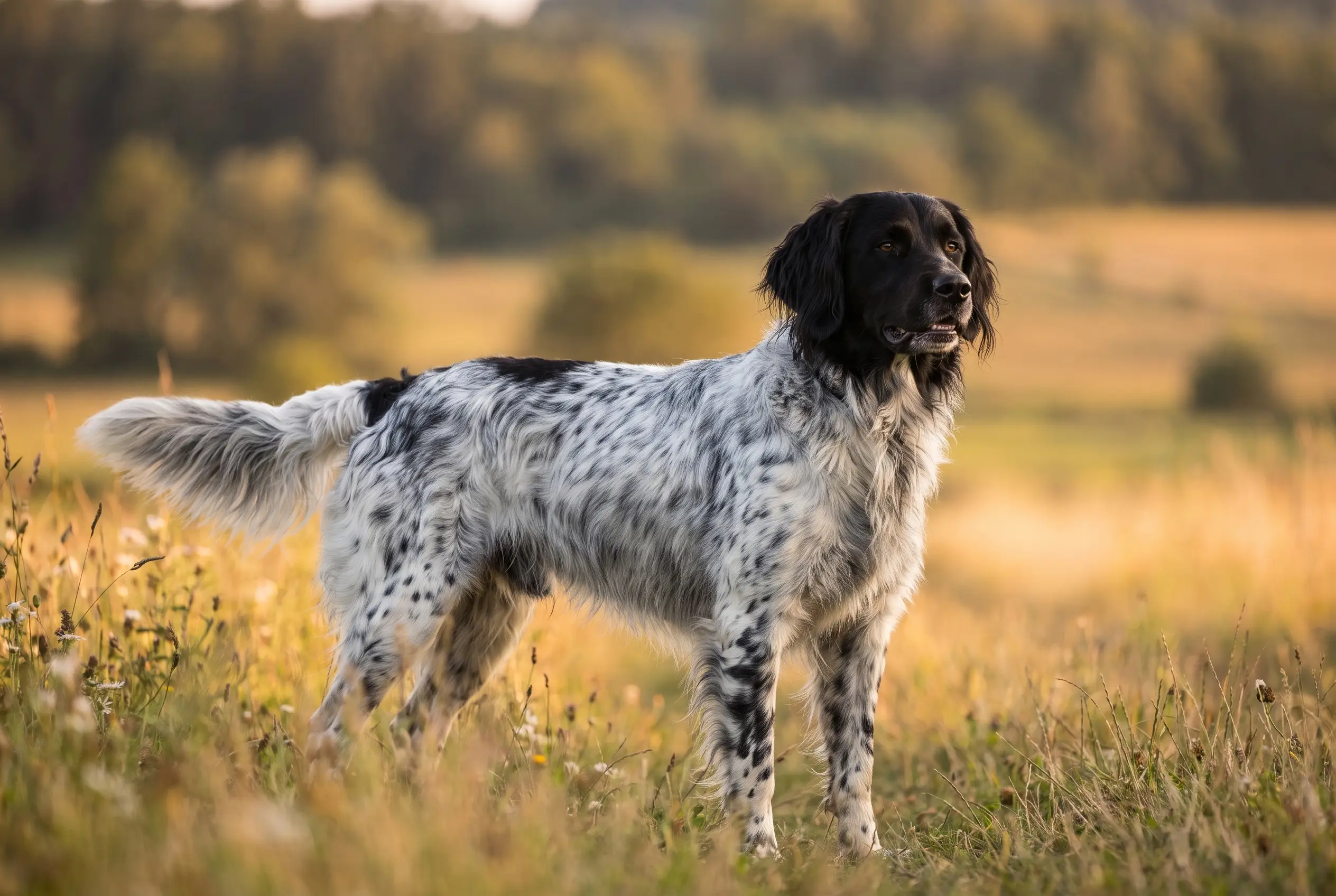
Large Munsterlander
The black-and-white half of Germany's longhaired pointer family — split off over one colour rule, and the head is always black.
Vital stats
| Size | Large · 60–65 cm (males), 58–63 cm (females) |
| Weight | Around 30 kg — the standard states an average, not a range |
| Life expectancy | 12–13 years — breed literature, not survey data |
| Energy | High — 2+ hrs/day of real work |
| Shedding | Moderate, heavier in the seasonal moults |
| Coat | Long, dense, sleek, never curly · white with black patches and spots, blue roan, or solid black — head always black |
| Group | Sporting · Continental Pointing Dogs, Spaniel type (FCI №118, Group 7) |
| Origin | Münsterland, Germany |
| FCI group | 7 — Pointing Dogs · FCI 118 |
Breed traits
Friendliness
Care
Mind
The Large Munsterlander by the numbers
The Large Munsterlander facts owners search for most — price, lifespan, weight, shedding and colours, in one place.
Less common, so expect a waitlist and some travel to a reputable breeder — which pushes the price up. Ongoing costs run high — more food, bigger doses at the vet, and pricier insurance.
We don't quote a single figure: the real price swings with breeder, region, bloodline and health testing — and a rescue costs a fraction of a breeder's litter. Adopting is almost always the cheapest route.
Temperament
The standard's own behaviour clause is short and pointed: 'The most important qualities are: to be tractable and easily taught, dependable for use as a gundog, in particular after the shot. Lively temperament without being nervous.' Read plainly, that is a working brief before it is a household one — biddability and steadiness under gunfire matter more here than sociability, and the standard never mentions children, strangers or family life the way some of its Group 7 cousins do. Breed-club literature fills that gap with a dog described as affectionate and attentive toward its own people, reserved rather than outgoing with strangers, and prone to inventing its own entertainment if the hunting instinct goes unused — club literature, not standard text. The 'lively... without being nervous' line is doing real work too: overly shy or gun-sensitive dogs are disqualified outright, so a Large Munsterlander that flinches at the shot has failed its own breed standard, not just a hunt test.
Habits & quirks
Exactly three colours
The colour section names three varieties and nothing else: white with black patches and spots, blue roan, or pure black — and in every case the head is black, at most carrying a white snip or blaze. 'Colours which do not conform to the breed standard' is a listed disqualifying fault, so there is no fourth option to choose.
Ears furred to the very tip
The standard asks for long fringes on the ears that 'reach clearly and evenly over the tip' — bare 'leather ends' showing through the hair are called out as undesirable. It is a small, specific detail, and one judges check for.
No dewclaws, front or back
Both the forefeet and hindfeet descriptions end the same way: 'tight toes; no dewclaws.' The standard states it as part of the ideal foot rather than in the fault list, but it is written twice, once for each end of the dog.
A colour split, not a size split
The history section is explicit: the German Longhair Club excluded black from its own breeding in 1909, and the breeders left with black-and-white dogs founded a separate club in 1919. Planned breeding of the Large Munsterlander itself began in 1922, from a foundation list of 83 dogs, mostly out of West Münsterland and Lower Saxony. The FCI recognised the result as its own breed in 1954.
Care
| Exercise | The utilization clause asks for a gundog able to work field, forest and water 'before and after the shot' — a walk is not what this breed was bred for. Plan on real daily work: retrieving, tracking, swimming, or structured gundog training, with two hours or more as a running total. A Large Munsterlander with nothing to point at will find something else to do. |
| Grooming | The coat is long and dense but meant to lie sleek, not curl or stand off — a fault the standard says hurts hunting ability. Brush weekly, more often through the leg and tail feathering, and check the ear fringe and between the toes after work in cover. The tail plume is thickest at its midpoint and picks up burrs there first. |
| Training | 'Tractable and easily taught' is the standard's own phrase, and the breed is bred to earn it — this is a working gundog judged with a trial, not a show ring. Start early, keep sessions purposeful, and use the natural pointing and retrieving drives rather than fighting them; a dog that is gun-sensitive or overly shy fails the standard outright, so steady, positive exposure to gunfire matters from puppyhood. |
| Health | The FCI standard sets no health requirements beyond the working trial and the disqualifying faults. Breed-club literature flags hip and elbow dysplasia, hereditary cataracts and hyperuricosuria (a urinary condition also seen in Dalmatians) as conditions worth screening for; ask a breeder for hip results and any relevant DNA test results. There is no breed-wide health survey behind the usual 12–13-year estimate. |
Life expectancy
This breed has a typical life expectancy of 12–13 years — breed literature, not survey data.
Similar breeds
Breeds with a similar build and background — worth a look if this one isn't quite the fit.
Breeds that look like this
Common questions
Is the Large Munsterlander the same breed as the Small Munsterlander, just bigger?
No — they are two separate FCI breeds with two separate standards (No. 118 and No. 102), not a size split of one. The clearest tell is colour: the Large Munsterlander is white with black patches and spots, blue roan, or solid black, always with a black head; the Small Munsterlander is brown and white. Their histories diverge too — per its own standard, the Large Munsterlander was carved out of the Deutsch Langhaar in 1909, when that club excluded black from its breeding and a separate club formed in 1919 for the black-and-white dogs. The Small Munsterlander's roots lie elsewhere. Both share the Münsterland region's name and a job description, and nothing more.
How is it different from the German Longhaired Pointer (Deutsch Langhaar)?
Same longhaired pointing-dog family, opposite colour rule, and that rule is the reason they are two breeds. The Deutsch Langhaar's standard (FCI No. 117) allows only brown-based colours; the Large Munsterlander's standard allows only white with black patches and spots, blue roan, or solid black. The split runs back to 1909, when the German Longhair Club dropped black from its own standard and the breeders left holding black-and-white dogs organised separately — the Large Munsterlander's own history section tells that story.
Are Large Munsterlanders good family dogs?
The FCI standard is written for hunters, not households — it asks for a dog that is tractable, easily taught and dependable after the shot, and stops there; family suitability is not in the document. Breed-club literature describes a dog that is close with its own people and reserved with strangers, provided its hunting drive gets a real outlet. Skip the outlet and the standard's own words — 'lively temperament without being nervous' — tend to curdle into restlessness.
Does the Large Munsterlander shed a lot?
Moderately. The Large Munsterlander sheds a fair amount, steadily through the year with heavier seasonal patches. A weekly brush keeps most of the loose hair off your floors and clothes.
Is the Large Munsterlander hypoallergenic?
Not really. No dog is truly hypoallergenic, and the Large Munsterlander's shedding coat releases plenty of the dander that sets off allergies. If someone at home is allergic, this isn't the easiest breed to live with — spend time around one first.
Is the Large Munsterlander easy to train?
Yes. The Large Munsterlander is one of the more trainable breeds — quick to learn and keen to work with you, which makes reward-based training straightforward. Start early, keep it positive, and it picks things up fast.