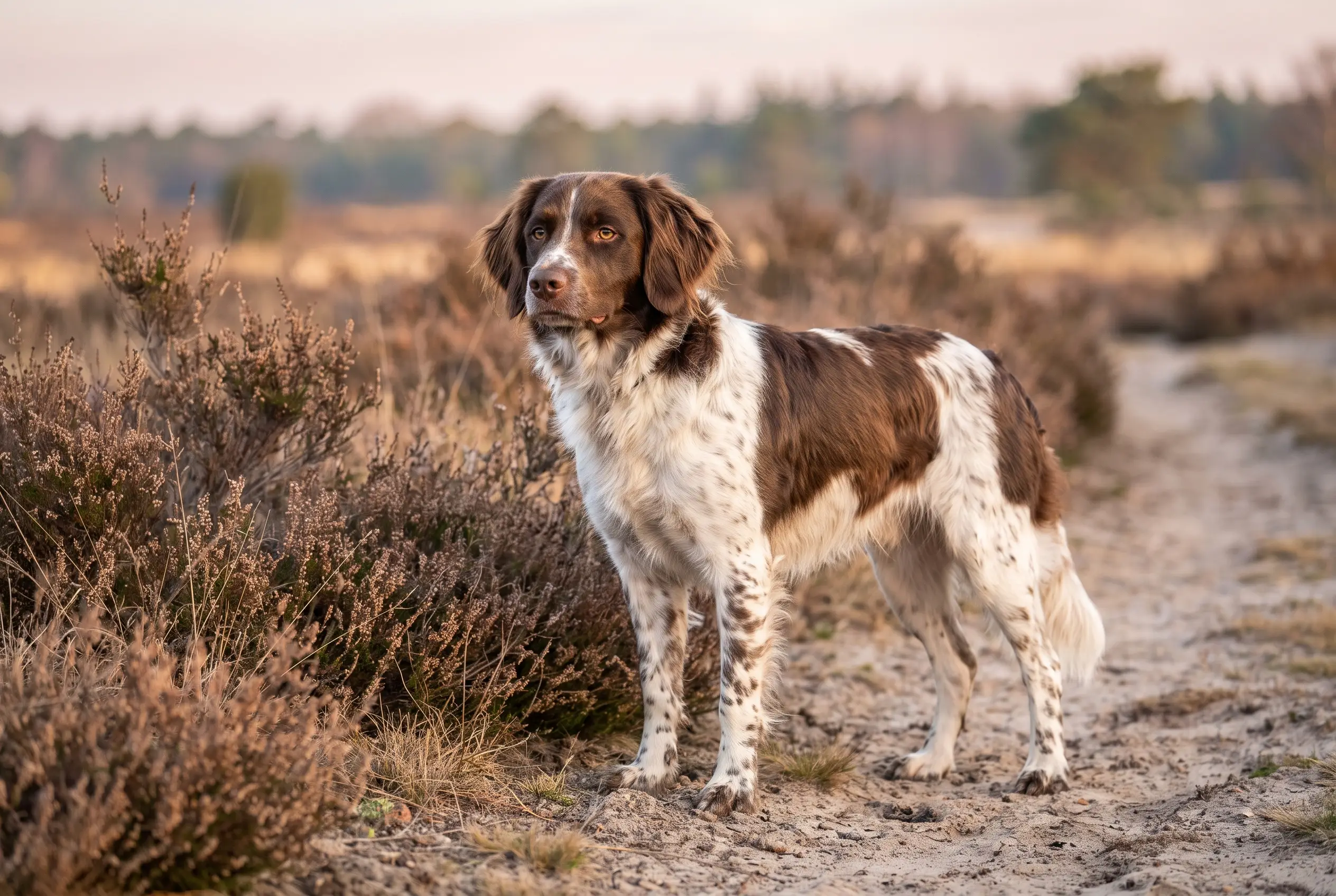
Drentsche Patrijshond
Drenthe's farmyard gundog: points like a rock, hunts within range of the gun, and comes home to the family.
Vital stats
| Size | Medium-large · 58–63 cm (dogs), 55–60 cm (bitches) |
| Weight | 30–35 kg (dogs), 25–31 kg (bitches) — set by the standard |
| Life expectancy | 12–14 years — breed literature, not survey data |
| Energy | High — 1–2 hrs/day, ideally with field-style work |
| Shedding | Moderate, seasonal |
| Coat | Dense and straight, feathered ears, legs and tail · white with brown markings |
| Group | Sporting · Continental Pointing Dogs, Spaniel type (FCI №224, Group 7) |
| Origin | Drenthe, the Netherlands |
| FCI group | 7 — Pointing Dogs · FCI 224 |
Breed traits
Friendliness
Care
Mind
The Drentsche Patrijshond by the numbers
The Drentsche Patrijshond facts owners search for most — price, lifespan, weight, shedding and colours, in one place.
Less common, so expect a waitlist and some travel to a reputable breeder — which pushes the price up. Ongoing costs run high — more food, bigger doses at the vet, and pricier insurance.
We don't quote a single figure: the real price swings with breeder, region, bloodline and health testing — and a rescue costs a fraction of a breeder's litter. Adopting is almost always the cheapest route.
Temperament
The standard reads like a hunter's diary. The Drent hunts within range of the gun, and keeping in touch with the hunter is, in its own words, 'apparently an innate quality': when a point runs long, the dog looks back for its master. It points 'as solid as a rock', retrieves from land and water, finds lost game, and needs little training to do any of it — the abilities are born in. The same paragraph carries the warning that matters most at home: the character is gentle, and forceful training methods are harmful. This is a dog that folds, not fights, under pressure. It can be reserved with new people at first — the standard is careful to add 'but never fearful' — and with its own family it is loyal, intelligent and, again in the standard's words, a highly esteemed family pet dog as well as a valuable companion of the hunter. Give it work for the nose and legs, or the farm dog will invent chores of its own.
Habits & quirks
The tail draws circles
When the Drent searches for game its tail moves in a circular motion, faster as the scent gets warm — a breed signature written straight into the standard.
Never out of earshot
It hunts within range of the gun and checks back with its handler as a matter of instinct. On a long point it turns its head to look for you. Off the field, the same habit makes it a dog that keeps track of where everyone is.
Reserved, never fearful
The standard's exact phrasing. A Drent may take a measured moment with a stranger before deciding, and early socialisation keeps that pause polite rather than worried.
Brown ears, by rule
The colour section is strict: white with brown markings, with or without spots or ticking; roan over the whole body is not permitted, and a mantle is less desired. A white or partly white ear, or white marks around an eye, disqualifies outright.
Health
The Drent is a sturdy farm breed on the whole, and the healthiest come from breeders who test. Breed literature names hip dysplasia, progressive retinal atrophy and epilepsy, and North American club practice is to screen hips, elbows and eyes before breeding — ask any breeder to show you those results. Beyond that, keep him lean, give him real work, and handle him gently: a gentle dog under harsh pressure shuts down rather than toughens up.
Nutrition
| Exercise | An hour or two a day, and the breed is happiest when some of it is work: retrieving dummies, swimming, tracking games, or the real thing in season. The standard calls its hunting abilities innate — unused, they resurface as restlessness around the house. |
| Grooming | A thorough weekly brush, paying attention to the feathering on the ears, the backs of the legs, the trousers and the tail, where tangles start. The hair between the toes collects mud and burrs after field days; shedding rises with the seasons. |
| Training | The standard says it plainly: forceful methods are harmful to this gentle character. Keep sessions short, rewards real and corrections mild — a Drent that trusts its handler needs remarkably little teaching, because most of the job came with the dog. |
| Health | A sturdy farm breed overall. Breed literature lists hip dysplasia, progressive retinal atrophy and epilepsy, and North American club practice is to screen hips, elbows and eyes before breeding — ask any breeder for those results. The 12–14 years in circulation is breed literature, not survey data. |
This is a medium-large gundog that spends an hour or two a day working, so feed to the dog in front of you — a Drent hunting in season and a Drent between seasons do not need the same bowl. Weigh the meals, count the training treats in the day's total, and aim for ribs you can feel under that dense feathered coat. Keep him lean; the joints and the stamina both last longer for it.
Puppy guide
A Drent puppy comes with most of the gundog already built in, so the first year is about shaping the character rather than drilling skills. Socialise him widely — the standard wants a dog reserved with strangers but never fearful, and that line stays polite only if he meets the world early. Keep the body's work light while the joints are forming, busy the nose with short retrieve and search games, and teach an off switch so the farm dog doesn't invent chores of its own.
Training
The standard says it plainly: forceful methods are harmful to this gentle character. Keep sessions short, rewards real and corrections mild, and you will find a Drent needs remarkably little formal training, because most of the job came with the dog. What it does need is trust — a Drent that trusts its handler works out of loyalty, and one that has been bullied simply folds.
Life expectancy
Drents live 12–14 years — breed literature, not survey data. The Drent is a long-lived farm breed, and you keep it at the top of that range the same way you keep it happy: lean weight, parents screened for hips, elbows and eyes, gentle handling, and enough real work for the nose and legs to keep body and mind sound. The years quoted for the breed come from breed literature rather than a survey, so treat them as a guide.
Similar breeds
Breeds with a similar build and background — worth a look if this one isn't quite the fit.
Breeds that look like this
Common questions
Is the Drent related to the Small Münsterländer?
Yes — the standard itself names the Small Münsterländer and the Epagneul Français as relatives, all spaniel-type pointing dogs from the same old stock. The Drent is the big one of the family: 58–63 cm against the Münsterländer's 50–56, and around ten kilos more. Colour separates them too — a Drent must be white with brown markings and roan is not permitted, while the Münsterländer commonly carries it.
Are they good family dogs?
The standard answers this one directly, calling the breed a highly esteemed family pet dog as well as a valuable companion of the hunter — it was bred to live in the farmhouse, not a kennel. The honest caveats: it needs real daily exercise, soft-handed training, and company. A gentle dog left alone and unworked goes flat, and then finds trouble.
How rare is the breed?
Rare outside its homeland. The population is a few thousand dogs, most of them in the Netherlands, with small clubs and breeding programmes in North America and Scandinavia — the figures in circulation are approximate, and no registry publishes a firm worldwide count. In the United States the breed is reported in the AKC's Foundation Stock Service rather than fully recognised.
Does the Drentsche Patrijshond shed a lot?
Moderately. The Drentsche Patrijshond sheds a fair amount, steadily through the year with heavier seasonal patches. A weekly brush keeps most of the loose hair off your floors and clothes.
Is the Drentsche Patrijshond hypoallergenic?
Not really. No dog is truly hypoallergenic, and the Drentsche Patrijshond's shedding coat releases plenty of the dander that sets off allergies. If someone at home is allergic, this isn't the easiest breed to live with — spend time around one first.
Is the Drentsche Patrijshond easy to train?
Yes. The Drentsche Patrijshond is one of the more trainable breeds — quick to learn and keen to work with you, which makes reward-based training straightforward. Start early, keep it positive, and it picks things up fast.