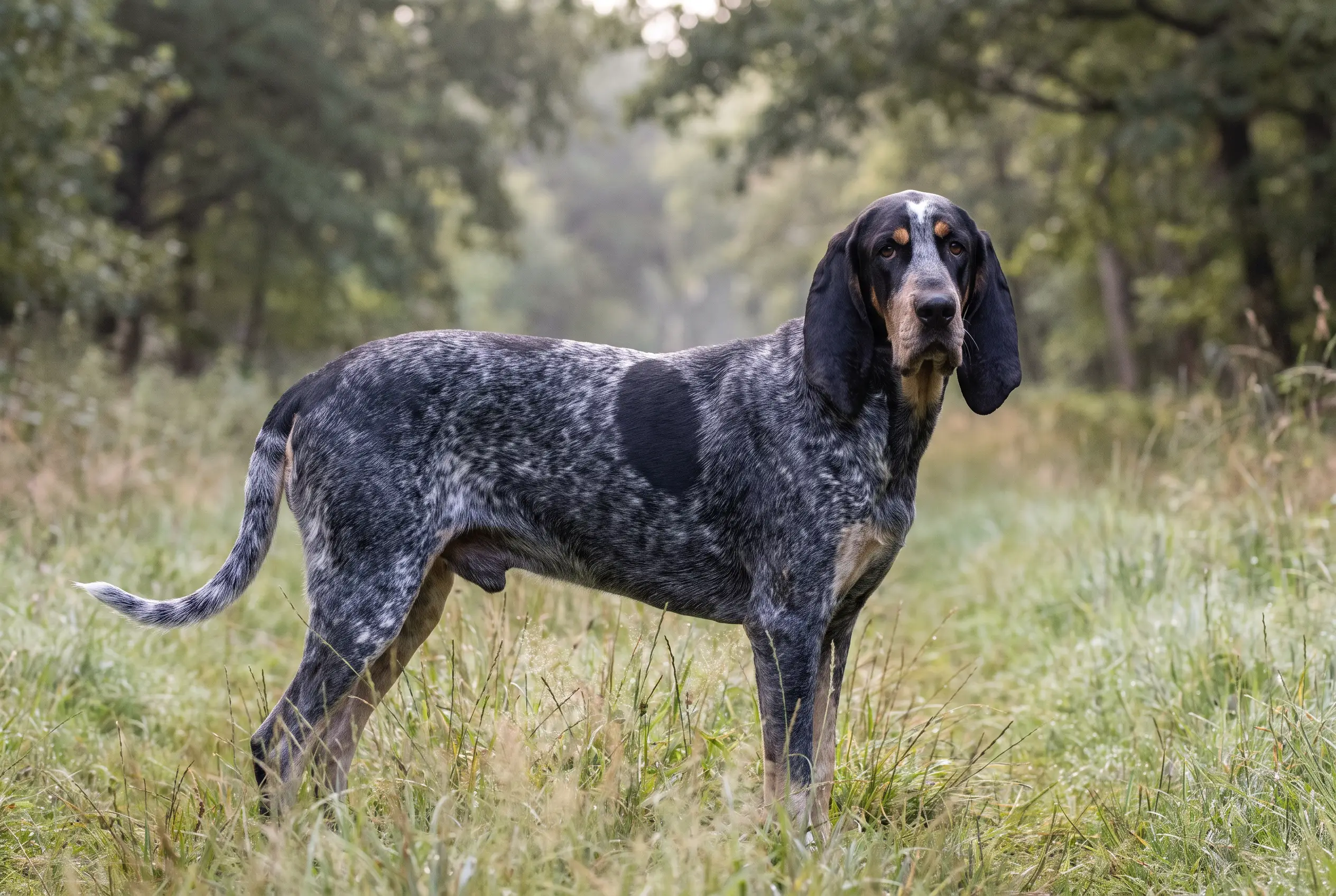
Grand Bleu de Gascogne
The oldest and largest of the Bleu de Gascogne hounds, its slate-blue coat is black ticking on white and nothing else.
Vital stats
| Size | Very large · 65–72 cm (dogs), 62–68 cm (bitches) |
| Weight | 32–40 kg — breed literature; the standard sets none |
| Life expectancy | 10–12 years — breed literature, not survey data |
| Energy | High — built for full-day pack hunts over rough ground |
| Shedding | Moderate — short, dense coat, brushed weekly |
| Coat | Short, dense · black-ticked white reading slate blue, with black head patches and tan markings |
| Group | Hound · Large-sized Hounds (FCI №22, Group 6) |
| Origin | Gascony, southwest France |
| FCI group | 6 — Scent hounds and related breeds · FCI 22 |
Breed traits
Friendliness
Care
Mind
The Grand Bleu de Gascogne by the numbers
The Grand Bleu de Gascogne facts owners search for most — price, lifespan, weight, shedding and colours, in one place.
Less common, so expect a waitlist and some travel to a reputable breeder — which pushes the price up. Ongoing costs run high — more food, bigger doses at the vet, and pricier insurance.
We don't quote a single figure: the real price swings with breeder, region, bloodline and health testing — and a rescue costs a fraction of a breeder's litter. Adopting is almost always the cheapest route.
Temperament
The standard's behaviour section runs four short clauses, and each one is doing real work: very fine nose; endowed with a sonorous howling voice, with deep tones; very intent in his way of hunting; instinctively a pack hound. Then comes the line that matters at home — temperament calm; obeys orders easily. That pairing is the whole breed: a nose-driven pack hunter with a famously loud voice, who is nonetheless steady and biddable once the hunt is over. The standard disqualifies aggressive or overly shy dogs outright, which tells you neither extreme is what generations of breeders selected for. Left without work, the nose and the voice do not switch off — they just find something else to chase and something to say about it.
Habits & quirks
The blue is an illusion
The standard's own words: entirely mottled (black and white) giving a slate blue colouring effect — never entirely white, but no blue pigment either. Two black patches usually cover the ears and ring the eyes without meeting at the top of the skull, leaving a white gap that often holds one small black oval spot, which the standard calls typical of the breed.
Ears built to overshoot the nose
The standard sets an exact test: the ear leather is fine, curls inward to a point, and must reach beyond the tip of the nose. Set low, well below the eyeline, narrow at the base.
A voice that reached Mount Vernon
The standard credits it with a sonorous howling voice, with deep tones, and the history backs that up: Lafayette shipped seven Grand Bleus to George Washington in 1785, who wrote that their voices on the hunt sounded like the bells of Moscow.
A few coarse hairs at the tail tip
The standard notes a detail most breed pages skip: near the tip, some hairs run longer and coarser, slightly offstanding, like ears of grain. The tail itself is thick, strong at the root, and carried sabre-fashion to the point of the hock.
Health
Breed literature flags no condition unique to the Grand Bleu de Gascogne beyond what any large, deep-chested hound carries — bloat is the one to know cold, and ear infections are the everyday one, since those long, low-set ears hang past the nose and drag through water and undergrowth. Check and clean them often. The usually quoted lifespan has no breed-wide survey behind it, so a health-testing breeder matters more than any number.
Nutrition
| Exercise | A scenthound built to run with a pack from morning to evening over rough ground; plan on well over an hour a day of real distance, not a stroll around the block. Its nose takes over on any walk, so let scent trailing count as the exercise it is. |
| Grooming | The short, dense coat needs only a weekly brush and sheds moderately. The long, curled ears are the real job — check and clean them regularly, since anything that hangs past the nose also drags through water and undergrowth. |
| Training | The standard says it obeys orders easily, and that biddability is real, but it is still a pack hound with a very fine nose, so recall around scent needs early, consistent work. It responds to calm, steady handling; the standard disqualifies both aggressive and overly shy dogs, and neither temperament is what the breed is selected for. |
| Health | Breed literature reports no widely documented breed-specific condition beyond what any large, deep-chested hound faces — bloat risk and ear infections chief among them, from those long, low-set leathers. There is no breed-wide health survey behind the usually quoted 10–12 years. |
A pack hound built to run all day eats to its actual work, so feed the dog you have, not the one on the box. Because it's big and deep-chested, treat bloat seriously: split the daily ration into two meals and let the stomach settle before and after hard exercise. Keep it lean — easy ribs under that short coat — and count treats in the total.
Puppy guide
A Grand Bleu puppy is a sociable pack dog with a serious nose already switched on, so front-load the year with socialization and early, patient recall. Get it used to other dogs and calm handling, and start teaching that a scent doesn't override you — a lesson this breed needs early and often. Make containment secure from the start: this is a determined trailer that will follow its nose straight through a weak fence.
Training
The breed standard says it obeys orders easily, and that biddability is real — but it's still a pack scenthound with a very fine nose, so recall around a strong scent takes early, consistent work. Handle it calmly and steadily; it responds to that far better than to force. Expect a deep, sonorous voice too, used freely, which training can shape but won't switch off.
Life expectancy
Grand Bleus de Gascogne live 10–12 years — breed literature, not survey data. There's no breed-wide health survey behind the usual figure, so read it as a guide rather than a promise. You give a Grand Bleu its best shot the plain way: lean weight, ears checked and cleaned, meals split with bloat in mind, real daily running, and parents from a breeder who tests and is honest about their dogs.
Similar breeds
Breeds with a similar build and background — worth a look if this one isn't quite the fit.
Breeds that look like this
Common questions
Is the Grand Bleu de Gascogne the same breed as the Petit Bleu de Gascogne?
No — related, not interchangeable, and "Petit" has nothing to do with puppies. The Petit Bleu de Gascogne (FCI No. 31) is a separate, smaller breed built down from the Grand Bleu de Gascogne (FCI No. 22) to hunt smaller game at a slower pace; it is not a variety, a growth stage or a miniature of this dog. The Griffon Bleu de Gascogne (FCI No. 32) and Basset Bleu de Gascogne (FCI No. 35) are two more descendants — rough-coated and short-legged respectively. The Grand is the oldest and largest of the four, the breed the other three were bred down from.
Why is it called "blue" if the coat is black and white?
Because of how the ticking reads from a distance, not because of any blue pigment. The standard describes the coat as entirely mottled (black and white), giving a slate blue colouring effect — dense black flecking through a white base, with distinct black patches typically over the ears and eyes. Close up it is plainly black and white; the blue only appears once the ticking blends at range.
How much exercise does it need, and is it a good family dog?
Plenty, and yes with the right setup. It is a pack scenthound built for full-day hunts on rough terrain, so it needs a serious daily outlet — running, scent work, or hunting itself — not a leash walk around the block. At home the standard calls its temperament calm and says it obeys orders easily, and it is loud rather than aggressive; expect a deep-voiced dog that does best with space and tolerant neighbours, not a quiet apartment.
Does the Grand Bleu de Gascogne shed a lot?
Moderately. The Grand Bleu de Gascogne sheds a fair amount, steadily through the year with heavier seasonal patches. A weekly brush keeps most of the loose hair off your floors and clothes.
Is the Grand Bleu de Gascogne hypoallergenic?
Not really. No dog is truly hypoallergenic, and the Grand Bleu de Gascogne's shedding coat releases plenty of the dander that sets off allergies. If someone at home is allergic, this isn't the easiest breed to live with — spend time around one first.
Is the Grand Bleu de Gascogne easy to train?
Reasonably. The Grand Bleu de Gascogne is trainable with consistency and rewards, though it isn't the quickest study. Keep sessions short and positive, and be patient with the basics like recall.