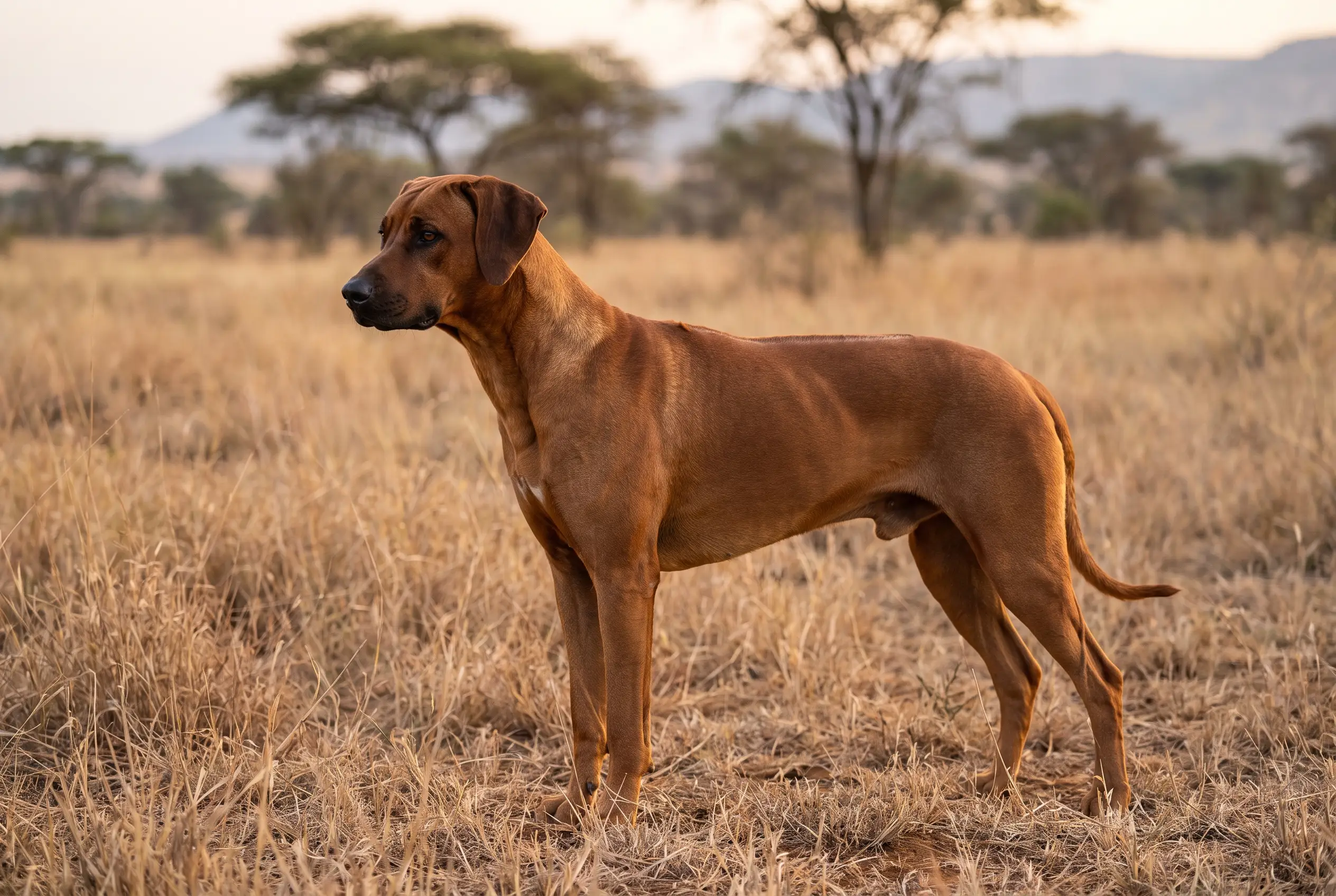
Rhodesian Ridgeback
The lion hound of Africa — quiet power, wearing its signature in reverse.
Vital stats
| Size | Large · 61–69 cm |
| Weight | 32–43 kg |
| Life expectancy | 10–12 years |
| Energy | High — 60+ min/day |
| Shedding | Low, year-round |
| Coat | Short, dense · wheaten shades |
| Group | Hound · FCI №146 / AKC |
| Origin | Southern Africa |
| FCI group | 6 — Scent hounds and related breeds · FCI 146 |
Breed traits
Friendliness
Care
Mind
The Rhodesian Ridgeback by the numbers
The Rhodesian Ridgeback facts owners search for most — price, lifespan, weight, shedding and colours, in one place.
Widely bred, so you can usually find a litter from a registered breeder without a long wait. Ongoing costs run high — more food, bigger doses at the vet, and pricier insurance.
We don't quote a single figure: the real price swings with breeder, region, bloodline and health testing — and a rescue costs a fraction of a breeder's litter. Adopting is almost always the cheapest route.
Temperament
Bred by southern African pioneers from European dogs and the ridged hunting dogs of the Khoikhoi, the Ridgeback tracked big game across brutal terrain and guarded the homestead at night. That history built a hound that is calm and affectionate with its family, aloof with strangers, rarely barks — and makes its own decisions unless taught otherwise, early.
Habits & quirks
The silent alert
No barking fits — just a raised head, a fixed stare and a low rumble when something's genuinely wrong.
Sun leopard
It drapes itself across the warmest spot in the house with feline entitlement.
The counter patrol
That nose operates at worktop height; unattended roasts are considered donations.
Selective hearing
Recall is a suggestion it weighs against whatever just moved in the hedgerow.
Health
The Rhodesian Ridgeback is a sound, athletic hound, and its health starts with a good breeder. Ask about hips and elbows, and ask specifically about dermoid sinus, a congenital condition tied to the ridge that responsible breeders check for. Beyond screening, this is a deep-chested breed, so treat bloat as a real risk: feed measured meals and keep hard exercise away from mealtimes. Keep him lean and well-muscled and you have a dog built to last.
Nutrition
| Exercise | An hour-plus of daily running, hiking or lure coursing — an under-exercised Ridgeback redecorates. |
| Training | Start young with consistent, reward-based methods; this independent hound respects fairness, not force. |
| Health | Reputable breeders screen for hip and elbow dysplasia and dermoid sinus, a congenital condition linked to the ridge. |
| Feeding | Feed measured meals and avoid exercise straight after eating — deep-chested breeds carry bloat risk. |
Under that easy coat, a Ridgeback is a working athlete, so feed to the dog in front of you: a hound in hard daily training and a steadier housemate don't eat the same. Weigh the meals, count treats into the day's total, and aim for ribs you can feel over real muscle. One rule matters more here than in most breeds: split the food into measured meals and leave a gap around exercise, because a deep chest and a bolted bowl are how bloat starts.
Puppy guide
A Ridgeback puppy is confident and quick to make up its own mind, so the first year is where you set the terms. Socialize him early and widely, because this is a naturally aloof, protective hound and you want that judgement built on good experiences, not nerves. Start reward-based training from the start so the independent streak works with you, keep the growing joints in mind by going easy on repetitive hard exercise, and teach recall early, because a Ridgeback nose follows its own agenda.
Training
This is an intelligent, independent hound that respects fairness and shuts down under force. Start young, keep it consistent and reward-based, and give the training a point: a Ridgeback that understands the deal cooperates, one that's been bullied simply switches off. Put real work into recall and impulse control around the strong prey drive, and remember that a bored, under-exercised Ridgeback finds its own projects, usually expensive ones.
Known health issues
No breed is problem-free. These are the conditions most worth knowing about for this breed — with what a good breeder screens for and what an owner watches. General guidance, not a substitute for your vet.
Dermoid sinus
A narrow channel of skin tissue left over from development, running along the spine — tied to the Ridgeback's signature ridge and can connect down toward the spinal cord. Good breeders screen: Puppies checked at birth for a sinus along the midline; affected pups aren't bred. Watch for: A small pit or a cord you can feel under the skin along the back, or swelling and discharge if it gets infected.
Hip dysplasia
A poorly fitting hip joint that wears early and can cause pain and arthritis, most common in larger breeds. Good breeders screen: Hip-scored parents (BVA/OFA/FCI). Watch for: Stiffness, a bunny-hop run, or reluctance on stairs.
Bloat (GDV)
A sudden, life-threatening twisting of the stomach, mostly in deep-chested breeds — a true emergency. Good breeders screen: Ask about family history; discuss preventive gastropexy for high-risk lines. Watch for: A swollen belly, unproductive retching, restlessness — go to a vet at once.
Life expectancy
Rhodesian Ridgebacks live 10–12 years. The Ridgeback is a fairly long-lived hound for its size, and you keep it at the top of that range with the basics done well: a breeder who screens hips, elbows and dermoid sinus, lean weight over good muscle, and enough daily running to keep body and mind sound. Guard against bloat around mealtimes and you've handled the one that matters most.
Similar breeds
Breeds with a similar build and background — worth a look if this one isn't quite the fit.
Breeds that look like this
Common questions
Why does the Rhodesian Ridgeback have a ridge?
It's a stripe of hair growing backwards along the spine, inherited from the ridged dogs kept by the Khoikhoi people of southern Africa. It's purely a hallmark — it has no function.
Are Rhodesian Ridgebacks good family dogs?
Yes, for active families — they're calm indoors, devoted and naturally protective. Their size and strength mean training and supervision around small children are essential.
Did Rhodesian Ridgebacks really hunt lions?
They tracked and cornered lions for hunters, baying to hold them at bay — never fighting them. The job demanded courage, speed and judgement, all still visible in the breed.
Does the Rhodesian Ridgeback shed a lot?
Not much. The Rhodesian Ridgeback is a low-shedding breed, so loose hair around the home stays minimal. It still needs regular grooming, but you won't be fighting drifts of fur.
Is the Rhodesian Ridgeback hypoallergenic?
No dog is truly hypoallergenic, but the Rhodesian Ridgeback comes closer than most: its low-shedding coat releases less of the dander that triggers allergies. Many allergy sufferers manage well with this breed, but spend time around one before committing.
Is the Rhodesian Ridgeback easy to train?
Reasonably. The Rhodesian Ridgeback is trainable with consistency and rewards, though it isn't the quickest study. Keep sessions short and positive, and be patient with the basics like recall.