Greyhound
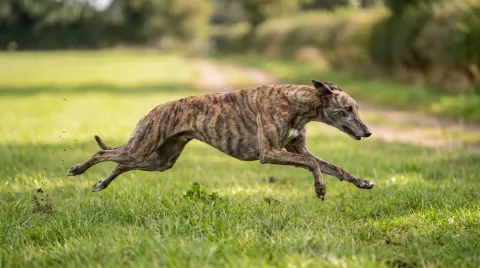
The 70 km/h couch potato — a gentle sprinter who mostly wants to nap.
On these lists: Dogs for apartments · Dogs for hot weather
Vital stats
| Size | Large · 68–76 cm |
| Weight | 26–40 kg |
| Life expectancy | 10–14 years |
| Energy | Moderate — short sprints, long naps |
| Shedding | Low |
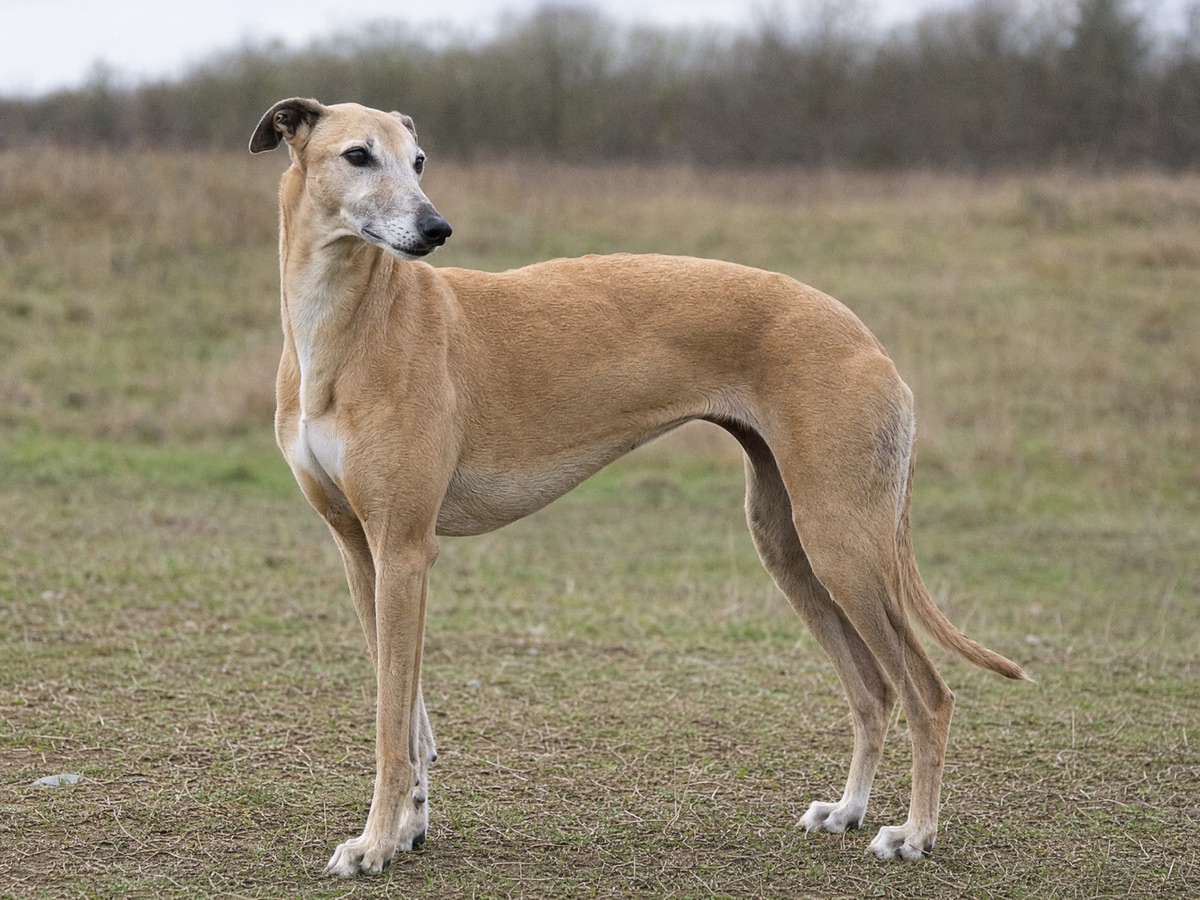
| Coat | Fine short single coat · nearly every colour |
| Group | Hound · FCI №158 / AKC |
| Origin | England |
| FCI group | 10 — Sighthounds · FCI 158 |
Breed traits
Friendliness
Care
Mind
The Greyhound by the numbers
The Greyhound facts owners search for most — price, lifespan, weight, shedding and colours, in one place.
Widely bred, so you can usually find a litter from a registered breeder without a long wait. Ongoing costs run high — more food, bigger doses at the vet, and pricier insurance.
We don't quote a single figure: the real price swings with breeder, region, bloodline and health testing — and a rescue costs a fraction of a breeder's litter. Adopting is almost always the cheapest route.
Temperament
Bred for millennia to chase by sight at breathtaking speed, the Greyhound spends its explosive energy in seconds and its affection in hours. At home it is quiet, polite, and faintly cat-like — happiest folded onto the softest surface available, watching the world with mild, aristocratic interest until something small runs past.
Habits & quirks
Roaching
Sleeping upside-down, all four legs in the air — the signature pose of a truly relaxed Greyhound.
The zoomies, scheduled
Two minutes of flat-out laps, then straight back to the sofa for the rest of the day.
Soft-surface radar
A Greyhound can locate the most comfortable spot in any house within minutes of arrival.
The lean and stare
Affection arrives as a full-body lean and a long, silent gaze — barking is rarely on the menu.
Health
The Greyhound is a healthy, long-lived breed, but two serious things are worth knowing. Like other deep-chested dogs it can suffer bloat, where the stomach fills with gas and can twist — gastric torsion is a genuine emergency, so learn the signs and act fast. And heart disease, particularly dilated cardiomyopathy (DCM), turns up in the breed, so ask a breeder about it. Two everyday quirks matter just as much day to day: with thin skin, a fine coat and almost no body fat, a Greyhound feels the cold and needs a warm coat in winter, and that same bony, muscular frame wants a padded bed rather than a thin mat.
Nutrition
| Exercise | A couple of short walks plus the odd safe sprint — they're sprinters, not marathoners. |
| Warmth | Thin skin, fine coat, no fat: a winter coat is essential kit, not fashion. |
| Containment | High prey drive means secure, fenced spaces for off-lead running — recall loses to instinct. |
| Comfort | Bony frames need padded bedding; a bare floor is genuinely uncomfortable for them. |
A Greyhound naturally carries almost no body fat, so the outline that would look worryingly thin on another breed is exactly right here — a little of the hip bones and the last ribs showing is normal, not a sign to feed up. Feed good, measured meals to hold lean muscle over that racy frame, split into two rather than one big bowl, since a deep-chested dog is better off not gorging in one go. If you have taken on a retired racer, your vet or the rehoming group can tell you the weight to aim for, and it is worth getting right.
Puppy guide
Many Greyhounds arrive as retired racers rather than puppies, but either way the early days are about the same thing: settling a sensitive dog into home life. A Greyhound pup is gentle and a little reserved, so socialise him kindly and never with force, and let him learn that the sofa, the stairs and the hoover are nothing to fear. Get him used to a warm coat and a padded bed from the start, teach recall early while remembering the prey drive will always be there, and keep any exercise easy and low-impact while the long limbs are still growing.
Training
For all their speed, Greyhounds are calm, sensitive dogs that respond best to a soft, reward-based approach — raise your voice and you get a worried dog that shuts down, not a keener one. They are sprinters, not endurance athletes: a couple of short walks and the occasional safe sprint suit them far better than a long march, and they are perfectly happy to nap the rest of the day away. Recall is the honest limit. A high prey drive means a Greyhound in chase has stopped hearing you, so save the off-lead running for securely fenced ground and keep the lead on everywhere else.
Known health issues
No breed is problem-free. These are the conditions most worth knowing about for this breed — with what a good breeder screens for and what an owner watches. General guidance, not a substitute for your vet.
Bloat (GDV)
A sudden, life-threatening twisting of the stomach, mostly in deep-chested breeds — a true emergency. Good breeders screen: Ask about family history; discuss preventive gastropexy for high-risk lines. Watch for: A swollen belly, unproductive retching, restlessness — go to a vet at once.
Heart muscle disease (DCM)
A weakening of the heart muscle that enlarges the heart, seen in several large and giant breeds. Good breeders screen: Heart-screened parents (echo/Holter where advised). Watch for: Tiring, coughing, fainting, or a swollen belly.
Life expectancy
Greyhounds live 10–14 years. Greyhounds are a naturally long-lived, sound breed, and keeping one at the top of that range is mostly about comfort and common sense: a lean racing weight, a warm coat in winter, a soft bed for that bony frame, and awareness of bloat and the breed's heart risk. Split the meals, learn the signs of gastric torsion, and a Greyhound will spend most of a long life doing what it does best — sprinting once and sleeping the rest.
Popular Greyhound mixes
Lurcher
Traditionally a sighthound crossed with a working breed — here the Collie — the lurcher pairs Greyhound speed with working brains: fast, clever and a keen hunter.
Longdog
A longdog is two sighthounds crossed, so this is speed doubled down: fast, sensitive and a calm couch companion between sprints.
Greyador
The Lab's friendliness with the Greyhound's ease: an affectionate, athletic dog that is calmer indoors than a pure Labrador.
Similar breeds
Breeds with a similar build and background — worth a look if this one isn't quite the fit.
Compare this breed
Breeds that look like this
Common questions
Do Greyhounds need a lot of exercise?
Less than you'd think — a couple of short daily runs or walks satisfy most. They're sprinters, not endurance dogs, and love to lounge.
Can Greyhounds be let off-leash?
Carefully — a strong sight-chase instinct means many can't be trusted off-leash near small running animals. Use secure fields.
Do Greyhounds feel the cold?
Very much — thin skin, a fine single coat and almost no body fat mean they chill quickly. A proper winter coat and a warm bed are non-negotiable.
Does the Greyhound shed a lot?
Not much. The Greyhound is a low-shedding breed, so loose hair around the home stays minimal. It still needs regular grooming, but you won't be fighting drifts of fur.
Is the Greyhound hypoallergenic?
No dog is truly hypoallergenic, but the Greyhound comes closer than most: its low-shedding coat releases less of the dander that triggers allergies. Many allergy sufferers manage well with this breed, but spend time around one before committing.
Is the Greyhound good with children?
They can be. The Greyhound is reasonably sociable and can be good with children in the right home, especially when socialised early. Supervise around young kids and teach dog and child to respect each other.
Is the Greyhound easy to train?
Reasonably. The Greyhound is trainable with consistency and rewards, though it isn't the quickest study. Keep sessions short and positive, and be patient with the basics like recall.