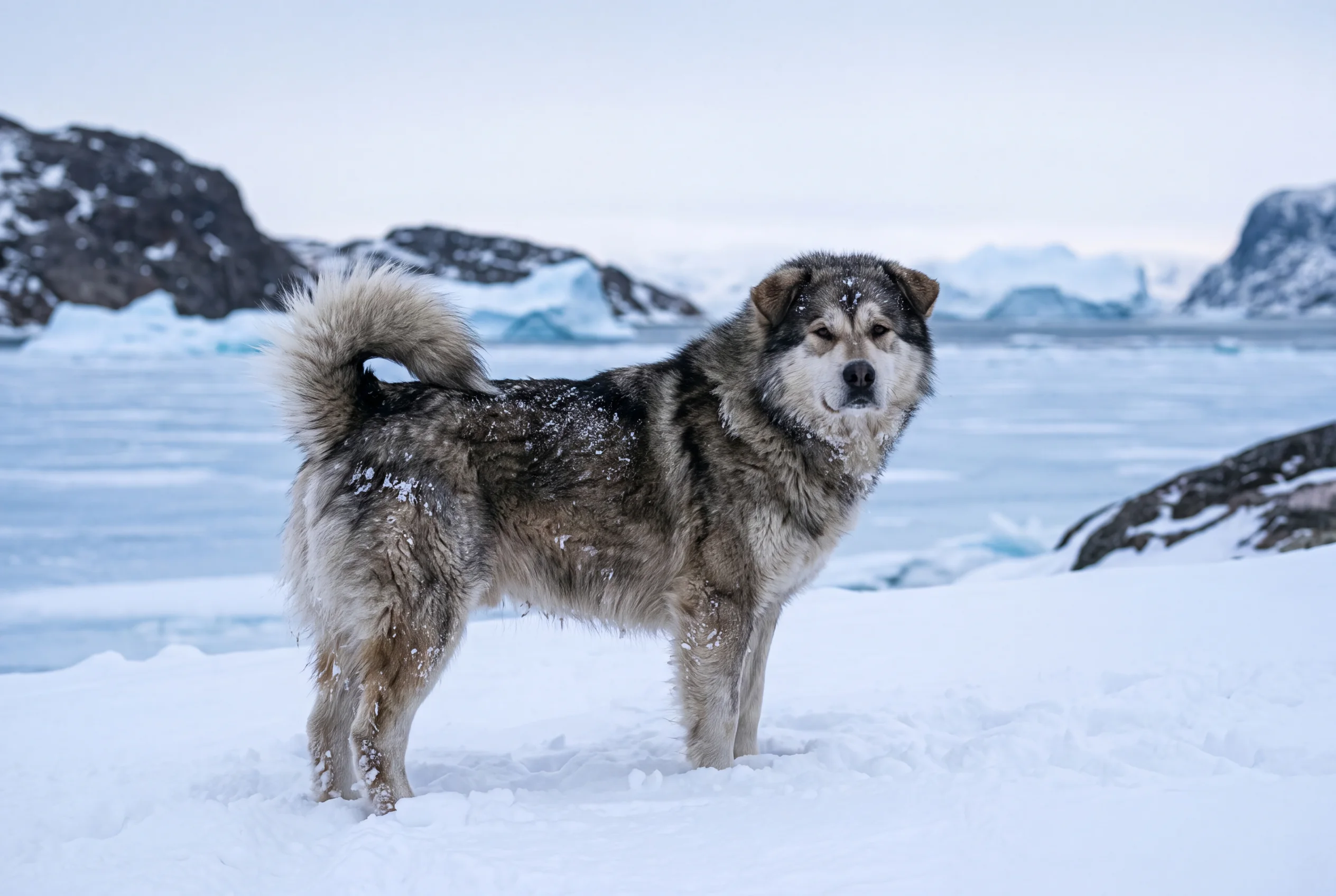
Greenland Dog
Greenland's only sled dog, kept pure by a line on the map.
Vital stats
| Size | Large · 60 cm and upwards (males), 55 cm and upwards (females) |
| Weight | 30–32 kg — no weight is given in the standard |
| Life expectancy | 12–14 years |
| Energy | Very high — bred to haul a loaded sledge all day |
| Shedding | Heavy — the arctic undercoat lifts out in handfuls |
| Coat | Dense double coat · any colour, solid or parti-coloured, except albino |
| Group | Working · Nordic Sled Dog (FCI №274, Group 5) |
| Origin | Greenland (patronage: Denmark) |
| FCI group | 5 — Spitz and primitive types · FCI 274 |
Breed traits
Friendliness
Care
Mind
The Greenland Dog by the numbers
The Greenland Dog facts owners search for most — price, lifespan, weight, shedding and colours, in one place.
Less common, so expect a waitlist and some travel to a reputable breeder — which pushes the price up. Ongoing costs run high — more food, bigger doses at the vet, and pricier insurance.
We don't quote a single figure: the real price swings with breeder, region, bloodline and health testing — and a rescue costs a fraction of a breeder's litter. Adopting is almost always the cheapest route.
Temperament
The FCI standard leads with three qualities: energy, mental strength and boldness. Then it says something most standards avoid saying. A Greenland Dog working in harness is not closely attached to any particular person, and the standard draws the obvious conclusion, that this makes a poor guard dog. It is friendly to people it has never met. What it attaches to is the team and the job. These dogs live in groups, settle rank between themselves and read another dog fast, which is what lets a musher run a dozen of them side by side on open ice. The standard also records a strong hunting instinct on seal and polar bear, and that instinct does not switch itself off for sheep or for the neighbour's cat. Boldness here means a dog that keeps going when the going hurts, not a dog looking for an argument.
Habits & quirks
Runs in a fan, not a line
On sea ice Greenlandic teams spread out abreast, each dog on its own trace, so every one of them picks its own footing and a dog that breaks through thin ice does not drag the rest in behind it. Avannaata Qimussersua, the championship race started in 1989 at Uummannaq, caps a team at twelve dogs.
Answers in howls
It barks little and howls a lot, and it howls in company. One dog starts, the yard joins, and it runs for a minute or two before it dies out. Neighbours notice this long before they notice anything else about the breed.
Lives outside
In Greenland the dogs are kept outdoors year-round and, by law, tethered once they pass six months. The coat is the reason it works: a soft dense undercoat under a coarse straight outer coat, with no curl or wave in it.
Changes nose colour in winter
The standard names it plainly. The big dark nose can turn pink over the winter months, then darken again, and the term for it in the breed is winter-nose.
Health
The Greenland Dog is a functional working breed, never bred for looks, and 2025 genome work found only limited inbreeding — a sound base to start from. Ask a breeder for hip screening and an eye check all the same. Day to day, the real risks are self-inflicted: overheating, weight gain in a dog that isn't working enough, and the wreckage a bored one makes of a garden. Keep it worked, kept cool, and it's a hardy dog.
Nutrition
| Exercise | It has to pull. A rig, a scooter, a sled, a bike, hours of it on most days. Walks do not touch the requirement. Heat is the real ceiling, so summer work happens at dawn or does not happen, and this is a poor breed for a warm climate. |
| Grooming | Brush weekly to keep the undercoat from packing, then daily through the two moults, when it comes out in handfuls for a fortnight. Never clip the coat. It carries little smell and rarely wants a bath. |
| Training | Reward-based and early, but be clear about what training buys. A Greenland Dog learns the lines and the commands of the sled quickly and takes far longer to care about household obedience. Recall is the weak point, and with the hunting drive intact, off-lead work is not a realistic goal. Fence deep as well as high. |
| Health | A functional population that has never been bred for looks, with limited inbreeding by the 2025 genomic work. Ask breeders for hip screening and an eye check. Day to day the risks are overheating, weight gain in an under-worked dog, and the damage a bored one does to a garden. |
This is a dog built to haul a loaded sledge all day, so feed to what it actually does — a hard-pulling winter and a quiet week are not the same ration. The flip side is the common pet problem: an under-worked Greenland Dog puts on weight fast, so if the mileage drops, the food drops with it. Keep it lean and adjust with the season.
Puppy guide
A Greenland Dog pup is bold, high-energy and friendly to everyone, which is charming and not the same as biddable. Start reward-based training early and socialize it with other dogs — this is a pack animal that lives and works alongside its own kind. Get the fence right before anything else: deep as well as high, because it will dig, and never build the routine around off-lead freedom, which this breed won't reliably give you.
Training
Train early and with rewards, but be clear about what training buys. A Greenland Dog picks up the lines and commands of the sled quickly and takes far longer to care about household obedience. Recall is the weak point, and with the hunting drive fully intact — the standard records seal and polar bear — off-lead reliability isn't a realistic goal. Manage it with a secure, dug-in fence rather than hoping to train the instinct away.
Life expectancy
Greenland Dogs live 12–14 years. Generations bred for work rather than show have left a robust, functional dog, and you keep it that way with the life it's built for: real pulling work most days, a cool climate, lean weight, and parents screened for hips and eyes. A Greenland Dog kept busy and cool ages well.
Similar breeds
Breeds with a similar build and background — worth a look if this one isn't quite the fit.
Breeds that look like this
Common questions
Can a Greenland Dog live as a pet?
In a narrow set of homes, yes, and most homes are not that set. The breed is friendly to people, strangers included, but it does not fix on one owner the way a gundog does. It howls, it digs, it drops an arctic undercoat through the house twice a year, and it needs to pull weight for hours most days of the week. Recall is the sticking point: the standard records a strong hunting instinct on seal and polar bear, which in Europe reads as a dog you cannot trust around livestock or small animals, so off-lead freedom is out. The homes that work have canine company, secure ground, a cool climate and someone who runs a rig through the winter. In Greenland the question barely arises, because the dogs are kept outdoors as working teams and tethered by law from six months old.
Can you get a puppy from Greenland itself?
Not out of the sled-dog district. West Greenland north of the Arctic Circle and the whole east coast are closed: no dog of another breed may be brought in, and a Greenland Dog that leaves is not allowed back, so any export is a one-way departure from the working gene pool. Every dog there has had to be microchipped and entered in the national database since 2017. Breeders in Denmark, Norway, Britain and a few other countries work from stock exported decades ago, and litters are few and slow.
How does it differ from a Siberian Husky or an Alaskan Malamute?
It is heavier and blunter than the Husky and plainer than the show-bred Malamute, because nobody selected it for a look. The FCI colour clause shows that: any colour, solid or parti-coloured, with albinos and merle-marked dogs the only exclusions. Height is a floor rather than a range, 60 cm and up for males, 55 cm and up for females, on the reasoning that size may vary so long as the dog still works. A Siberian Husky is a distance runner; the Greenland Dog is built to haul loads over broken sea ice, and it is the only one of the three still doing that job for a living at home.
Does the Greenland Dog shed a lot?
Yes — the Greenland Dog is a heavy shedder, dropping hair year-round or in big seasonal moults. Brush it several times a week and expect regular vacuuming; it isn't the coat for you if loose fur is a dealbreaker.
Is the Greenland Dog hypoallergenic?
Not really. No dog is truly hypoallergenic, and the Greenland Dog's shedding coat releases plenty of the dander that sets off allergies. If someone at home is allergic, this isn't the easiest breed to live with — spend time around one first.
Is the Greenland Dog good with children?
They can be. The Greenland Dog is reasonably sociable and can be good with children in the right home, especially when socialised early. Supervise around young kids and teach dog and child to respect each other.
Is the Greenland Dog easy to train?
They can be a challenge. The Greenland Dog is intelligent but independent, and would rather make its own decisions than take orders. Reward-based training and patience work best; expect recall in particular to take time.