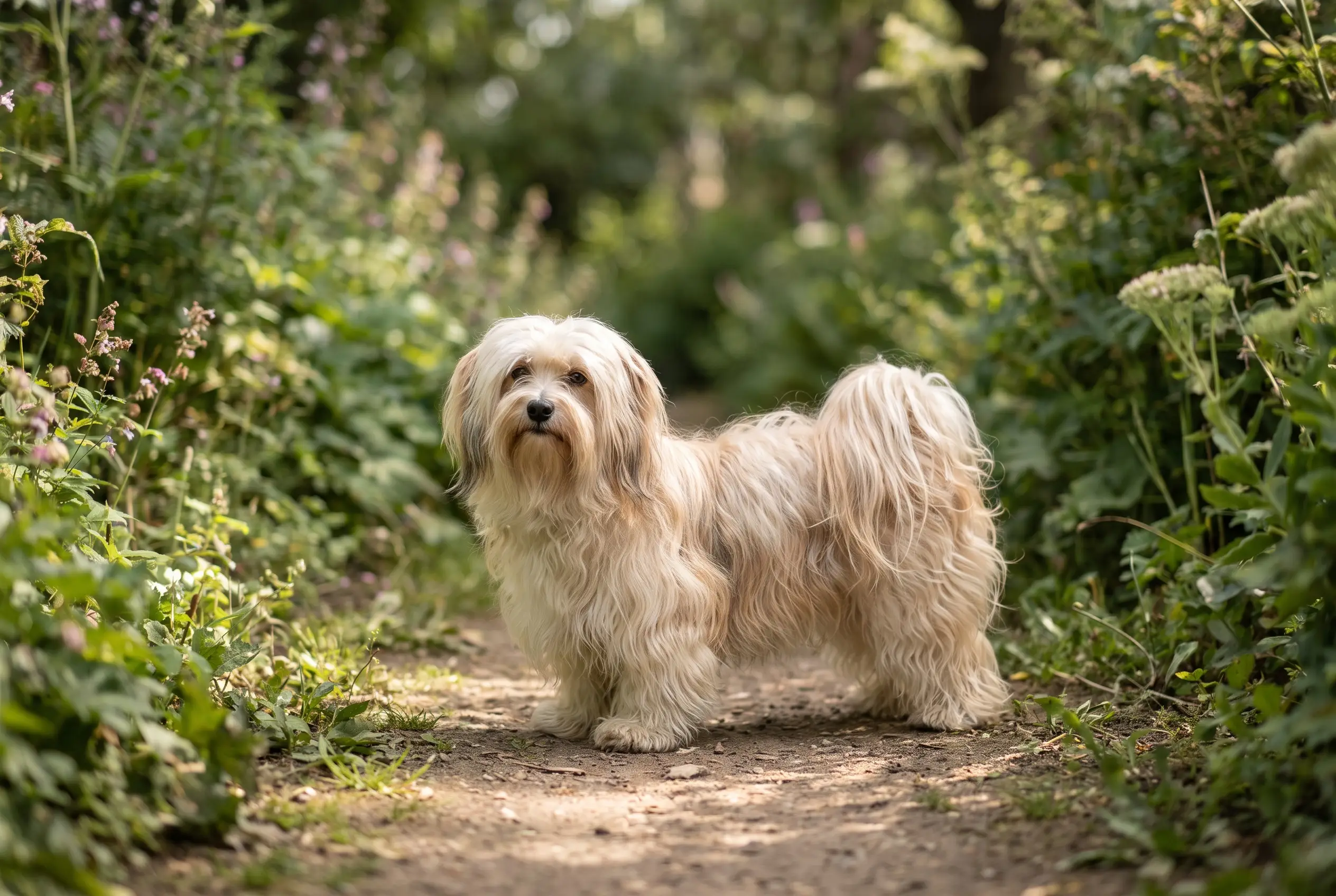
Havanese
Havana's silk-coated charmer — a small dog with a headline personality.
On these lists: Dogs for apartments · Dogs for first-time owners · Small dogs · Dogs for seniors · Dogs for anxiety
Vital stats
| Size | Toy · 23–27 cm |
| Weight | 3–6 kg |
| Life expectancy | 13–15 years |
| Energy | Moderate — 30 min/day plus play |
| Shedding | Low — but the coat mats |
| Coat | Long silky double coat · many colours |
| Group | Toy · FCI №250 / AKC |
| Origin | Havana, Cuba |
| FCI group | 9 — Companion and Toy Dogs · FCI 250 |
Breed traits
Friendliness
Care
Mind
The Havanese by the numbers
The Havanese facts owners search for most — price, lifespan, weight, shedding and colours, in one place.
Widely bred, so you can usually find a litter from a registered breeder without a long wait. Ongoing costs stay modest — it eats little and routine vet care sits at the lower end. Its coat also needs a professional groom every few weeks — a real line in the budget.
We don't quote a single figure: the real price swings with breeder, region, bloodline and health testing — and a rescue costs a fraction of a breeder's litter. Adopting is almost always the cheapest route.
Temperament
Bred purely for companionship in the salons of colonial Havana, the Havanese made an art of being delightful: clownish, clever, and tuned to its people like a small furry barometer. It learns tricks for the applause, follows you room to room, and considers a closed bathroom door a personal affront.
Habits & quirks
Room-to-room escort
Wherever you go, a small silky shadow follows — solitude is not in the job description.
The showman
Learns tricks fast and performs them faster, ideally to a full room.
Perch patrol
Many Havanese love a sofa-back vantage point, watching the street like tiny doormen.
The play bow opener
Greets people and dogs alike with an invitation to games first, questions later.
Health
The Havanese is one of the sturdier, healthier toy breeds, so most of the work is everyday care rather than managing a long list of conditions. Teeth come first — small mouths crowd, and dental disease is the most common and most preventable problem small dogs face — so brush daily. Keep the weight lean, keep up the coat so it never mats, and buy from a breeder who health-tests their dogs. The one real need is company: this breed does badly left alone too long.
Nutrition
| Grooming | Brush the silky coat every day or two to stop mats — or keep a low-maintenance puppy clip. |
| Company | This breed genuinely struggles alone; teach short absences early and keep them short. |
| Training | Quick and eager — house-training takes patience, tricks take minutes. |
| Exercise | A daily walk and lively play sessions suffice; big personality, modest legs. |
A Havanese needs little food to stay in trim, so measure the meals and keep it lean — this is a clever dog that learns fast for treats, so count anything you hand over at training into the day's total. Feed set meals rather than free-feeding, and favour dental-friendly chewing, since small-breed mouths are prone to dental trouble. Under all that coat a little weight gain hides easily, so go by feel, not by eye.
Puppy guide
A Havanese puppy is bright, funny and quick to bond, and the most important lesson of the first year is one owners often skip: learning to be alone. This is a true velcro breed, so teach short, calm separations early and build them up rather than being together every minute. Start gentle daily grooming from the beginning so a lifetime of brushing is easy, socialise widely, put that eager brain to work with tricks, and be patient with housetraining.
Training
Havanese are quick, eager little dogs that genuinely enjoy learning — tricks take minutes, and a few upbeat, reward-based sessions a day keep the clever brain happy. Housetraining is the slower part and takes patience, so keep a routine and stay consistent. Because they're so people-focused, teach short spells alone as part of training too, and reward the calm as readily as the clever.
Known health issues
No breed is problem-free. These are the conditions most worth knowing about for this breed — with what a good breeder screens for and what an owner watches. General guidance, not a substitute for your vet.
Slipping kneecap
A kneecap that slips out of place, common in small breeds and usually manageable. Good breeders screen: Vet-checked knees on the parents. Watch for: An occasional skip or hop on a back leg.
Inherited eye disease
Progressive retinal atrophy and cataracts run in several breeds and can dim or take sight over time. Good breeders screen: Eye-tested parents and, where available, a DNA test for PRA. Watch for: Night-time bumping, cloudy eyes, or hesitation in dim light.
Life expectancy
Havanese live 13–15 years. The Havanese is a long-lived breed, and the things that keep one at the top of that range are the everyday ones: a lean weight, teeth that are brushed and checked, and a coat kept brushed so it never mats. Keep up the yearly vet visit and give it the company it needs, and a well-kept Havanese stays a funny, affectionate companion for a very long time.
Popular Havanese mixes
Havapoo
A small, clever, often low-shedding cross that's playful and affectionate; a popular pick for allergy-conscious homes, with a coat that needs regular brushing.
Havachon
A soft, cheerful little companion with a low-shedding coat and an easy temperament; friendly with everyone and happiest in company.
Havamalt
A small, devoted companion that loves being with its people; the silky coat mats without regular brushing and the teeth need daily care.
Havashu
A soft, sociable little cross with a long coat and a fondness for company; the coat needs regular grooming.
Hava-Jack
A lively, clever, energetic cross with more drive than most companion dogs. It needs real activity and training as well as company.
Similar breeds
Breeds with a similar build and background — worth a look if this one isn't quite the fit.
Breeds that look like this
Common questions
Do Havanese shed?
Barely — loose hair catches in the silky coat instead of falling. That's why brushing matters: what doesn't shed, mats.
Can a Havanese be left alone all day?
Not happily — this is one of the most people-dependent breeds. Half-day absences with practice are realistic; full workdays alone usually aren't.
Are Havanese good with children?
Yes — sturdier and more playful than most toy breeds, they generally adore gentle kids. Supervise as with any small dog.
Is the Havanese hypoallergenic?
No dog is truly hypoallergenic, but the Havanese comes closer than most: its low-shedding coat releases less of the dander that triggers allergies. Many allergy sufferers manage well with this breed, but spend time around one before committing.
Is the Havanese easy to train?
Yes. The Havanese is one of the more trainable breeds — quick to learn and keen to work with you, which makes reward-based training straightforward. Start early, keep it positive, and it picks things up fast.