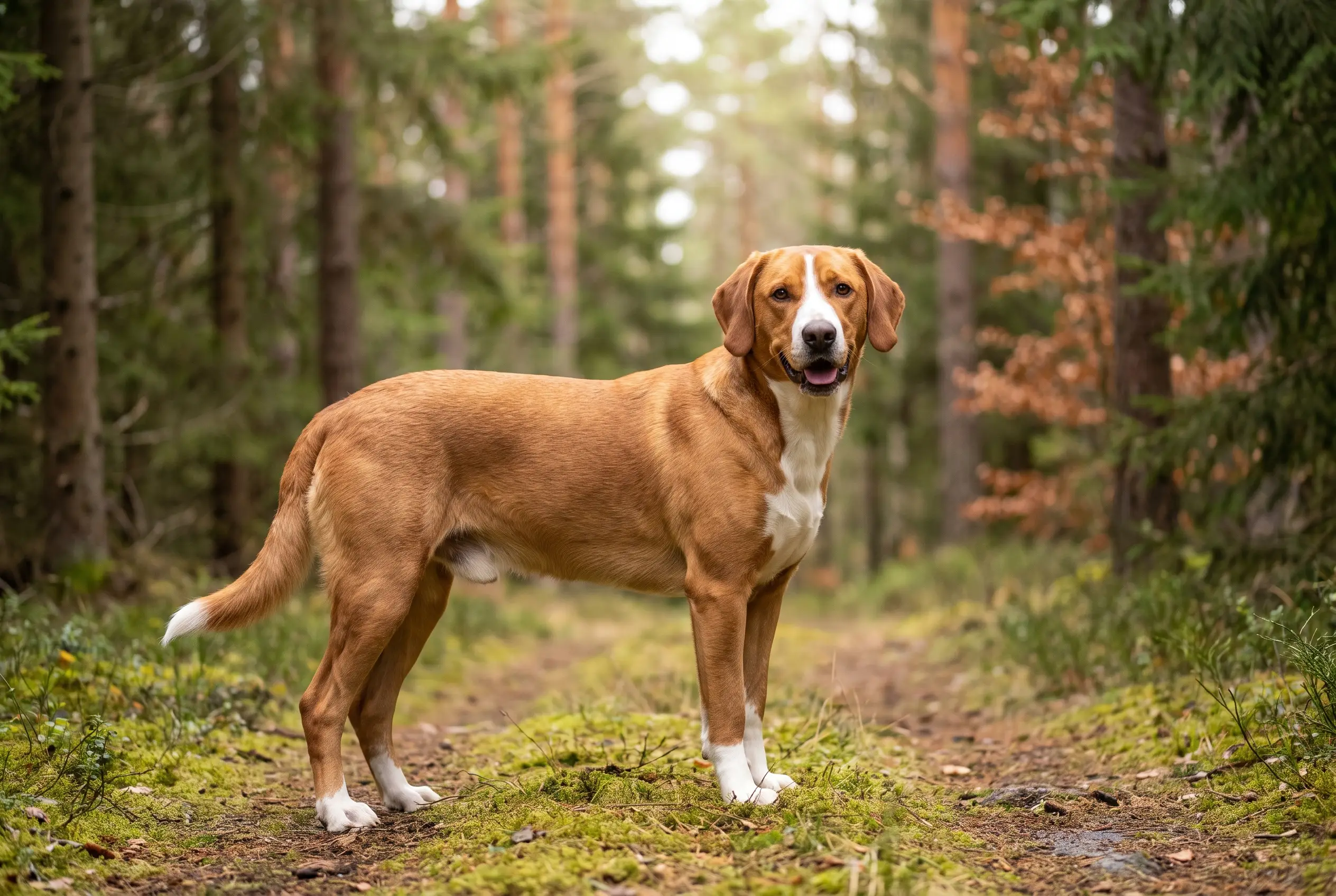
Hygenhund
A compact Norwegian hare hound, built short where its closest relative is built long.
Vital stats
| Size | Medium · 50–58 cm (dogs), 47–55 cm (bitches) |
| Weight | 20–28 kg — breed literature; the standard sets none |
| Life expectancy | 10–12 years — breed literature, not survey data |
| Energy | High — built for a full day's hare hunting on rough, cold ground |
| Shedding | Moderate — dense, harsh-textured coat, weekly brushing keeps it in check |
| Coat | Straight, somewhat rough, dense and shiny · red-brown or yellow-red, black-and-tan, or white with red or black-and-tan markings |
| Group | Scenthound · Medium-sized Hounds (FCI №266, Group 6) |
| Origin | Norway |
| FCI group | 6 — Scent hounds and related breeds · FCI 266 |
Breed traits
Friendliness
Care
Mind
The Hygenhund by the numbers
The Hygenhund facts owners search for most — price, lifespan, weight, shedding and colours, in one place.
Less common, so expect a waitlist and some travel to a reputable breeder — which pushes the price up. Plan for steady ongoing costs — mid-range food, routine vet care and insurance.
We don't quote a single figure: the real price swings with breeder, region, bloodline and health testing — and a rescue costs a fraction of a breeder's litter. Adopting is almost always the cheapest route.
Temperament
The Hygenhund's standard has no dedicated behaviour section, which is unusual even among the shorter Nordic hound standards, so its temperament has to be read at the edges of the text. The eyes should give a 'calm and earnest expression,' and the disqualifying faults draw the outer line plainly: 'aggressive or overly shy dogs' and 'any dog clearly showing physical or behavioural abnormalities' are both grounds for disqualification, which sets the boundary of acceptable temperament even where the standard never spells out what sits inside it. Breed literature fills the middle consistently, describing the Hygenhund as calm, friendly and eager to learn, easier to train than most trailing hounds, and vocal on the trail — hunters are said to judge how close it is running to the hare by the pitch and pace of its voice.
Habits & quirks
A working trial attached to the breed
Section 1.2's medium-sized hounds carry a working trial requirement, and the Hygenhund is bred to earn it — a hare hound judged on the hunt, not just the stand.
Ears that fall short on purpose
The standard specifies leathers 'reaching hardly half-way to the nose when pulled forward' — noticeably shorter than the sweeping ears of many other trailing hounds, and an easy, measurable tell in the show ring.
A gene pool topped up by design
Registrations run only 27 to 44 puppies a year, so between the 1970s and 2006 breeders deliberately crossed in outside blood — the Dunker, the Finnish Hound, one litter to a Hamiltonstövare — to widen the base rather than let a closed studbook narrow it further.
Temperament as a disqualifier, not just a fault
Most of the standard's faults are structural, but 'aggressive or overly shy dogs' sits in the disqualifying-faults list alongside physical defects — one of the few places character gets the same weight as conformation.
Health
By breed-club account the Hygenhund is a robust, working-sound dog with no inherited condition that shows up widely: the standard asks only for functionally sound, breed-typical dogs and two descended testicles, and leaves it at that. Where the breed is genuinely fragile is in its numbers, not its joints. Norway registers only around thirty to forty puppies a year, and breeders have deliberately crossed in outside hound blood since the 1970s to keep the gene pool from narrowing. So the health question to ask a breeder here is about pedigree diversity, not a test panel.
Nutrition
| Exercise | Built for a full day on a hare's trail over broken, cold ground — plan on serious daily exercise, scent work, or hunting rather than a lead walk round the block. Conformation without stamina misses the point of a working trial breed. |
| Grooming | The coat is straight, dense, faintly rough to the touch and never too short. A weekly brush keeps it in order; it sheds, but it is nowhere near the volume some Nordic double coats carry. |
| Training | Breed literature calls it easier to train than most trailing hounds — calm, food- and praise-responsive, eager to learn — but the nose still wins arguments once a hare's scent crosses the yard. Start recall early, and expect the voice: this breed hunts loud on purpose, so hunters can track it by ear. |
| Health | Breed literature calls the Hygenhund a robust breed with no widely reported inherited condition, and the standard's own note asks only for two descended testicles and functionally sound, breed-typical dogs used for breeding. The real pressure point is population size — Norway registers roughly 30 to 40 puppies a year, small enough that breeders have deliberately crossed in outside hound blood since the 1970s to protect genetic diversity. |
This is a working scenthound built to run a hare trail all day, and a Hygenhund in real work eats to match. But the same dog kept as a companion, exercised for an hour and dozing the rest, needs far less than its drive suggests it wants. Feed to the actual workload, not the enthusiasm: a hound this size stays healthiest lean and level, so weigh the meals, keep the treats you use for recall in the day's total, and check the ribs by hand under that dense coat.
Puppy guide
A Hygenhund puppy is a hunting hound first, and the nose wakes up early. Start recall and basic manners while you still have its attention, because once a hare's scent crosses the yard the nose wins the argument. Get it used to people, dogs and everyday life young, since it's a friendly breed that's rarely socialised by circumstance in its native hunting homes. Expect the voice too: this breed hunts loud on purpose, so teaching a puppy when noise is and isn't wanted pays off for years.
Training
Breed people rate the Hygenhund as easier to train than most trailing hounds: it's calm, it works for food and praise, and it genuinely wants to learn. The catch is the one every scenthound carries. A fresh hare trail out-argues any recall you've built, so start that early, keep it rewarding, and don't trust it off-lead where there's live game. And plan around the voice rather than against it, because this dog is bred to hunt out loud so a hunter can place it by ear.
Life expectancy
Hygenhunds live 10–12 years — breed literature, not survey data. That figure comes from breed literature rather than any real survival study, since the population is small enough that nobody has the numbers for more. What's clear is that a fit, lean, well-exercised working hound tends to do well, so the ordinary things carry the most weight here: keep the dog at a working weight, give it the exercise its build demands, keep teeth and ears clean, and buy from a breeder minding the gene pool, since diversity is the health issue this breed actually lives with.
Similar breeds
Breeds with a similar build and background — worth a look if this one isn't quite the fit.
Breeds that look like this
Common questions
Is the Hygenhund the same breed as the Dunker?
No, though the two share a direct history. Hans Fredrik Hygen bred the Hygenhund from local hounds starting in the 1830s; his line and the Dunker (Norwegian Hound, FCI №203) were defined as separate breeds in 1902, merged by the Norwegian Kennel Club from 1925 to 1934 over the objections of the hound clubs, then split apart again. They still get compared by silhouette: where the Dunker's standard calls for a long body, the Hygenhund's asks for something shorter and more compact. FCI standard No. 266 (Hygenhund) and No. 203 (Dunker) both sit in Group 6, Section 1.2, both from Norway — close relatives, not one breed under two names.
How is it different from the Haldenstøver, the other Norwegian scenthound in this group?
Different recipe and a different generation, aimed at the same hare. The Haldenstøver was built roughly a generation later, from the 1860s onward around the town of Halden, out of English Foxhounds, Beagles and local scenthounds bred for raw speed. The Hygenhund is older — Hygen was already crossing Holstein Hounds, English Pointers and local stock in the 1830s — and built shorter and more solid rather than for pure pace. Coat gives the fastest tell: Haldenstøver breed descriptions run predominantly white with black patches and tan shading, while the Hygenhund runs red-brown, black-and-tan, or white patched with either. FCI standard No. 267 (Haldenstøver) and No. 266 (Hygenhund) sit side by side in Group 6, Section 1.2, both Norwegian, both built for hare, from different foundation stock.
Can you get a Hygenhund outside Norway?
Rarely, and that is partly by design. Norway registers only around 30 to 40 puppies a year, the breed is kept almost entirely by and for Norwegian hare hunters, and breed-club material stresses how thin the gene pool already is — which is why outside crosses were folded in on purpose rather than left to chance. Outside Scandinavia, expect a long wait list and a breeder who wants to know what you plan to hunt with it.
Does the Hygenhund shed a lot?
Moderately. The Hygenhund sheds a fair amount, steadily through the year with heavier seasonal patches. A weekly brush keeps most of the loose hair off your floors and clothes.
Is the Hygenhund hypoallergenic?
Not really. No dog is truly hypoallergenic, and the Hygenhund's shedding coat releases plenty of the dander that sets off allergies. If someone at home is allergic, this isn't the easiest breed to live with — spend time around one first.
Is the Hygenhund good with children?
Generally yes. The Hygenhund is a friendly, people-loving breed that usually does well with children when raised and socialised well. As with any dog, teach children to be gentle and supervise around toddlers.
Is the Hygenhund easy to train?
Reasonably. The Hygenhund is trainable with consistency and rewards, though it isn't the quickest study. Keep sessions short and positive, and be patient with the basics like recall.