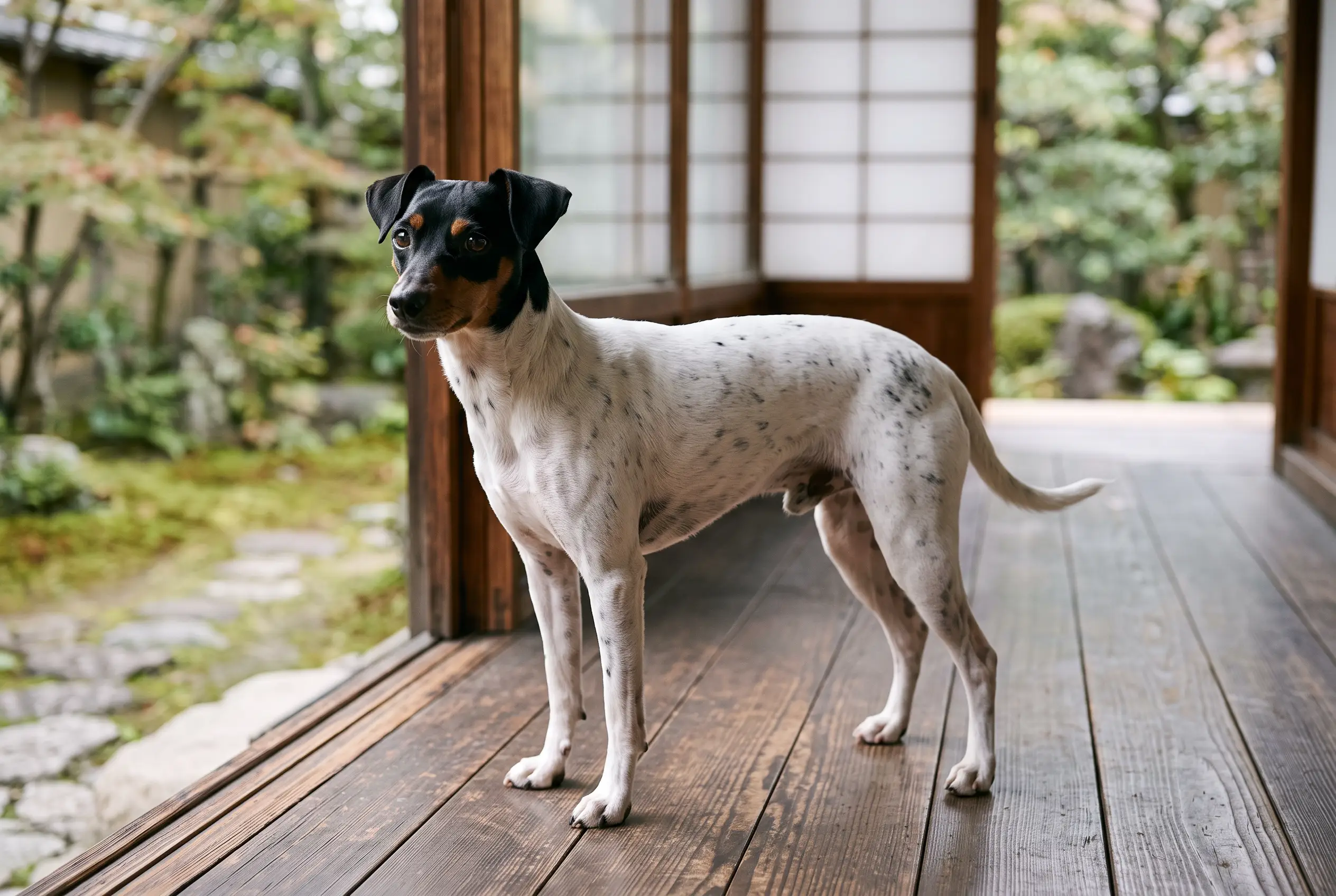
Japanese Terrier
Japan's only terrier, and a lapdog underneath it.
Vital stats
| Size | Small · 30–33 cm |
| Weight | 4–6 kg |
| Life expectancy | 12–15 years |
| Energy | Moderate — short fast bursts, then a lap |
| Shedding | Low — the hair is only about 2 mm long, with no real undercoat |
| Coat | Very short, smooth and glossy · black, tan or black-and-tan head over a white, spotted body |
| Group | Terrier · Small-sized Terrier (FCI №259, Group 3) |
| Origin | Nagasaki and Kobe, Japan |
| FCI group | 3 — Terriers · FCI 259 |
Breed traits
Friendliness
Care
Mind
The Japanese Terrier by the numbers
The Japanese Terrier facts owners search for most — price, lifespan, weight, shedding and colours, in one place.
Less common, so expect a waitlist and some travel to a reputable breeder — which pushes the price up. Ongoing costs stay modest — it eats little and routine vet care sits at the lower end.
We don't quote a single figure: the real price swings with breeder, region, bloodline and health testing — and a rescue costs a fraction of a breeder's litter. Adopting is almost always the cheapest route.
Temperament
The FCI standard calls the breed lively and cheerful, and swift, and all three words hold up. A Japanese Terrier works in bursts: a few minutes flat out after a ball or a blown leaf, then straight back to press against someone's leg. The attachment is close and usually specific — most pick one person and stay near them, which is not what the terrier group is known for and makes long days home alone a poor fit. With strangers they hang back and watch, then thaw quickly once their person is relaxed. What they cannot take is heavy handling. A raised voice, a jerked lead or a correction repeated three times shuts one down, and bringing a shut-down Japanese Terrier back takes weeks.
Habits & quirks
Two millimetres of coat
The standard puts the hair at about 2 mm, and there is no undercoat under it. On a cold morning it shivers, and it will find the one warm square of floor in the house before you notice there is one.
Attached at the ankle
It picks a person and stays within a metre of them — sofa, kitchen, bathroom, all of it. The famous terrier independence largely skipped this breed.
Sprint, then collapse
Play arrives in short fast episodes and ends abruptly in a nap against somebody's thigh. This is not a dog that paces the house looking for a job.
Announces, then steps back
It hears the gate before you do and says so. Then it moves behind you and leaves the rest to you — sharp ears, no appetite for a confrontation.
Care
| Exercise | Two proper walks a day plus indoor play, call it 45 minutes to an hour in total, with something to think about folded in. Cold and rain shorten the walk rather than cancel it — a coat solves most of the problem. |
| Grooming | A rubber mitt once a week lifts the dead hair, and there is nothing to trim, strip or clip. It sheds little, but the short bristly hairs weave into upholstery and stay there. Bathe rarely, and watch the pink skin on white areas in strong sun. |
| Training | Quiet, short, reward-based sessions. It learns fast and remembers who was unfair to it. Socialise early so the natural reserve with strangers does not harden into fear, and put real work into recall, because the chase reflex is intact. |
| Health | A sound breed overall, and long-lived for its size. Known concerns are patellar luxation, skin allergies and poor tolerance of cold, and congenital deafness has been reported in dogs carrying a lot of white. Ask breeders about hearing testing and about how closely the parents are related — the gene pool is small. |
Life expectancy
This breed has a typical life expectancy of 12–15 years.
Similar breeds
Breeds with a similar build and background — worth a look if this one isn't quite the fit.
Breeds that look like this
Common questions
Is the Japanese Terrier the same as a Toy Fox Terrier or a Japanese Spitz?
Neither. It shares an ancestor with the Toy Fox Terrier — both go back to the smooth Fox Terrier — but the American breed was developed separately from the 1930s and carries erect ears, while the Japanese Terrier has small V-shaped ears that drop forward and a head that is usually solid black or black-and-tan. The Japanese Spitz is a different animal entirely: a white, thick double-coated spitz in FCI Group 5. The Japanese Terrier is the only Japanese breed in Group 3.
Is it a working terrier?
No. Nobody bred it to go to ground after fox or badger. It dealt with rats around the port houses of Kobe, Nagasaki and Yokohama and otherwise lived indoors as a companion — the FCI standard still lists its utilisation as toy dog, even though the breed sits in the terrier group. The reflexes survive, so it will chase and it will dig when bored, but it has none of the hardness European working terriers were selected for, and it takes rough correction much worse.
How hard is one to find outside Japan?
Hard. Japan registers fewer than a hundred a year, the breed came close to disappearing around the Second World War, and nearly all breeding is still domestic. The UKC recognised it in 2006 and the AKC took it into its Foundation Stock Service in 2020, but only a handful of litters are born in Europe and North America in any given year. Expect a waiting list, and probably a flight.
Does the Japanese Terrier shed a lot?
Not much. The Japanese Terrier is a low-shedding breed, so loose hair around the home stays minimal. It still needs regular grooming, but you won't be fighting drifts of fur.
Is the Japanese Terrier hypoallergenic?
No dog is truly hypoallergenic, but the Japanese Terrier comes closer than most: its low-shedding coat releases less of the dander that triggers allergies. Many allergy sufferers manage well with this breed, but spend time around one before committing.
Is the Japanese Terrier good with children?
Generally yes. The Japanese Terrier is a friendly, people-loving breed that usually does well with children when raised and socialised well. As with any dog, teach children to be gentle and supervise around toddlers.
Is the Japanese Terrier easy to train?
Reasonably. The Japanese Terrier is trainable with consistency and rewards, though it isn't the quickest study. Keep sessions short and positive, and be patient with the basics like recall.