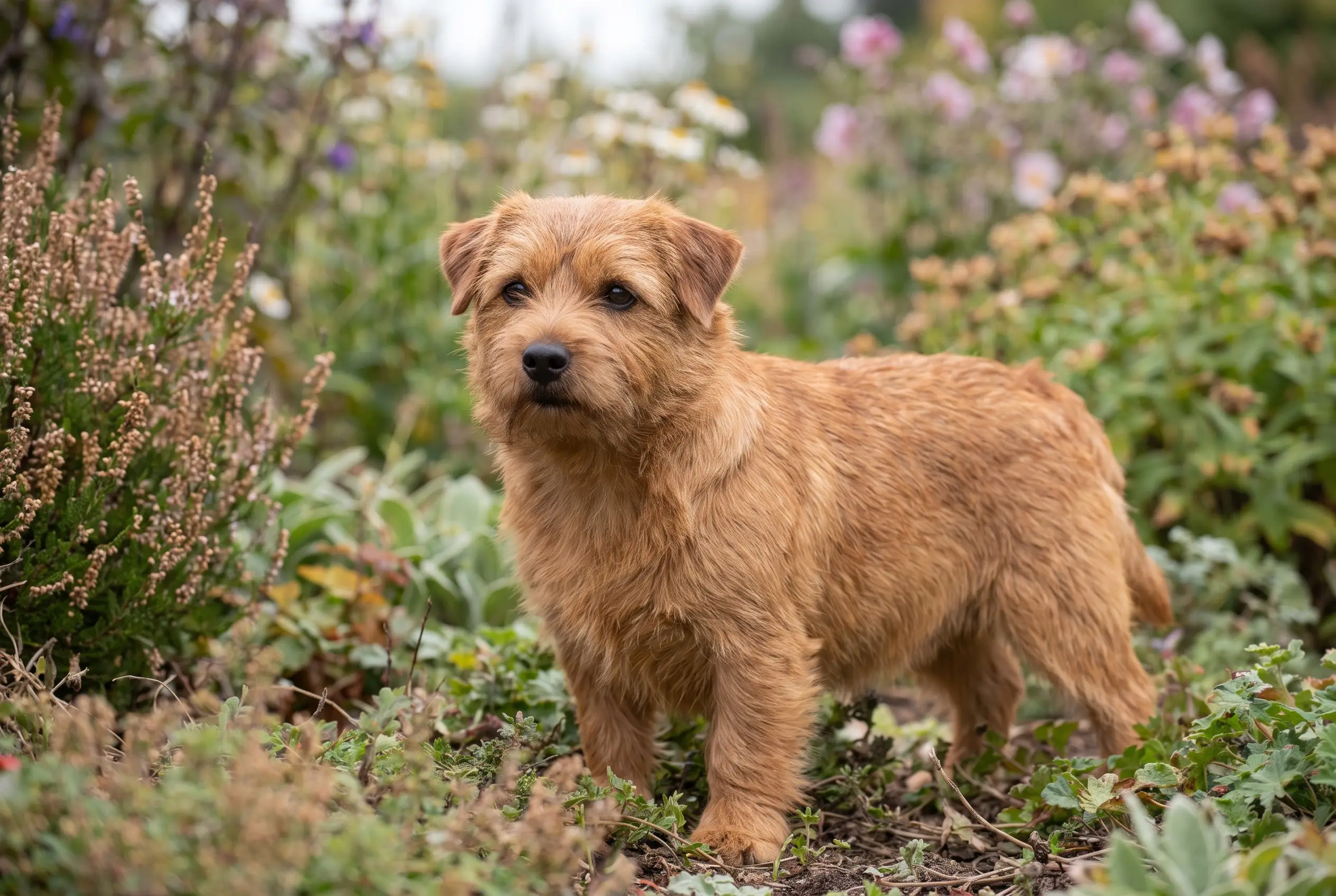
Norfolk Terrier
Pocket-sized courage with folded ears and a farm-dog heart.
Vital stats
| Size | Very small · 23–25 cm |
| Weight | 5–5.5 kg |
| Life expectancy | 12–16 years |
| Energy | Moderate — 45–60 min/day |
| Shedding | Low, seasonal |
| Coat | Hard wiry coat · red, wheaten, black-and-tan, grizzle |
| Group | Terrier · FCI №272 / AKC |
| Origin | East Anglia, England |
| FCI group | 3 — Terriers · FCI 272 |
Breed traits
Friendliness
Care
Mind
The Norfolk Terrier by the numbers
The Norfolk Terrier facts owners search for most — price, lifespan, weight, shedding and colours, in one place.
Widely bred, so you can usually find a litter from a registered breeder without a long wait. Ongoing costs stay modest — it eats little and routine vet care sits at the lower end.
We don't quote a single figure: the real price swings with breeder, region, bloodline and health testing — and a rescue costs a fraction of a breeder's litter. Adopting is almost always the cheapest route.
Temperament
Bred in East Anglia to dispatch rats and bolt foxes alongside the hunt, the Norfolk worked in company — which left it notably more sociable with other dogs than the average terrier. At home it is affectionate, game for anything, and convinced that hedgerows exist to be investigated at full speed.
Habits & quirks
The excavation unit
Flowerbeds are treated as archaeological sites with rats presumed below.
Size unread
It never received the memo about being small, and greets large dogs as equals.
Blanket burrowing
A den dog at heart — it tunnels under throws and emerges only for meals.
Hedge patrol
Every walk doubles as a sweep for anything that rustles.
Care
| Grooming | Hand-strip the harsh coat roughly twice a year to keep its colour and weatherproof texture; weekly brushing between. |
| Exercise | A brisk daily hour of walks and play; this is a working terrier, not a lap ornament. |
| Containment | Fence the garden low and deep — a bored Norfolk digs with professional intent. |
| Training | Build recall early and keep it leashed near wildlife; centuries of prey drive outrank your biscuits. |
Life expectancy
This breed has a typical life expectancy of 12–16 years.
Similar breeds
Breeds with a similar build and background — worth a look if this one isn't quite the fit.
Breeds that look like this
Common questions
What is the difference between a Norfolk and a Norwich Terrier?
Ears, mainly: the Norfolk's fold forward while the Norwich's stand pricked. They shared a breed name until 1964, and remain near-identical in size and character.
Are Norfolk Terriers good with children?
Yes — they are sturdy, playful and patient for their size, and suit families who respect a small dog's limits. Teach children gentle handling and everyone thrives.
Do Norfolk Terriers bark a lot?
They alert like any terrier but are less shrill than most small breeds. Enough exercise and a job for the brain keep announcements reasonable.
Does the Norfolk Terrier shed a lot?
Not much. The Norfolk Terrier is a low-shedding breed, so loose hair around the home stays minimal. It still needs regular grooming, but you won't be fighting drifts of fur.
Is the Norfolk Terrier hypoallergenic?
No dog is truly hypoallergenic, but the Norfolk Terrier comes closer than most: its low-shedding coat releases less of the dander that triggers allergies. Many allergy sufferers manage well with this breed, but spend time around one before committing.
Is the Norfolk Terrier easy to train?
Reasonably. The Norfolk Terrier is trainable with consistency and rewards, though it isn't the quickest study. Keep sessions short and positive, and be patient with the basics like recall.