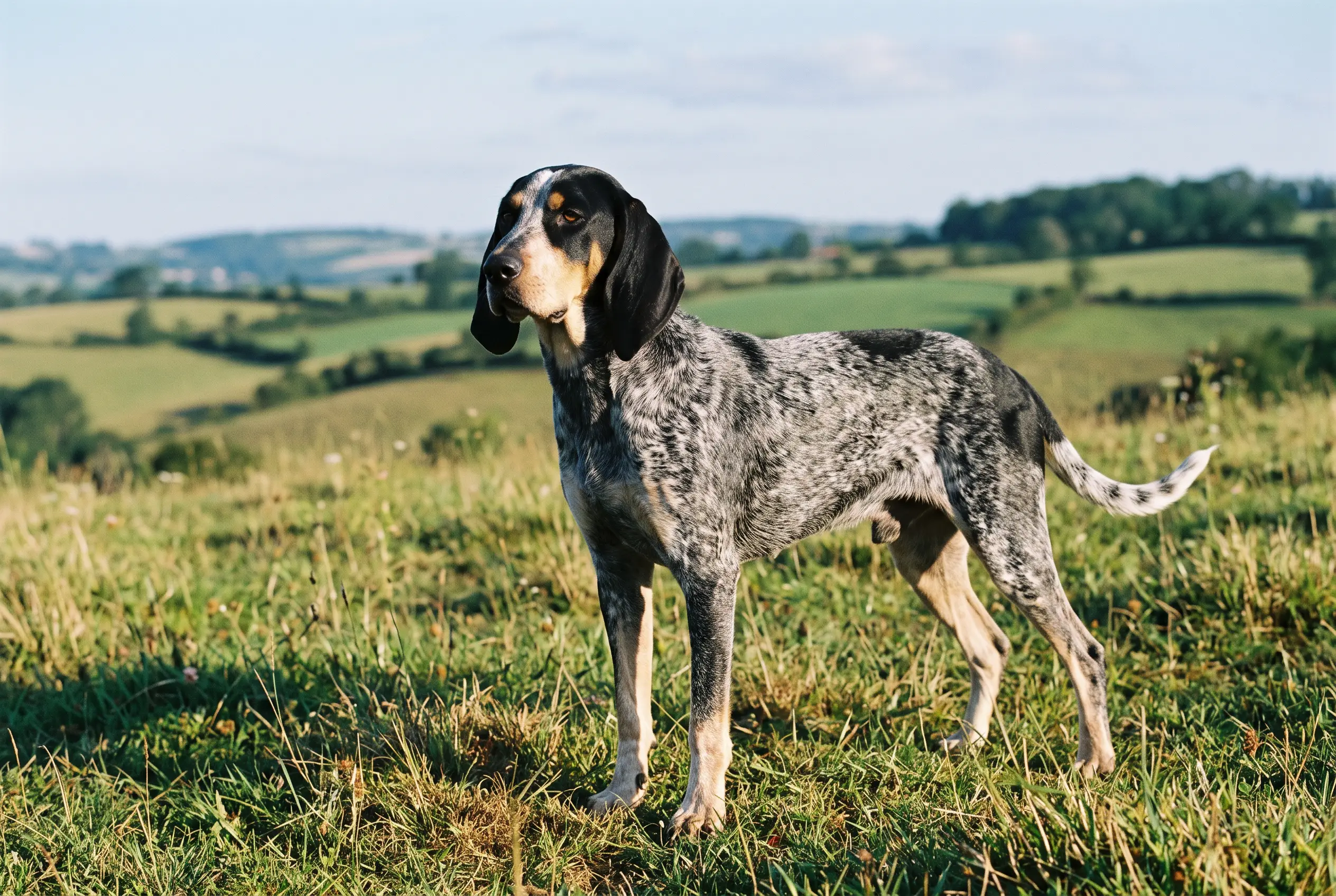
Petit Bleu de Gascogne
Built smaller than the Grand Bleu de Gascogne on purpose, to hunt hare on foot rather than from horseback.
Vital stats
| Size | Medium · 52–58 cm (males), 50–56 cm (females) |
| Weight | 18–22 kg — breed literature; the standard sets none |
| Life expectancy | 10–12 years — breed literature, not survey data |
| Energy | High — built to hunt on foot all day |
| Shedding | Low to moderate — short, dense coat |
| Coat | Short, semi-thick, dense · mottled black and white, slate-blue effect, tan markings |
| Group | Scenthound · Medium-sized Hound (FCI № 31, Group 6) |
| Origin | Gascony, southwest France |
| FCI group | 6 — Scent hounds and related breeds · FCI 31 |
Breed traits
Friendliness
Care
Mind
The Petit Bleu de Gascogne by the numbers
The Petit Bleu de Gascogne facts owners search for most — price, lifespan, weight, shedding and colours, in one place.
Less common, so expect a waitlist and some travel to a reputable breeder — which pushes the price up. Plan for steady ongoing costs — mid-range food, routine vet care and insurance.
We don't quote a single figure: the real price swings with breeder, region, bloodline and health testing — and a rescue costs a fraction of a breeder's litter. Adopting is almost always the cheapest route.
Temperament
The standard's behaviour section is short and exact: “Fine nose, intent in his way of hunting, endowed with a beautiful voice; works well in a pack. Character calm and affectionate. Obeys orders easily.” That reads as a working description as much as a personality one — the nose and the voice are what a hunter follows through cover, and working well in a pack matters for a hound used both solo and in groups. At home, it's the calm-and-affectionate half that owners notice: this is not a highly strung breed, and it takes direction readily. The voice the standard calls beautiful is, in practice, loud and frequent the moment that nose finds something worth announcing.
Habits & quirks
Two black masks, one white gap
The standard's colour section is unusually precise: two black patches sit either side of the head, covering the ears, ringing the eyes, and stopping at the cheeks — they never meet on top of the skull, and the white gap between them often holds one small black oval spot the standard calls typical of the breed.
Black skin under a mottled coat
Pull the coat aside and the skin itself is black, or strongly marbled with black patches, and never entirely white — the standard states this outright, along with black mucous membranes. It's a pigmentation check breeders and judges actually use.
Ears sized to the nose
The standard doesn't just say the ears hang — it sets a measurable rule: the leather, curled in and moderately fine, should reach at least to the tip of the nose when drawn forward. Short of that is a fault.
Judged on the job, not just the ring
The FCI classification carries “with working trial,” meaning the breed standard expects dogs to prove themselves hunting hare — its stated favourite quarry — and to handle bigger game credibly, not just stand well for conformation.
Care
| Exercise | Built for a full day on foot following scent, not a leash-only stroll. Give it real off-lead time somewhere it can work its nose — hunting, tracking, scent games — and expect it to want more than a walk around the block provides. |
| Grooming | The short, semi-thick coat needs only a weekly brush; there's no long hair to mat, and the standard doesn't flag a heavy seasonal moult. The ears hang low enough to trap moisture, so check and clean them regularly, especially after time in cover. |
| Training | The standard says it obeys orders easily, which matches its history as a pack hound worked under command alongside others. Start early, keep that nose occupied, and build recall carefully — a scent this good will pull a hound past a half-trained command. |
| Health | The standard sets no life-expectancy figure, and no breed-wide health survey backs the 10–12 years usually quoted — that number is breed literature, not census data. As with most French regional scenthounds bred outside a large population, ask breeders about hip screening and pedigree depth rather than assuming a documented health scheme. |
Life expectancy
This breed has a typical life expectancy of 10–12 years — breed literature, not survey data.
Similar breeds
Breeds with a similar build and background — worth a look if this one isn't quite the fit.
Breeds that look like this
Common questions
Is a Petit Bleu de Gascogne just a small Grand Bleu de Gascogne, or a puppy of it?
No. The FCI standard describes it as “a voluntary reduction in size” of the Grand Bleu de Gascogne (FCI No. 22) — a deliberate breeding decision, not a growth stage or a runt line. They are two separate FCI breeds with two separate standards: the Petit stands 52–58 cm at the withers for males, against the Grand's 65–72 cm, a gap of well over 10 cm that no amount of growing closes. The smaller size was bred on purpose for a specific job — hunting hare on foot with the gun — rather than the wolf, boar and larger game the Grand was built to run from horseback.
How do you tell a Petit Bleu de Gascogne from the Griffon Bleu de Gascogne or the Basset Bleu de Gascogne?
By coat and legs. The Griffon Bleu de Gascogne (FCI No. 32) stands almost the same height — 50–57 cm for males — but its standard calls for a hard, rough and shaggy coat, the product of crossing a medium-sized Gascony Blue with a griffon; the Petit's coat is short and smooth. The Basset Bleu de Gascogne (FCI No. 35) shares the coat and colouring almost exactly but is built low and long, a true basset with short legs and a body-length-to-height ratio the standard sets near 5:8. All three wear the same mottled slate-blue coat and the same tan “quatreoeuillé” eye markings, so coat texture and leg length are the tells, not colour.
Are Petit Bleus de Gascogne good family dogs?
For a household ready for a working scenthound, yes. The standard's own words are “calm and affectionate,” and it takes direction well — but it's built to hunt, with a fine nose and what the standard calls a beautiful voice, which it uses freely once that nose finds a trail. It needs real daily exercise and a secure boundary near any open scent trail; recall against a hunting hound's nose takes early, deliberate training. Outside France the breed is uncommon, so expect a wait and a breeder working from hunting lines rather than a show-only litter.
Does the Petit Bleu de Gascogne shed a lot?
Moderately. The Petit Bleu de Gascogne sheds a fair amount, steadily through the year with heavier seasonal patches. A weekly brush keeps most of the loose hair off your floors and clothes.
Is the Petit Bleu de Gascogne hypoallergenic?
Not really. No dog is truly hypoallergenic, and the Petit Bleu de Gascogne's shedding coat releases plenty of the dander that sets off allergies. If someone at home is allergic, this isn't the easiest breed to live with — spend time around one first.
Is the Petit Bleu de Gascogne easy to train?
Reasonably. The Petit Bleu de Gascogne is trainable with consistency and rewards, though it isn't the quickest study. Keep sessions short and positive, and be patient with the basics like recall.