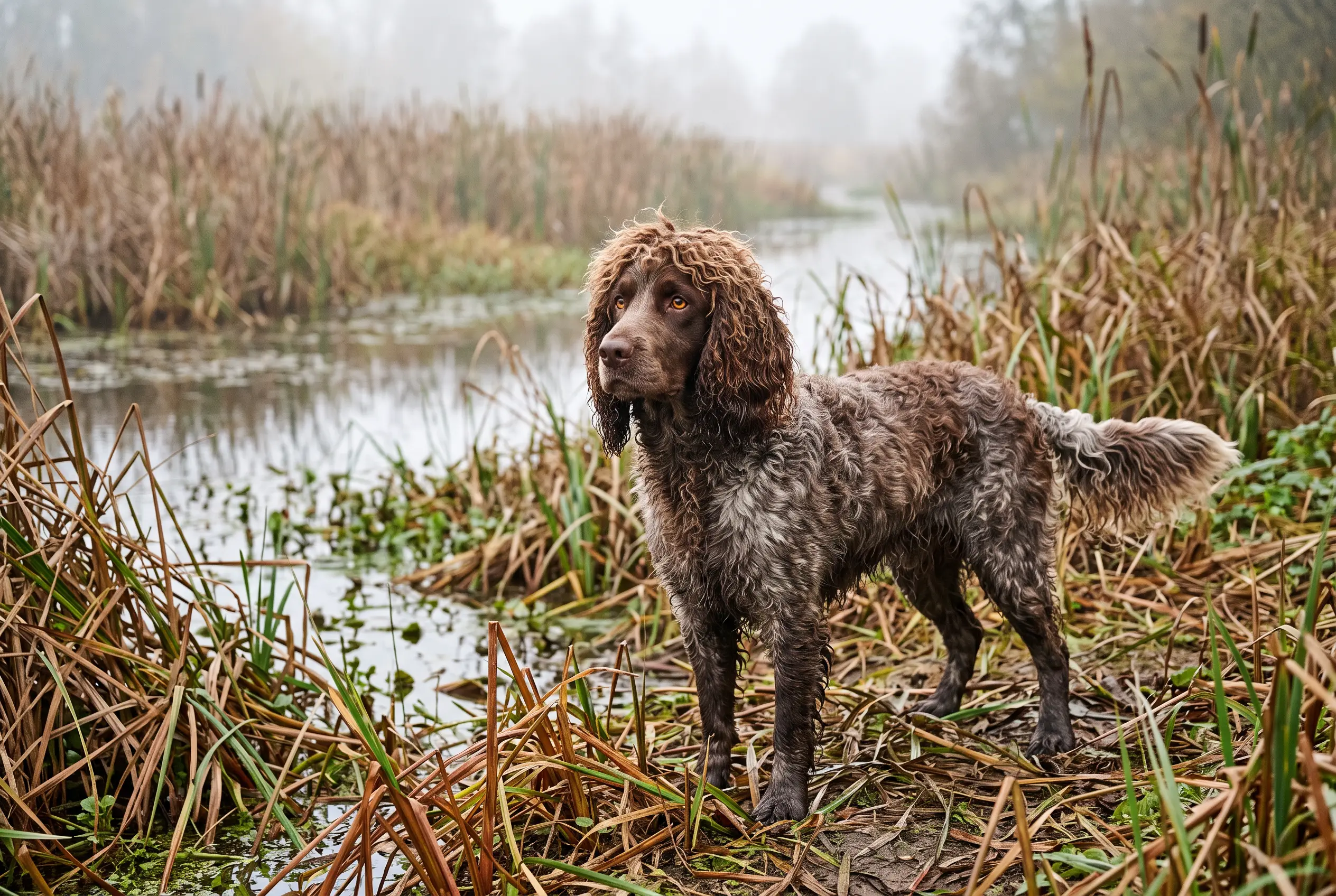
Pont-Audemer Spaniel
Normandy's curly marsh pointer, wearing its wig to work, and one of France's rarest dogs.
Vital stats
| Size | Medium · 52–58 cm, no sex split in the standard |
| Weight | 20–27 kg — breed literature; the standard sets none |
| Life expectancy | 12–14 years — breed literature, not survey data |
| Energy | High — bred to hunt marshland all day, happiest with water work |
| Shedding | Low — loose hair stays caught in the curl until combed out |
| Coat | Curly and slightly ruffled · brown, preferably brown and grey mottled, with dead-leaf glints |
| Group | Sporting · Continental Pointing Dogs, spaniel type (FCI №114, Group 7) |
| Origin | Normandy, France |
| FCI group | 7 — Pointing Dogs · FCI 114 |
Breed traits
Friendliness
Care
Mind
The Pont-Audemer Spaniel by the numbers
The Pont-Audemer Spaniel facts owners search for most — price, lifespan, weight, shedding and colours, in one place.
Less common, so expect a waitlist and some travel to a reputable breeder — which pushes the price up. Plan for steady ongoing costs — mid-range food, routine vet care and insurance. Its coat also needs a professional groom every few weeks — a real line in the budget.
We don't quote a single figure: the real price swings with breeder, region, bloodline and health testing — and a rescue costs a fraction of a breeder's litter. Adopting is almost always the cheapest route.
Temperament
The standard says almost nothing about character. It asks for a kind and frank expression in the eye, disqualifies aggressive or overly shy dogs, and stops there; everything else comes from the French breed club and hunting literature. That picture is consistent: a docile, affectionate dog, playful enough around children to have earned the nickname le petit clown des marais, and easy company on a walk or a hike. In the field the club describes a passionate water worker that quarters into the wind on its own judgement, points reliably, and retrieves from deep water without being taught. For a breed this small the honest move is to meet the parents of any litter rather than lean on reputation, but across sources the same dog keeps appearing — gentle in the house, serious in the reeds.
Habits & quirks
The wig is written down
The very curly topknot must sit on top of the skull and leave the forehead bare, and the long, low-set ears carry long silky curls that join it — the standard calls the result a beautiful curly wig really framing the head. A topknot that falls like a Poodle's is a fault.
Brown, with dead-leaf glints
One colour is allowed: brown, preferably brown and grey mottled, with glints the standard names after dead leaves. Black, black and white, and any tan markings are faults, and the nose must be brown — a black nose is faulted too.
Low-built, and not a Cocker
The standard wants the legs rather short and the dog rather low to the ground, then adds a warning in the same sentence: without falling into the Cocker type. The outline should stay that of a stocky, vigorous marsh worker.
The little clown of the marshes
The nickname, le petit clown des marais, comes from the club rather than the standard: a playful, affectionate dog around children, with its serious side saved for reeds and open water.
Care
| Exercise | A working pointer with a marsh dog's engine: plan an hour or two a day, and give it water whenever you can. Swimming, retrieving from water and long walks through rough ground work both the body and the nose; a lead walk on pavement works neither. |
| Grooming | Comb through the curls weekly to catch mats before they set, more often after marsh work, and rinse mud out rather than letting it dry in. Dry the long, curl-covered ears after every swim — a heavy drop ear that lives in water needs air. The coat drops little hair on its own; the loose hair waits in the curl for the comb. |
| Training | Club sources describe a willing dog that quarters and retrieves largely on instinct, so the job is polish rather than pressure: short reward-based sessions, early introduction to water, and a steady recall. A soft-natured gundog goes flat under harsh handling. |
| Health | There is no breed-wide health survey for a population this small. Alopecia has been reported in the breed, first appearing between seven and eighteen months, and a tiny gene pool makes pedigree diversity a real question — ask a breeder how a litter's parents are related and what the club advised on the pairing. |
Life expectancy
This breed has a typical life expectancy of 12–14 years — breed literature, not survey data.
Similar breeds
Breeds with a similar build and background — worth a look if this one isn't quite the fit.
Breeds that look like this
Common questions
How rare is the Pont-Audemer Spaniel?
Rare enough that it lost its own club: in 1980 the Société Centrale Canine had it merge with the Picardy Spaniel club because too few puppies were being born to sustain one. Only a few litters arrive each year, almost all in France. The breed came through both world wars close to extinction, and in 1949 the club president opened the breeding to water-spaniel crosses to rebuild it.
Is it related to the Irish Water Spaniel?
Probably, and possibly twice. Breed histories trace its curls to nineteenth-century crosses between local Normandy spaniels and water dogs, with the Irish Water Spaniel and the extinct English Water Spaniel both named as candidates, and when the breed needed rescuing in 1949 water-spaniel blood was brought in again. Sources disagree on exactly which water dog did what; the curls, the topknot and the love of deep water are the evidence either way.
Is it a spaniel or a pointer?
Both words are true in French and misleading in English. Épagneul is what France calls its continental pointing dogs, and the FCI files the breed in Group 7 with the pointers, spaniel type, with a working trial. It points and retrieves for a walking hunter; it does not flush game like an English Springer or a Cocker.
Does the Pont-Audemer Spaniel shed a lot?
Not much. The Pont-Audemer Spaniel is a low-shedding breed, so loose hair around the home stays minimal. It still needs regular grooming, but you won't be fighting drifts of fur.
Is the Pont-Audemer Spaniel hypoallergenic?
No dog is truly hypoallergenic, but the Pont-Audemer Spaniel comes closer than most: its low-shedding coat releases less of the dander that triggers allergies. Many allergy sufferers manage well with this breed, but spend time around one before committing.
Is the Pont-Audemer Spaniel good with children?
Generally yes. The Pont-Audemer Spaniel is a friendly, people-loving breed that usually does well with children when raised and socialised well. As with any dog, teach children to be gentle and supervise around toddlers.
Is the Pont-Audemer Spaniel easy to train?
Yes. The Pont-Audemer Spaniel is one of the more trainable breeds — quick to learn and keen to work with you, which makes reward-based training straightforward. Start early, keep it positive, and it picks things up fast.