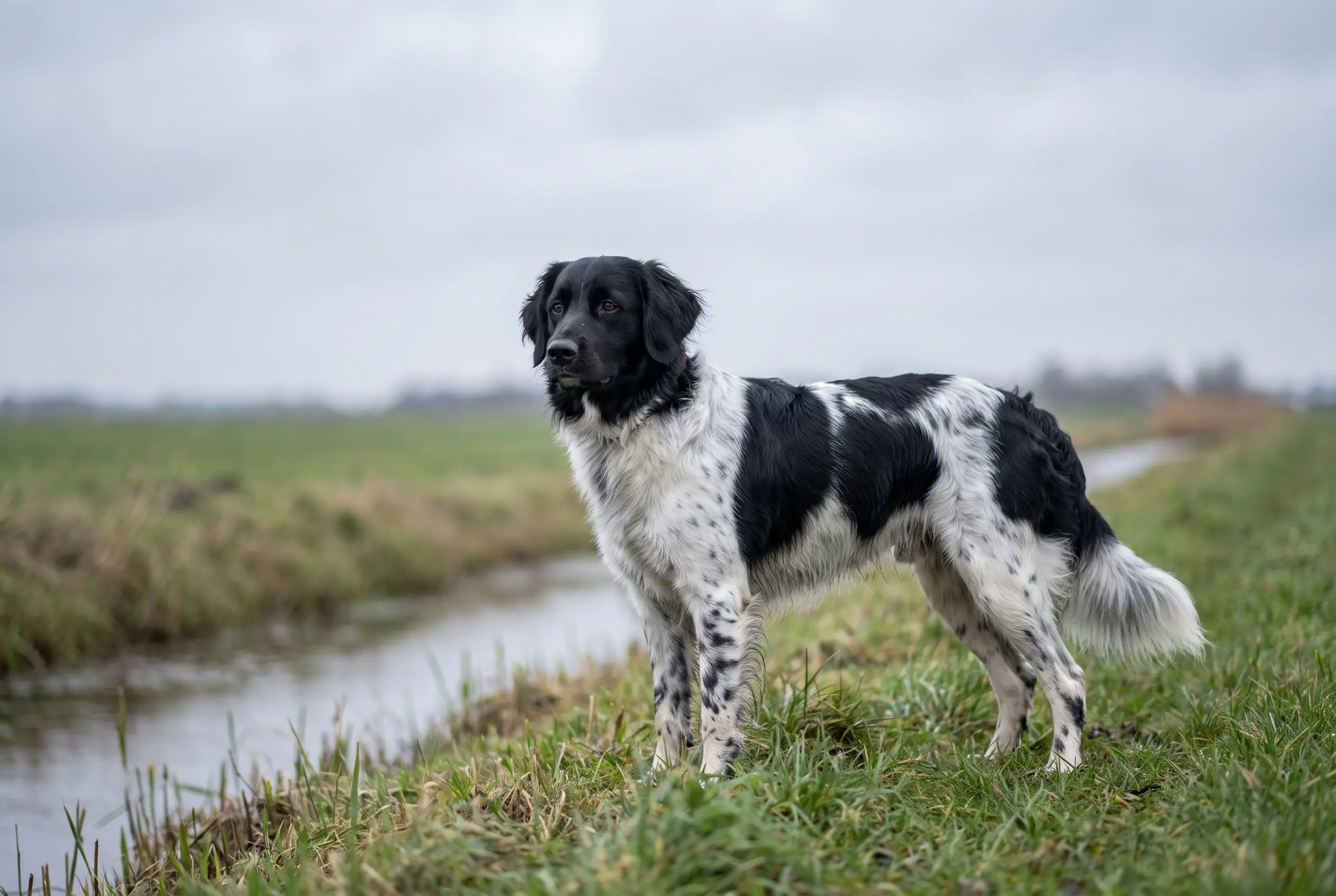
Stabyhoun
Its name means stand by me, and it does every job on a Frisian farm at once.
Vital stats
| Size | Medium · 50–53 cm (dogs), 48–50 cm (bitches) |
| Weight | 22–27 kg (dogs), 18–23 kg (bitches) — the standard's own figures |
| Life expectancy | 13–15 years — breed literature, not survey data |
| Energy | Moderate to high — an all-round hunting dog that settles indoors |
| Shedding | Moderate — sheds year-round with a heavier blow twice a year |
| Coat | Medium length, straight, weather-resistant undercoat · black or brown pied with white, never curly |
| Group | Sporting · Continental Pointing Dogs, Spaniel type (FCI №222, Group 7) |
| Origin | Friesland, Netherlands |
| FCI group | 7 — Pointing Dogs · FCI 222 |
Breed traits
Friendliness
Care
Mind
The Stabyhoun by the numbers
The Stabyhoun facts owners search for most — price, lifespan, weight, shedding and colours, in one place.
Less common, so expect a waitlist and some travel to a reputable breeder — which pushes the price up. Plan for steady ongoing costs — mid-range food, routine vet care and insurance.
We don't quote a single figure: the real price swings with breeder, region, bloodline and health testing — and a rescue costs a fraction of a breeder's litter. Adopting is almost always the cheapest route.
Temperament
The FCI standard's behaviour section reads like a warning label stapled to a compliment. In its own words, the Stabyhoun is very independent and likes to go his own way, and is affectionate but can also be very headstrong; patience and a consistent education are essential. At home that turns into a dog the standard calls quiet but vigilant, watching the yard rather than patrolling it loudly. With strangers or new situations it may be reserved at first, but should not be afraid, and the standard draws that line on purpose, since reserve and fear are not the same fault. It reads as gentle and attentive rather than eager to please, and it does best with a handler willing to negotiate rather than one expecting instant obedience.
Habits & quirks
Its name is an instruction
Stabijhoun comes from the Frisian sta mij bij, stand by me, plus houn, dog, pronounced roughly hoon. The standard credits the name to the breed's versatility: one dog for pointing, retrieving, ratting the yard and working the farm.
Two dogs, one job list
The standard describes a larger type that used to pull the milk cart and a smaller type that made its name catching moles, a skill valuable enough that moleskins were sold as linings for sleeve cuffs. Farmhands carried the dog out to the fields in a basket lashed to a bicycle.
The coat stays straight
Medium length, straight, with a weather-resistant undercoat and feathering at the chest, collar, legs and tail that reads as longhaired without the length. A curly coat disqualifies outright, astrakan being the standard's own word for the fault.
The tail stays down
Carried low, reaching to the hock, with only the last third lifting at rest or on point. During movement it rises above the topline with a slight bow, but a spiral tail is a severe fault and a kinked one disqualifies.
Care
| Exercise | An hour or more of real work a day: pointing, retrieving, scent work, or a run through cover. It's built for a full day's hunting and a long list of farm jobs, and settles calmly indoors once the work is done. |
| Grooming | Comb through the feathering on chest, collar, legs and tail weekly, more often during the two seasonal moults. The coat is meant to stay straight and weather-resistant rather than styled long; the standard is explicit that curl is a fault, so skip anything that encourages it. |
| Training | The standard's own advice is patience and consistent education. It's independent enough to decide for itself whether a command is worth following right now, so keep sessions short, fair and worth the dog's while rather than a contest of wills. |
| Health | Buy from a breeder who runs the NVSW's DNA test for cerebral dysfunction, an inherited condition identified in the breed; affected puppies fail to thrive and are usually euthanised within a few months, and the test has been mandatory for breeding dogs since 2015. Hip and elbow screening are standard practice too. The Dutch club also caps inbreeding at 10% over four generations and limits how often and how young dogs may breed, rules built for a population that numbers in the low thousands. |
Life expectancy
This breed has a typical life expectancy of 13–15 years — breed literature, not survey data.
Similar breeds
Breeds with a similar build and background — worth a look if this one isn't quite the fit.
Breeds that look like this
Common questions
Is the Stabyhoun the same dog as the Wetterhoun?
No, related but bred apart on purpose. Both come from the same corner of Friesland, and early in the twentieth century breeders crossed them so often that the two types blurred together; a group at the Kynologenclub Friesland began sorting them back out in 1938, and both were officially recognised as separate breeds in 1942. Today the standards pull them in opposite directions: the Stabyhoun (FCI No. 222, Group 7) has a straight coat and a tail that must stay down, where a spiral tail is a severe fault, while the Wetterhoun (FCI No. 221, Group 8) is built around greasy curls and a tail that spirals by design. The Stabyhoun points and retrieves on land; the Wetterhoun hunts otter in the water and guards the yard.
How rare is a Stabyhoun, really?
Rare enough that the breed club runs the gene pool like a shared resource. The FCI standard's own count, from 2013, puts the world population at a bit over 6,000 dogs, most still in the Netherlands. The Dutch club, the NVSW, caps inbreeding on any planned litter at 10% across four generations, limits a bitch to five litters and a stud to ten matings in a lifetime, and requires a DNA test for a hereditary cerebral condition before approving a breeding. Outside the Netherlands, a waiting list is normal.
Are Stabyhouns good family dogs?
For a family with time for a real hunting dog, yes. The standard calls it affectionate at home and quiet but vigilant, good with the yard and, by most breed accounts, easy with children it's raised alongside. The catch is the same temperament that makes it a working dog in the first place: independent, occasionally headstrong, and reserved with strangers until it decides otherwise. It wants training that respects that rather than fights it.
Does the Stabyhoun shed a lot?
Moderately. The Stabyhoun sheds a fair amount, steadily through the year with heavier seasonal patches. A weekly brush keeps most of the loose hair off your floors and clothes.
Is the Stabyhoun hypoallergenic?
Not really. No dog is truly hypoallergenic, and the Stabyhoun's shedding coat releases plenty of the dander that sets off allergies. If someone at home is allergic, this isn't the easiest breed to live with — spend time around one first.
Is the Stabyhoun easy to train?
Reasonably. The Stabyhoun is trainable with consistency and rewards, though it isn't the quickest study. Keep sessions short and positive, and be patient with the basics like recall.