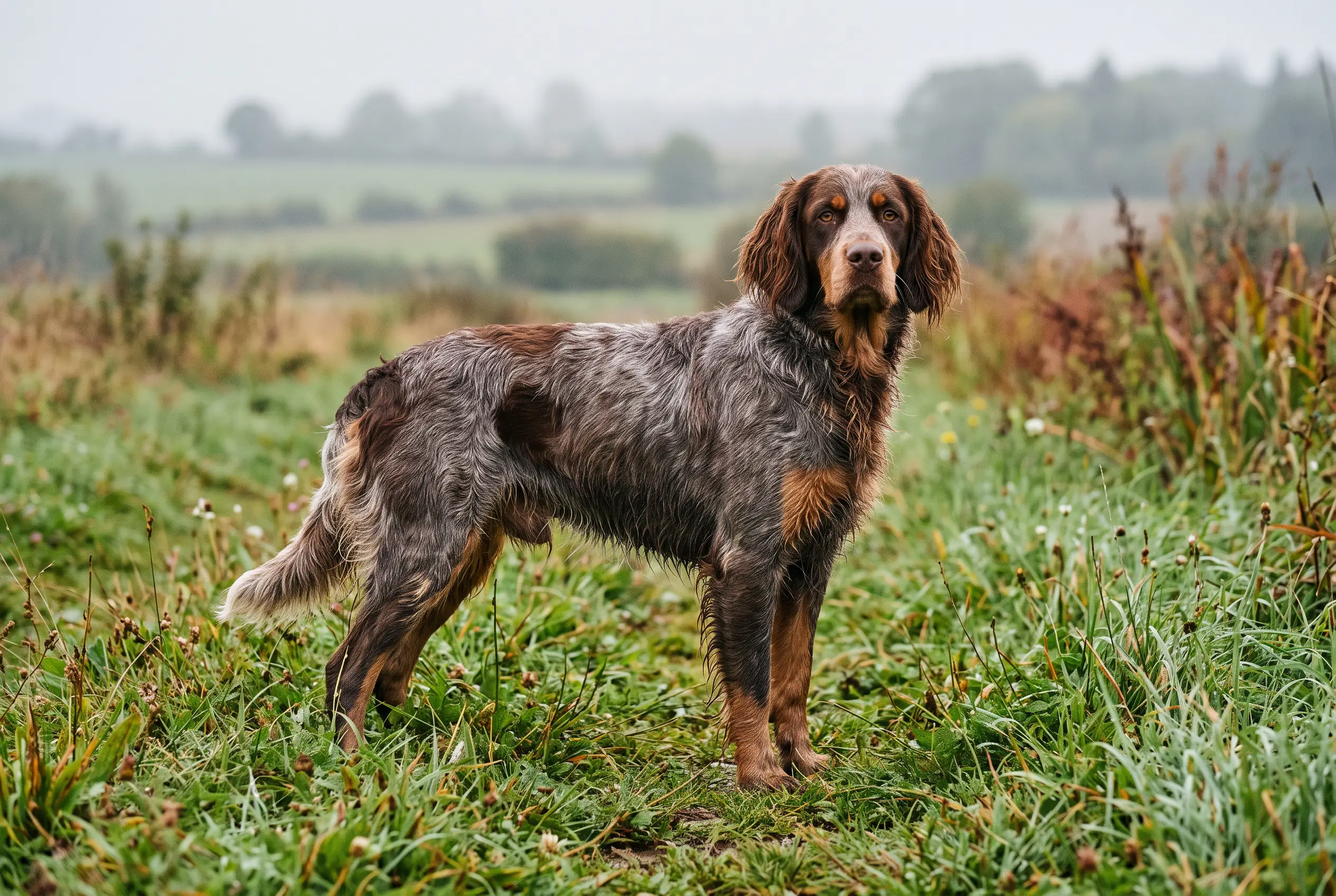
Picardy Spaniel
Picardy's original gundog, mottled brown and grey — older than its Blue cousin, and just as devoted to the kids.
Vital stats
| Size | Medium · 57–62 cm (dogs), 55–60 cm (bitches) |
| Weight | 20–25 kg — breed literature; the standard sets none |
| Life expectancy | 12–14 years — breed literature, not survey data |
| Energy | High — the standard prescribes a daily walk to work it off |
| Shedding | Moderate — a weekly brush keeps ahead of it |
| Coat | Dense, slightly wavy, feathered · grey mottling patched brown and tan ('autumn leaves') |
| Group | Sporting · Continental Pointing Dogs, Spaniel type (FCI №108, Group 7) |
| Origin | Picardy, France |
| FCI group | 7 — Pointing Dogs · FCI 108 |
Breed traits
Friendliness
Care
Mind
The Picardy Spaniel by the numbers
The Picardy Spaniel facts owners search for most — price, lifespan, weight, shedding and colours, in one place.
Less common, so expect a waitlist and some travel to a reputable breeder — which pushes the price up. Plan for steady ongoing costs — mid-range food, routine vet care and insurance.
We don't quote a single figure: the real price swings with breeder, region, bloodline and health testing — and a rescue costs a fraction of a breeder's litter. Adopting is almost always the cheapest route.
Temperament
The standard's behaviour clause is short and plain: a flexible and gentle dog, with an even temperament, well adapted to family life. Its history section adds the specific case owners actually care about — a real kid lover, it will happily join in their games without ever outplaying them, a rare thing for an FCI text to put in writing. The other half of the same page calls it an athletic dog that enjoys a daily walk in order to work off its energy, and that half is not optional: this is a working gundog judged with a trial, carrying a sense of smell the standard calls legendary. Expression is meant to read as frank and friendly, with dark amber eyes well opened; a light or undersized eye counts as a severe fault, which tells you the standard treats an honest, soft look as part of the breed's character, not just its looks.
Habits & quirks
A brown nose, never a black one
The nose must be brown, medium-sized and nicely rounded, with the colour of the nostrils, eyelid rims and other natural orifices matching the coat; any colour but brown, or a largely flesh-coloured nose, is a severe fault. It is one of the clearest ways to tell this breed apart on sight from its Blue Picardy cousin, whose standard calls for black.
An 'autumn leaves' coat
The colour section describes grey mottling patched with dark brown, most often marked with tan on the head and legs — a look breed tradition names 'autumn leaves.' White or black patches disqualify; grey and brown, blended, are the only story the coat is allowed to tell.
Teeth are counted, not just checked
The standard disqualifies a dog missing one canine, two incisors, or more than two other teeth — premolars or molars — with the first premolar and last molar excepted. Few breed standards spell out dental bookkeeping this precisely.
A slight tilt at the gallop
Movement should be easy, supple, even and strong, yet elegant, with the legs staying within the body line so the topline doesn't bounce. The one exception is written in on purpose: at a gallop, the standard wants a slight tilting movement in the topline, not the dead-flat back some judges expect elsewhere.
Care
| Exercise | The standard calls a daily walk necessary to work off an athletic dog's energy, and behind that mild phrasing is a gundog built to hunt marsh, wood and hedgerow from morning on. An hour of real walking, with scent work or retrieving folded in, suits it better than a lap around the block. |
| Grooming | A weekly brush through the wavy body coat and the feathering on legs, chest and tail keeps mats from forming, and the coat often carries an undercoat that needs extra attention through the moults. The ears, framed in silky hair long enough to reach the nose when drawn forward, want a regular check and a dry after any wet work. |
| Training | Breed literature and the standard agree here: docile, biddable and easy to educate, even for a first-time owner. Keep sessions reward-based rather than forceful — the standard prizes a frank, friendly expression and a gentle temperament, and heavy-handed correction works against both. |
| Health | Breed literature reports no widely recognised hereditary problems, though pendulous ears carry the usual infection risk shared by most spaniel-type gundogs. There is no breed-wide health survey behind that claim, and the population outside France is thin enough that pedigree depth is worth asking a breeder about. |
Life expectancy
This breed has a typical life expectancy of 12–14 years — breed literature, not survey data.
Similar breeds
Breeds with a similar build and background — worth a look if this one isn't quite the fit.
Breeds that look like this
Common questions
Is the Picardy Spaniel the same as the Blue Picardy Spaniel?
Related but distinct. Both breeds' FCI histories answer this the same way, in one line: the main difference between the two Picardy breeds is the colour of the coat. This one carries grey mottling patched with brown and tan (FCI No. 108); the Blue carries a denser grey-black speckle that reads blue at a distance (FCI No. 106) and disqualifies any brown patch. The Picardy Spaniel is also the older of the two — the Blue split off after English Setter blood was worked into some local lines, and breed literature has the two breed clubs merging as late as 1937.
Is it a spaniel or a pointer?
Neither in the English sense, and both, functionally. The FCI classifies it as a continental pointing dog of 'Spaniel' type: it points and holds game rather than flushing and retrieving the way an English Springer does, and its own general-appearance clause even describes it as a Continental spaniel-type dog, 'Braque' in French. The working trial in its FCI classification reflects that pointing role.
Are Picardy Spaniels good family dogs?
The standard makes the case almost affectionately: a flexible and gentle dog with an even temperament, well adapted to family life, and a real kid lover who joins children's games without ever outplaying them. The trade-off is the one every working gundog carries — the daily walk is not optional, and a nose the standard calls legendary wants a job, not just a stroll around the block.
Does the Picardy Spaniel shed a lot?
Moderately. The Picardy Spaniel sheds a fair amount, steadily through the year with heavier seasonal patches. A weekly brush keeps most of the loose hair off your floors and clothes.
Is the Picardy Spaniel hypoallergenic?
Not really. No dog is truly hypoallergenic, and the Picardy Spaniel's shedding coat releases plenty of the dander that sets off allergies. If someone at home is allergic, this isn't the easiest breed to live with — spend time around one first.
Is the Picardy Spaniel easy to train?
Yes. The Picardy Spaniel is one of the more trainable breeds — quick to learn and keen to work with you, which makes reward-based training straightforward. Start early, keep it positive, and it picks things up fast.