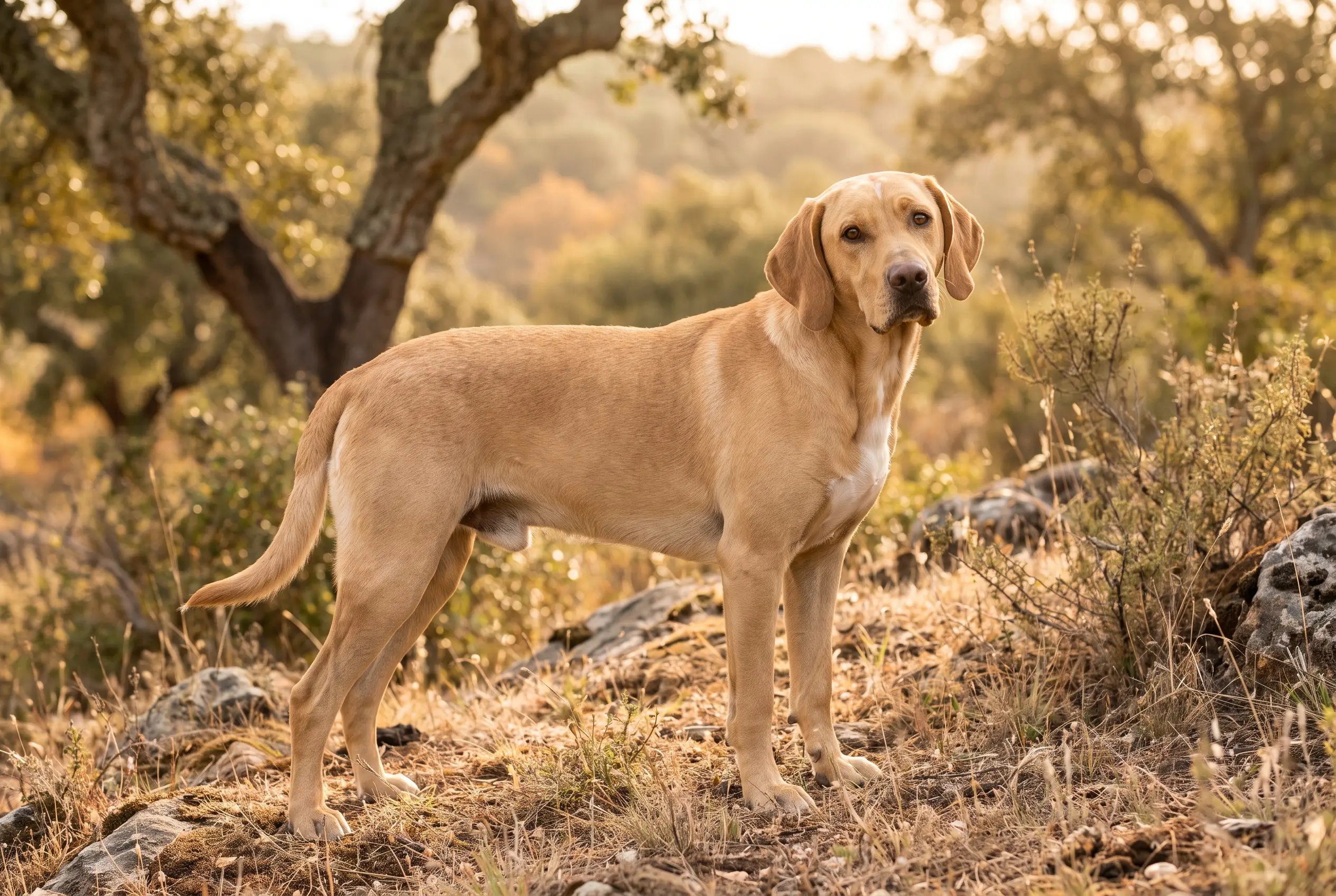
Portuguese Pointer
Portugal's partridge dog, built to hunt close to the gun instead of the horizon.
Vital stats
| Size | Medium · 52–60 cm (dogs), 48–56 cm (bitches) |
| Weight | 20–27 kg (dogs), 16–22 kg (bitches) |
| Life expectancy | 12–14 years — breed literature, not survey data |
| Energy | High — built for a full day's hunting at gallop or trot |
| Shedding | Low to moderate — short coat, no undercoat |
| Coat | Short, hard, close, dense · yellow (light to dark), solid or white-patched |
| Group | Sporting · Continental Pointing Dogs, braque type (FCI №187, Group 7) |
| Origin | Portugal |
| FCI group | 7 — Pointing Dogs · FCI 187 |
Breed traits
Friendliness
Care
Mind
The Portuguese Pointer by the numbers
The Portuguese Pointer facts owners search for most — price, lifespan, weight, shedding and colours, in one place.
Less common, so expect a waitlist and some travel to a reputable breeder — which pushes the price up. Plan for steady ongoing costs — mid-range food, routine vet care and insurance.
We don't quote a single figure: the real price swings with breeder, region, bloodline and health testing — and a rescue costs a fraction of a breeder's litter. Adopting is almost always the cheapest route.
Temperament
The standard's own words carry the breed: "Extremely kind and affectionate, hardy, capable of great endurance and devotion. Calm and very sociable, but somewhat haughty towards other dogs. Curious by nature, works with persistence and vivacity. Always a keen hunting dog that stays in close contact with the hunter." That closing line is the part that matters at home — this isn't a pointer that disappears over the hill chasing scent and forgets you exist; it hunts with one eye on its person, and the habit carries over to the house. The haughtiness toward other dogs is specific and worth taking seriously if you already have a pack: cordial with people by nature, not automatically friendly with strange dogs.
Habits & quirks
Close to the gun, not the horizon
The standard's behaviour clause ends on one specific line: it 'stays in close contact with the hunter.' Unlike wide-ranging continental pointers bred to work far out, this one is built to hunt within sight of its handler.
Cordial with people, cool with dogs
The same clause calls it 'calm and very sociable' with people but 'somewhat haughty towards other dogs' — a caveat written into the standard itself, not a generic warning. Introduce it to resident dogs deliberately rather than assuming instant friendliness.
Yellow, patched or plain, and nothing else
Coat colour is yellow in light, medium or dark shades, solid or with white confined to the head, neck, chest, lower legs and tail tip. Any other colour, including albinism, disqualifies outright — the standard leaves no grey area.
A Portuguese breed with an English standard
The FCI paperwork for this breed lists its official language as English, not Portuguese — translated by the Portuguese Kennel Club and revised by two English-speaking editors. Most non-English-speaking countries keep their own language as the FCI original; Portugal did it the other way round for this one.
Care
| Exercise | Built for a full day in the field, switching between a suspension gallop and an easy, rhythmic trot — plan on real daily exercise, not a lead-walk round the block. Hunting, scent work, field trials or long off-lead time on rough ground all suit a dog the standard itself calls capable of great endurance. |
| Grooming | The coat is short, hard and without undercoat, so a weekly brush is usually enough. Check the hanging, triangular ears after time in cover — folded ears trap moisture and debris more than a pricked ear would. |
| Training | The standard calls it curious, persistent and vivacious, with a hunting drive that stays close to the handler rather than ranging off independently — that partnership instinct makes early, consistent training more straightforward than with wider-ranging pointer breeds. The same curiosity needs somewhere to go, or it invents its own entertainment. |
| Health | Breed literature reports no widely recognised breed-specific problems, and there's no breed-wide health survey behind the commonly quoted 12–14 years. The population outside Portugal is small, so ask breeders about hip and eye screening as sensible practice for any medium-sized working gundog, not a documented requirement of a scheme specific to this breed. |
Life expectancy
This breed has a typical life expectancy of 12–14 years — breed literature, not survey data.
Similar breeds
Breeds with a similar build and background — worth a look if this one isn't quite the fit.
Breeds that look like this
Common questions
Did the Portuguese Pointer help create the English Pointer?
Breed literature repeats this more often than it proves it. The most common account has Spanish and Portuguese pointing dogs reaching England around 1713, brought home by soldiers after the Peace of Utrecht, and folded into the stock that became the English Pointer (FCI №1). Even William Arkwright's own 1902 history of the breed, after working through the evidence, called it "the most likely history" rather than a settled one — other early sources credit Italian braccos or French pointers instead, and pointing-dog types crossed borders freely before anyone wrote standards down. Treat it as the leading theory, not a fact either breed's FCI standard states outright.
Are Portuguese Pointers good family dogs?
The standard itself calls the breed extremely kind and affectionate, calm and very sociable — strong language for an FCI temperament clause. The condition is exercise: this is a hunting dog built for a full working day, and a bored one finds its own project. It's also 'somewhat haughty towards other dogs' by the standard's own wording, so plan introductions to resident dogs with that in mind rather than assuming instant friendliness.
Does the Portuguese Pointer have a docked tail?
The standard allows either: a natural tail of medium length that doesn't reach past the hock, or a docked one left just long enough to cover the genitals. Docking is now restricted or banned across much of Europe on welfare grounds, so most dogs bred there today keep the natural tail the standard also describes in full — carried level or slightly above the topline, never upright or curled.
Does the Portuguese Pointer shed a lot?
Moderately. The Portuguese Pointer sheds a fair amount, steadily through the year with heavier seasonal patches. A weekly brush keeps most of the loose hair off your floors and clothes.
Is the Portuguese Pointer hypoallergenic?
Not really. No dog is truly hypoallergenic, and the Portuguese Pointer's shedding coat releases plenty of the dander that sets off allergies. If someone at home is allergic, this isn't the easiest breed to live with — spend time around one first.
Is the Portuguese Pointer easy to train?
Reasonably. The Portuguese Pointer is trainable with consistency and rewards, though it isn't the quickest study. Keep sessions short and positive, and be patient with the basics like recall.