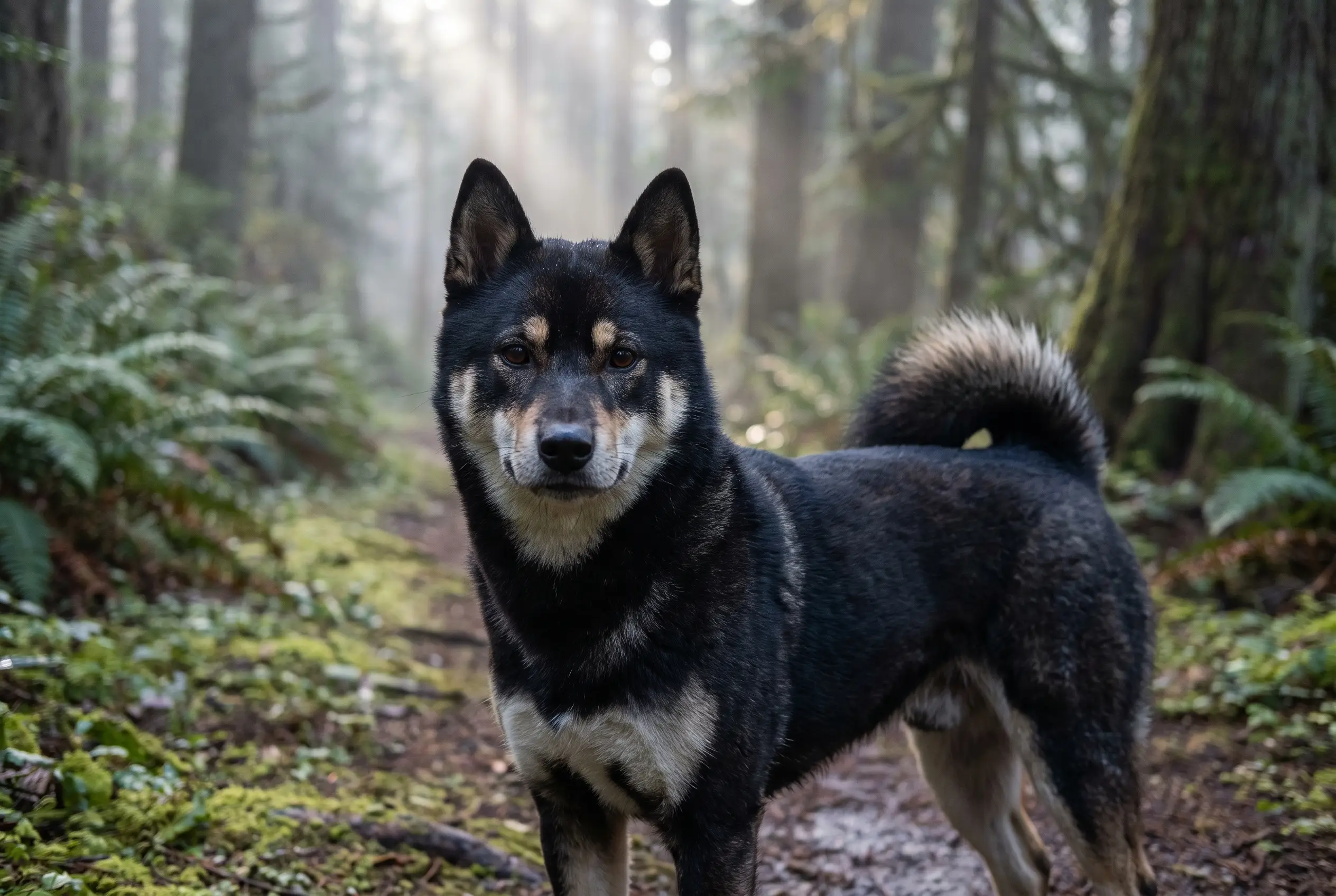
Shikoku
The boar hound of Japan's mountains, rare even at home.
Vital stats
| Size | Medium · 43–55 cm |
| Weight | 16–25 kg |
| Life expectancy | 12–14 years |
| Energy | High — bred to work steep ground all day |
| Shedding | High in season — two heavy moults a year |
| Coat | Dense double coat · sesame, black sesame or red sesame, with urajiro |
| Group | Non-Sporting · Asian Spitz (FCI №319, Group 5) |
| Origin | Shikoku island, Japan |
| FCI group | 5 — Spitz and primitive types · FCI 319 |
Breed traits
Friendliness
Care
Mind
The Shikoku by the numbers
The Shikoku facts owners search for most — price, lifespan, weight, shedding and colours, in one place.
Less common, so expect a waitlist and some travel to a reputable breeder — which pushes the price up. Plan for steady ongoing costs — mid-range food, routine vet care and insurance.
We don't quote a single figure: the real price swings with breeder, region, bloodline and health testing — and a rescue costs a fraction of a breeder's litter. Adopting is almost always the cheapest route.
Temperament
The Shikoku is a hunter first: keen, enduring, agile on ground that would stop most dogs, and quick to lock onto anything that moves like game. At home it is calmer than its job suggests — attached to its owner, more willing to cooperate than the Shiba, and quiet unless something is worth saying. With strangers it stands back and watches; the standard asks for wariness without fear, and a well-raised one delivers exactly that. What it never becomes is a dog that obeys for the sake of obeying. It works with you when the relationship is good, and files your request for later when it is not. Same-sex sharpness with other dogs is common and worth planning around.
Habits & quirks
Built for the climb
Steep rocks, fallen trees, a fence you thought was tall enough — mountain boar hounds treat vertical ground as a path, not an obstacle.
Eyes on the treeline
On a walk it scans constantly, and a deer trail or a rustle in the brush can take its whole attention in a second. That focus is the working dog surfacing.
One-person weather report
It tracks its owner's mood and location through the day and settles nearby — closer-bonded than the Shiba, without being clingy about it.
Picks its dog company
Many Shikoku are fine with familiar dogs and short-tempered with same-sex strangers. Careful introductions beat dog-park optimism.
Care
| Exercise | An hour or two of real work a day — hikes, jogging, nose work, drag lines in open country. A leash or a proven recall is non-negotiable where game lives. |
| Grooming | Brush the double coat weekly, then daily through the two big moults, when the undercoat comes out in handfuls. Baths are rarely needed. |
| Training | It learns fast and bores faster. Short, varied, reward-based sessions from puppyhood, heavy early socialisation, and no drilling — repetition it sees no point in gets ignored. |
| Health | A robust breed overall. Screen breeding stock for hip dysplasia, patellar luxation and eye disease; skin allergies turn up in some lines. |
Life expectancy
This breed has a typical life expectancy of 12–14 years.
Similar breeds
Breeds with a similar build and background — worth a look if this one isn't quite the fit.
Breeds that look like this
Common questions
How is a Shikoku different from a Shiba Inu?
Size and job. The Shikoku stands 43–55 cm — a head taller than the Shiba — and was kept as a working boar hound rather than a small-game hunter and companion. It bonds more closely to its owner and takes training somewhat better, but it carries more drive: more stamina, more prey focus, more dog to manage on a walk.
Are Shikoku really that rare?
Yes. Japan's own registry records only a few hundred puppies a year, and the breed is scarcer still abroad — most countries have a handful of breeders and waiting lists measured in years. Meeting one at all usually means someone planned it.
Can a Shikoku live with cats or other dogs?
Sometimes, with honest expectations. Raised together from puppyhood, many live peacefully with the family cat and familiar dogs. But the prey drive never uninstalls — outdoor cats and small pets stay at risk — and same-sex pairs of strangers are the most common friction point.
Does the Shikoku shed a lot?
Yes — the Shikoku is a heavy shedder, dropping hair year-round or in big seasonal moults. Brush it several times a week and expect regular vacuuming; it isn't the coat for you if loose fur is a dealbreaker.
Is the Shikoku hypoallergenic?
Not really. No dog is truly hypoallergenic, and the Shikoku's shedding coat releases plenty of the dander that sets off allergies. If someone at home is allergic, this isn't the easiest breed to live with — spend time around one first.
Is the Shikoku good with children?
They can be. The Shikoku is reasonably sociable and can be good with children in the right home, especially when socialised early. Supervise around young kids and teach dog and child to respect each other.
Is the Shikoku easy to train?
Reasonably. The Shikoku is trainable with consistency and rewards, though it isn't the quickest study. Keep sessions short and positive, and be patient with the basics like recall.