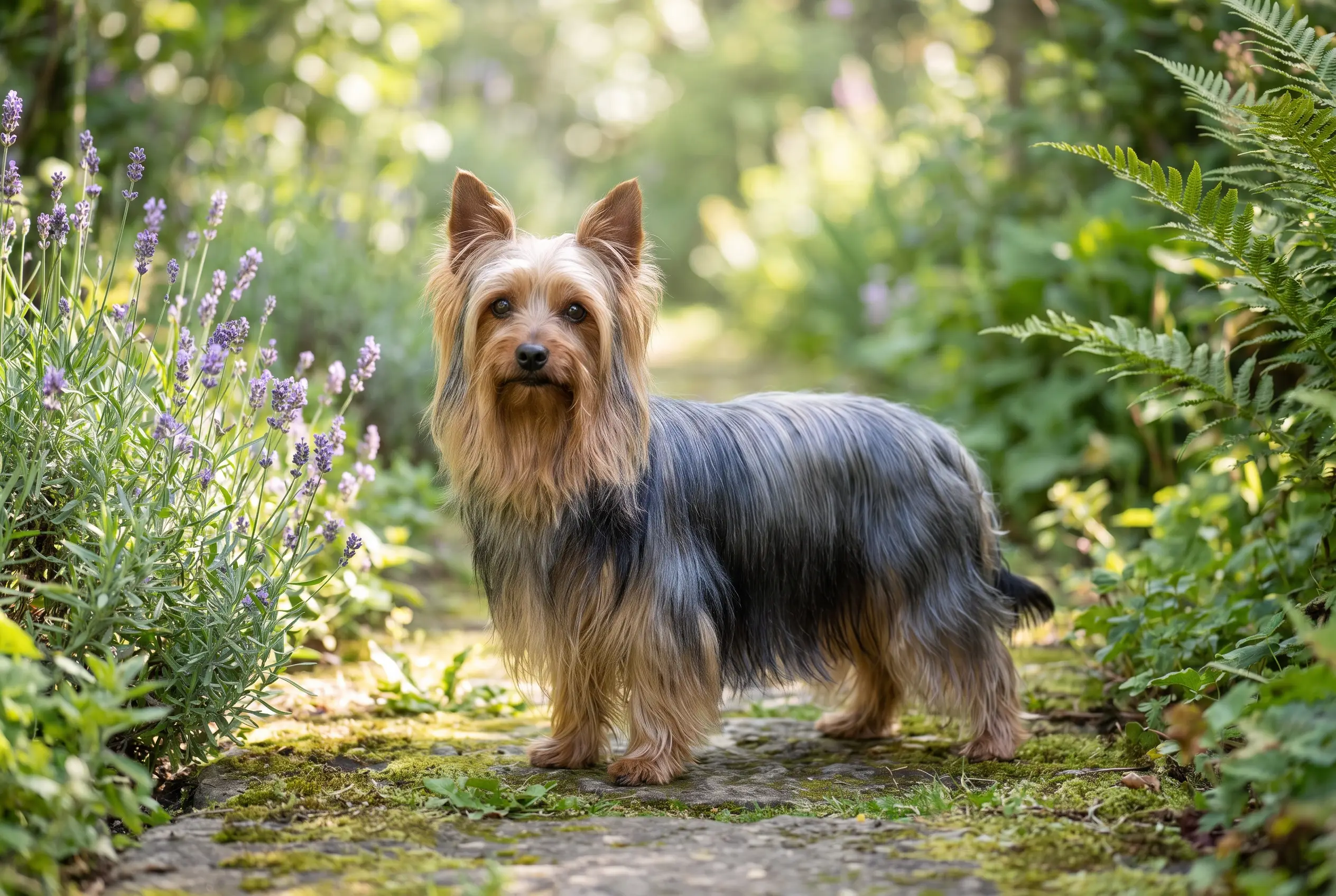
Silky Terrier
A working terrier in an evening gown.
Vital stats
| Size | Toy · 23–26 cm |
| Weight | 3.5–4.5 kg |
| Life expectancy | 13–15 years |
| Energy | Moderate — 45 min/day |
| Shedding | Very low |
| Coat | Long, silky single coat · blue and tan |
| Group | Toy · FCI №236 / AKC |
| Origin | Sydney, Australia |
| FCI group | 3 — Terriers · FCI 236 |
Breed traits
Friendliness
Care
Mind
The Silky Terrier by the numbers
The Silky Terrier facts owners search for most — price, lifespan, weight, shedding and colours, in one place.
Widely bred, so you can usually find a litter from a registered breeder without a long wait. Ongoing costs stay modest — it eats little and routine vet care sits at the lower end. Its coat also needs a professional groom every few weeks — a real line in the budget.
We don't quote a single figure: the real price swings with breeder, region, bloodline and health testing — and a rescue costs a fraction of a breeder's litter. Adopting is almost always the cheapest route.
Temperament
Created in Sydney by crossing Yorkshire and Australian Terriers, the Silky inherited glamour from one parent and a vermin-hunting job from the other. The result is a quick, confident little dog that patrols windowsills, announces visitors, and would rather investigate a rustle in the hedge than sit prettily on a cushion. That single silky coat is the trade-off: it drops very little hair, which is why the breed suits homes that can't cope with shedding, but it mats behind the ears and under the legs without a brush two or three times a week. The terrier half shows up in the garden and on walks — a Silky off-lead near squirrels is a Silky making its own decisions, and a bored one digs. Training works best in short sessions paid in food; repetition loses it fast, and the barking is far easier to shape at twelve weeks than at two years.
Habits & quirks
Window sentry
Every passing dog, cat and delivery van is logged and announced.
Flowerbed forensics
Something rustled there once; the investigation remains open.
Velcro with dignity
Follows you room to room, then pretends it was heading that way anyway.
The pounce
Anything small and fast-moving flips an ancient switch — leaves included.
Care
| Grooming | Brush every day or two and part the coat down the spine; many pet owners opt for a shorter trim. |
| Exercise | A brisk daily walk plus play — this is a toy dog with a terrier's engine. |
| Barking | Teach a quiet cue early; the watchdog instinct is enthusiastic. |
| Containment | Secure the garden — small prey will be chased without a second thought. |
Life expectancy
This breed has a typical life expectancy of 13–15 years.
Similar breeds
Breeds with a similar build and background — worth a look if this one isn't quite the fit.
Breeds that look like this
Common questions
Is a Silky Terrier the same as a Yorkie?
No — the Silky is a separate Australian breed, slightly larger and heavier-boned than the Yorkshire Terrier that helped create it. The temperament is more thoroughly terrier, too.
Do Silky Terriers shed?
Barely — the single coat behaves like human hair and drops very little. It tangles instead, so regular brushing is non-negotiable.
Are Silky Terriers good with children?
Good with respectful older children who match their playful energy. They're small enough to be injured by rough toddler handling, so supervise closely.
Is the Silky Terrier hypoallergenic?
No dog is truly hypoallergenic, but the Silky Terrier comes closer than most: its low-shedding coat releases less of the dander that triggers allergies. Many allergy sufferers manage well with this breed, but spend time around one before committing.
Is the Silky Terrier easy to train?
Reasonably. The Silky Terrier is trainable with consistency and rewards, though it isn't the quickest study. Keep sessions short and positive, and be patient with the basics like recall.