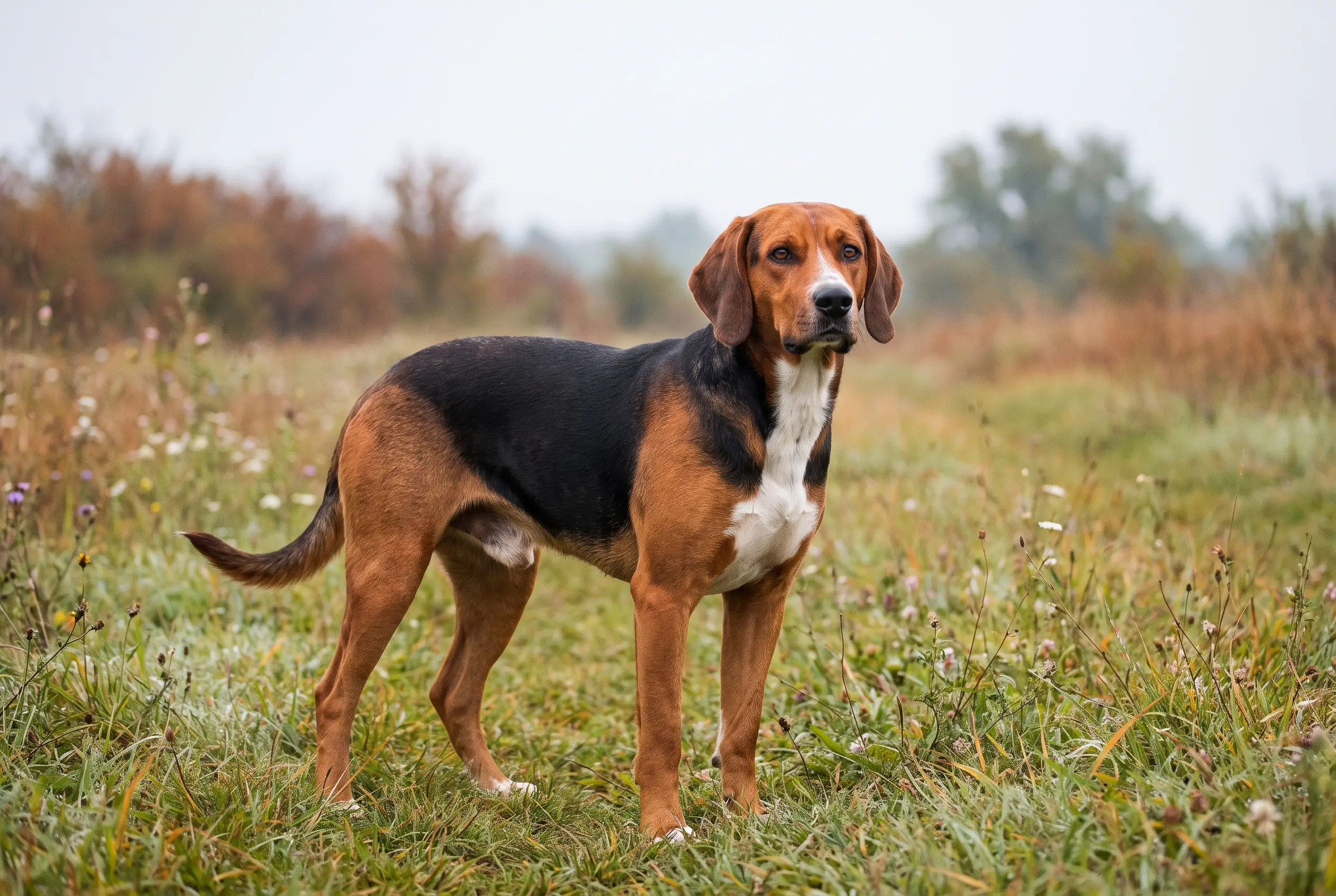
Srpski Trobojni Gonič
The tricolour cousin of the Serbian Hound, split off in 1946 over a question of colour.
Vital stats
| Size | Medium · 45–55 cm (males), 44–54 cm (females) |
| Weight | 20–25 kg — breed literature; the standard sets none |
| Life expectancy | 10–12 years — breed literature, not survey data |
| Energy | High — 1–2 hrs/day, scent work and real ground |
| Shedding | Moderate — short coat, heavier in seasonal moults |
| Coat | Short, dense, glossy · deep red with black mantle and white markings |
| Group | Hound · Medium-sized Hounds (FCI №229, Group 6) |
| Origin | Serbia |
| FCI group | 6 — Scent hounds and related breeds · FCI 229 |
Breed traits
Friendliness
Care
Mind
The Srpski Trobojni Gonič by the numbers
The Srpski Trobojni Gonič facts owners search for most — price, lifespan, weight, shedding and colours, in one place.
Less common, so expect a waitlist and some travel to a reputable breeder — which pushes the price up. Plan for steady ongoing costs — mid-range food, routine vet care and insurance.
We don't quote a single figure: the real price swings with breeder, region, bloodline and health testing — and a rescue costs a fraction of a breeder's litter. Adopting is almost always the cheapest route.
Temperament
The standard's own behaviour clause is short and specific: "Devoted, kind, lively temperament; dependable, showing remarkable tenacity." That last word does real work — bred to hold a scent trail for hours over difficult ground, this is not a dog that gives up on a task easily, in the field or in the house. Breed sources describe it as gentle with its own household and openly friendly toward visitors, more a watchful presence than a guard, which tracks with the standard's own disqualification of any dog that is aggressive or overly shy. Training asks for patience rather than force: hound literature calls it an eager but occasionally obstinate learner, food-motivated and quick to shut down under a heavy hand.
Habits & quirks
Split from its cousin over colour
The standard's own history section puts it plainly: in 1946 the idea that this dog was just a colour variant of the Serbian Hound (FCI №150) was rejected, and it was given breed status and a standard of its own. The Serbian Hound's standard disqualifies any white beyond a single 2 cm spot on the chest; the Trobojni Gonič runs the other way — white markings are not just tolerated, they are written into the description.
White, but only up to a third
The standard spells out exactly where white is allowed — a star and blaze on the head, a full or partial collar at the throat, a chest patch that can reach the belly and insides of the legs, a white tail tip — and exactly where it stops: more than a third of the total body surface, or any white patch speckled with the base colour, disqualifies outright.
Black to the temples
The black mantle running down the back is allowed to climb all the way to the head, where the standard calls for black marks on the temples. Nose, lip edges and nails are all supposed to run black too — the coat's dark half is held to nearly the same discipline as its lighter half.
Built to a set of percentages
The proportions section reads almost like a formula: body length 10% greater than height at the withers, head length equal to 45% of that height, chest girth 20% greater again. It is one of the more numerically precise standards in the hound group, and a judge can check most of it with a tape measure.
Care
| Exercise | This is a pack hound bred to trail hare, fox, deer and wild boar across rough Balkan ground for hours, and it keeps that appetite at home. Plan on 1–2 hours a day of real activity — off-lead country walks, scent games, tracking work — rather than a lead-only stroll around the block; breed sources report boredom turning into barking and chewed furniture fast. |
| Grooming | The short, dense coat needs a weekly brush and little else; it is close to self-cleaning, and bathing is rarely necessary outside a muddy hunt. Check the drop ears regularly, since pendulous ears on a working scent hound trap moisture and dirt more easily than upright ones. |
| Training | Breed sources describe average trainability with a real hound stubborn streak — eager to learn, food-motivated, and quick to disengage from a heavy-handed approach. Short, reward-based sessions and early socialisation suit it better than repetition drills; the nose will win most arguments unless recall is worked on from puppyhood. |
| Health | The standard says nothing about health beyond requiring functionally sound, typical dogs for breeding, and there is no breed-wide survey behind the 10–12 years usually quoted. Breed literature flags hip dysplasia, ear infections from the drop-ear shape, and weight gain if exercise falls short; the population is small even in Serbia, so ask breeders directly about hip and eye screening. |
Life expectancy
This breed has a typical life expectancy of 10–12 years — breed literature, not survey data.
Similar breeds
Breeds with a similar build and background — worth a look if this one isn't quite the fit.
Breeds that look like this
Common questions
What's the difference between the Serbian Tricolour Hound and the Serbian Hound?
Colour, mostly. The two share the same Balkan ancestry and were treated as one breed until 1946, when Yugoslav cynologists split them apart. The Serbian Hound (FCI №150) is a near-solid red dog with black saddle markings and a chest spot capped at 2 cm — any other white disqualifies it. The Serbian Tricolour Hound (FCI №229) carries the same red-and-black base but with white built into the standard itself: a blaze, a collar, a chest patch, a white tail tip, up to a third of the body. Same job, same build, different coat rule.
Is it related to the other Balkan gonič breeds?
Distantly, through shared regional scent-hound stock, but each carries its own FCI standard: Srpski Gonič (Serbian Hound, №150), Posavski Gonič (№154), Istarski Kratkodlaki Gonič (Istrian Shorthaired Hound, №151), Istarski Ostrodlaki Gonič (№152), Bosanski Oštrodlaki Gonič-Barak (№155) and Crnogorski Planinski Gonič (Montenegrin Mountain Hound, №279). Several of these standards changed their listed country of origin after Yugoslavia broke up in the 1990s, following the borders their national kennel clubs ended up inside. The Trobojni Gonič's own history follows the same pattern: recognised in 1961 as the Yugoslav Tricolour Hound, renamed Serbian Tricolour Hound once Yugoslavia no longer existed, with the dog itself unchanged.
Is the Serbian Tricolour Hound a good family pet?
It can be, for the right household. The standard's own description — devoted, kind, dependable — matches what owners report: a dog that bonds hard with its people and is gentle rather than guarding by instinct. The catch is the one that applies to most working scent hounds: it needs real daily exercise and a job for its nose, or that tenacity turns into barking and chewed furniture indoors. It also remains genuinely rare outside Serbia and its immediate region, so finding a breeder anywhere else takes real effort.
Does the Srpski Trobojni Gonič shed a lot?
Moderately. The Srpski Trobojni Gonič sheds a fair amount, steadily through the year with heavier seasonal patches. A weekly brush keeps most of the loose hair off your floors and clothes.
Is the Srpski Trobojni Gonič hypoallergenic?
Not really. No dog is truly hypoallergenic, and the Srpski Trobojni Gonič's shedding coat releases plenty of the dander that sets off allergies. If someone at home is allergic, this isn't the easiest breed to live with — spend time around one first.
Is the Srpski Trobojni Gonič easy to train?
Reasonably. The Srpski Trobojni Gonič is trainable with consistency and rewards, though it isn't the quickest study. Keep sessions short and positive, and be patient with the basics like recall.