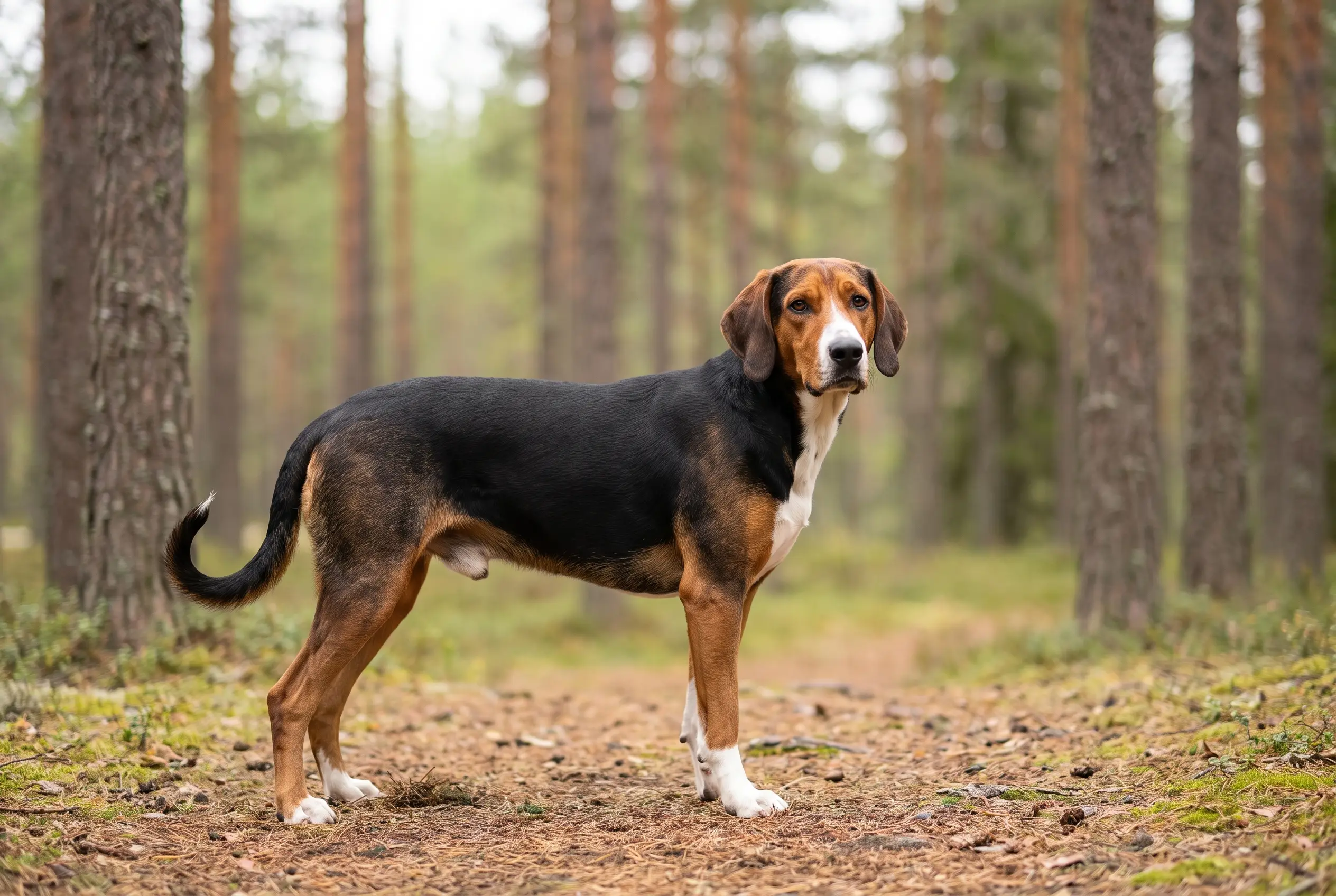
Suomenajokoira
Finland's own hare-and-fox hound — tricoloured, resonant-voiced, and still genuinely popular at home.
Vital stats
| Size | Medium · 55–61 cm (males), 52–58 cm (bitches) |
| Weight | 20–25 kg — breed literature; the standard sets none |
| Life expectancy | 12–14 years — breed literature, not survey data |
| Energy | High — built to trail hare and fox for hours in the field |
| Shedding | Moderate — dense coat, no dramatic seasonal blowout noted |
| Coat | Medium length, close-lying, dense and rather harsh outer coat over a soft undercoat · always tricolour |
| Group | Scenthound · Medium-sized Hound (FCI №51, Group 6) |
| Origin | Finland |
| FCI group | 6 — Scent hounds and related breeds · FCI 51 |
Breed traits
Friendliness
Care
Mind
The Suomenajokoira by the numbers
The Suomenajokoira facts owners search for most — price, lifespan, weight, shedding and colours, in one place.
Less common, so expect a waitlist and some travel to a reputable breeder — which pushes the price up. Plan for steady ongoing costs — mid-range food, routine vet care and insurance.
We don't quote a single figure: the real price swings with breeder, region, bloodline and health testing — and a rescue costs a fraction of a breeder's litter. Adopting is almost always the cheapest route.
Temperament
The standard's behaviour clause is four words: calm, energetic and friendly, never aggressive. Its utilization clause explains what that temperament is for — a hound that stays eager to hunt hare and fox even in difficult circumstances, works independently once it is on a scent, ranges as a versatile tracker, and pursues the quarry with resonant barking, the standard's own phrase for a voice loud and steady enough to follow through trees out of sight. That is a working brief, not a household one, and most Suomenajokoira in Finland are still bred and kept for exactly this job. At home the same calm default holds: it is not a breed that goes looking for a fight, with people or other dogs, and it settles readily once the exercise and the scent work it needs have actually happened.
Habits & quirks
A voice built for the forest
The FCI utilization clause names it directly: the Suomenajokoira "pursues the quarry with resonant barking." In the field that bark is the entire point — a hunter following on foot, out of sight of the dog, tracks the hunt by ear alone.
One coat pattern, no exceptions
The standard allows exactly one colour: tricolour, with a black mantle, rich tan on the head and legs, and white usually at the head, neck, chest and tail tip. Mottling, a broken mantle and "a lot of grey hairs or so called wolf hair" are all listed faults — there is no approved second pattern to fall back on.
Ears that measure past the muzzle
The standard is oddly precise here: ears set on the line from nose to eyes, flat against the head, and long enough that when drawn forward they reach over half the length of the muzzle — a specific, checkable detail in a standard mostly written in generalities.
Popular at home, unknown abroad
The Finnish Kennel Club registered 796 Suomenajokoira in 2024, ranking it eighth among the country's most-registered breeds that year, ahead of several far more famous names. Outside Finland and its Nordic neighbours it is barely seen at all; the AKC has never recognised it.
Care
| Exercise | This is a hunting hound built to run scent trails for hours, and the standard's own phrase — eager to hunt also in difficult circumstances — is the honest summary. Long daily walks or runs on varied ground, plus real scent work such as tracking games or actual hunting where that's the household's thing, suit it far better than a lead around the block. |
| Grooming | The dense, close-lying outer coat over a soft undercoat needs a weekly brush to clear loose hair; the standard describes no heavy seasonal blowout the way some northern spitz breeds have. Check the low, close-fitting hanging ears after time in cover. |
| Training | The standard's calm, friendly temperament makes it genuinely biddable, but the nose runs the show once a scent trail opens, so recall needs to be trained early and kept sharp. Short, consistent sessions built around its hunting drive work better than pure obedience drilling. |
| Health | Breed literature — not the FCI standard, which is silent on health — lists cerebellar ataxia, an inherited, early-onset neurological condition traced to a mutation in the SEL1L gene, alongside hip dysplasia, cardiomyopathy, lymphoma and some skin conditions reported in the breed. A DNA test for the ataxia mutation exists and is worth asking breeders about; the population's average inbreeding coefficient was measured at 3.12% in 1997, the only figure of its kind found for this breed. |
Life expectancy
This breed has a typical life expectancy of 12–14 years — breed literature, not survey data.
Similar breeds
Breeds with a similar build and background — worth a look if this one isn't quite the fit.
Breeds that look like this
Common questions
Is the Finnish Hound a family pet or only a hunting dog?
Almost every Suomenajokoira in Finland is bred and worked as a hunting hound — the standard's own utilization clause describes a dog for hunting hare and fox, and that's still how most breeders select for it. The temperament the standard asks for, calm, energetic and friendly, never aggressive, does make it workable as a household dog too, but only for owners ready to give it the daily exercise and scent work a working hound actually needs.
How rare is the Finnish Hound outside Finland?
Very. It has no AKC recognition and barely any presence outside Finland and its immediate Nordic neighbours, which makes its domestic numbers unusual: the Finnish Kennel Club registered 796 of them in 2024, the eighth-highest total of any breed in the country that year. It is a breed that is common at home and close to invisible everywhere else.
Why does the Finnish Hound bark so much on a hunt?
Because that is the job. The FCI standard's utilization clause has it pursuing the quarry with resonant barking — a loud, steady voice is how a hunter following on foot keeps track of a dog working out of sight in dense forest. Expect a vocal dog even off duty, especially if it's short on exercise.
Does the Suomenajokoira shed a lot?
Moderately. The Suomenajokoira sheds a fair amount, steadily through the year with heavier seasonal patches. A weekly brush keeps most of the loose hair off your floors and clothes.
Is the Suomenajokoira hypoallergenic?
Not really. No dog is truly hypoallergenic, and the Suomenajokoira's shedding coat releases plenty of the dander that sets off allergies. If someone at home is allergic, this isn't the easiest breed to live with — spend time around one first.
Is the Suomenajokoira easy to train?
Reasonably. The Suomenajokoira is trainable with consistency and rewards, though it isn't the quickest study. Keep sessions short and positive, and be patient with the basics like recall.