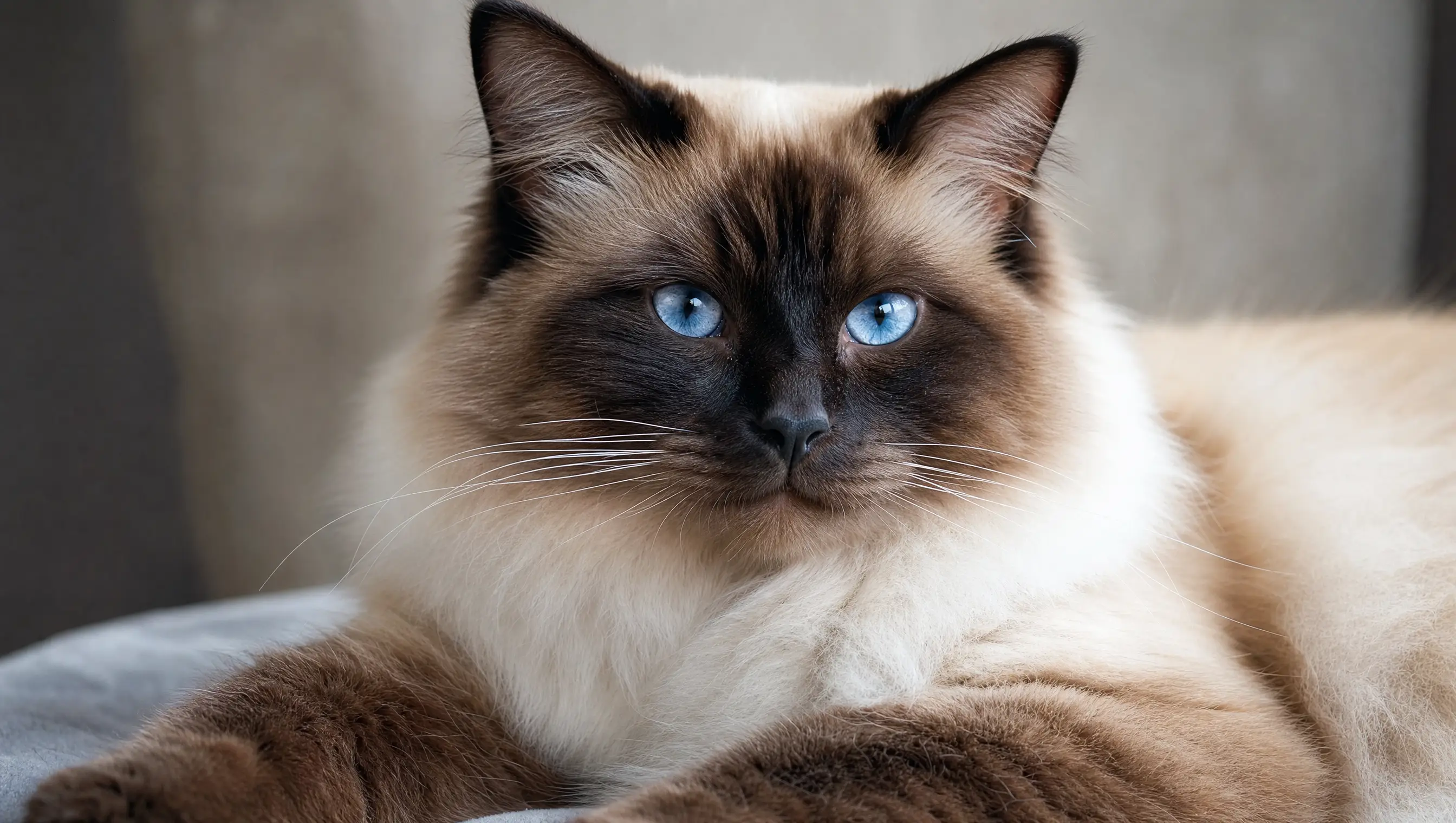
Ragdoll
The cat that goes limp in your arms and would rather be underfoot than up high.
On these lists: Cats for apartments · Family cats · Cats for first-time owners · Indoor cats · Cats for seniors
Vital stats
| Size | Large · long, broad-chested build |
| Weight | 4–9 kg · toms often 6–9 kg |
| Life expectancy | 12–17 years |
| Energy | Low to moderate — placid, not busy |
| Shedding | Moderate, seasonal |
| Coat | Semi-long, silky, little undercoat |
| Group | Longhair |
| Origin | United States |
Breed traits
Friendliness
Care
Mind
The Ragdoll by the numbers
The Ragdoll facts owners search for most — price, lifespan, weight, shedding and colours, in one place.
Widely bred, so you can usually find a litter from a registered breeder without a long wait. Ongoing costs stay modest — it eats little and routine vet care sits at the lower end. Its coat also needs a professional groom every few weeks — a real line in the budget.
We don't quote a single figure: the real price swings with breeder, region, bloodline and health testing — and a rescue costs a fraction of a breeder's litter. Adopting is almost always the cheapest route.
Temperament
Ragdolls are bred for one thing above all: an easy, unbothered temperament, and it shows. They greet you at the door, trail you from room to room, and flop down wherever you land — often going boneless in your arms. Most are quiet, with a soft voice they use sparingly, and they lean gentle rather than playful, though a feather wand still gets a rise out of them. They tend to stay low, preferring laps and sofas to the top of the bookshelf. The flip side of all that trust is a cat with little street sense: docile, slow to defend itself, and genuinely unhappy left alone for long stretches. This is an indoor companion that wants company, not an independent mouser.
Habits & quirks
Going limp
Pick one up and it often relaxes completely and hangs like its namesake — not universal, but common enough to define the breed.
Ground floor
Unlike most cats they rarely climb high; expect them at your feet, on the sofa, and in the bed rather than on top of the cupboards.
Door greeter
Many wait by the door and follow you around dog-style, wanting to be in the same room whatever you're doing.
Born white
Kittens arrive pure white and take up to two years to darken into their full seal, blue, chocolate or lilac points.
Health
Ragdolls are generally sound, but one condition deserves particular attention: hypertrophic cardiomyopathy (HCM), a heart-muscle disease that runs in the breed. There's a Ragdoll-specific MYBPC3 gene test, so ask a breeder for the DNA result and a normal heart scan on both parents. It's also worth asking about polycystic kidney disease (PKD) and bladder stones, both seen in the breed. Beyond that, the biggest risk is the Ragdoll's own trusting nature: slow to sense danger and slow to defend itself, this is a cat that does far better kept indoors or in a secure garden than roaming free.
Nutrition
| Grooming | The low-undercoat coat mats less than a Persian's but still needs a comb two or three times a week, more during the seasonal shed, with attention to the ruff and britches. |
| Health | HCM (a heart-muscle disease) runs in the breed and there's a specific Ragdoll MYBPC3 gene test — ask a breeder for the DNA result plus a normal heart scan on the parents. PKD and bladder stones are also worth asking about. |
| Keep them in | Trusting, slow to run from trouble and often unregistered street-smart, Ragdolls do best as indoor cats or with a secure garden or catio. |
| Company | They hate being alone for long — if the house is empty all day, a second cat or a predictable routine helps more than extra toys. |
Cats are obligate carnivores, so a meat-first diet with proper protein is the right foundation for a Ragdoll. Because the breed can be prone to bladder stones, keeping water going in matters — lean on wet food, or mix wet with dry, and always keep fresh water easy to reach. This is a big cat with a calm, low-energy temperament, exactly the combination that piles on weight if you free-feed, so measure meals and count treats in the daily total. Ragdolls grow slowly and finish large, so aim for a steady, lean build rather than rushing the weight on, and check you can feel the ribs under that silky coat.
Kitten guide
A Ragdoll kitten is born white and takes up to two years to darken into its full points, so the cat you bring home will keep changing. They're gentle, trusting kittens, which makes early handling a pleasure — get them used to being combed, to the carrier and to visitors, and they stay the easy-going lap cat the breed is bred for. Set the home up as an indoor one from the start: this breed has little street sense, so secure balconies and windows and plan for a life indoors or in a safe garden. Kitten-proof the space, keep introductions calm, and don't leave a young Ragdoll alone for long stretches, since the breed genuinely dislikes isolation. Book an early vet visit for vaccinations, a microchip, a neutering plan and a look at that heart-test paperwork.
Training
Ragdolls are calm and people-focused rather than driven, so training leans on routine and gentleness. Litter training is usually straightforward — keep a clean tray in an easy, ground-level spot, which suits a cat that prefers the floor to high shelves anyway. Put out a scratching post and reward its use; a Ragdoll won't scale the bookcase, but it still needs somewhere legitimate to scratch. Enrichment is gentle here: a feather wand still gets a rise out of them, and short daily play keeps a low-energy cat from getting pudgy. The real need is company — a Ragdoll hates being left alone, so a predictable routine, and a second pet if the house empties out, does more than a pile of toys. Get it comfortable with the carrier early to make vet visits calm.
Life expectancy
Ragdolls live 12–17 years. Reaching the top of that range is mostly about the heart and the front door. A kitten from MYBPC3-tested, heart-scanned parents starts with the best odds against the HCM that most threatens the breed, and keeping a trusting cat safely indoors removes the accidents that cut Ragdoll lives short. Add a lean weight and regular vet checks, and the upper end of that span is a realistic goal.
Similar breeds
Breeds with a similar build and background — worth a look if this one isn't quite the fit.
Common questions
Do all Ragdolls actually go limp when you hold them?
Not every single one, but a large share do relax and flop when picked up — it's a temperament trait the breed was selected for, not a trained trick. If yours doesn't, it's still normal.
Are Ragdolls good with children and other pets?
Yes — they're big, tolerant and slow to swat, which suits gentle kids and calm dogs. Because they won't defend themselves well, teach children to handle them kindly and supervise rough play.
How much grooming does a Ragdoll need?
Less than the coat length suggests. With little undercoat it mats far less than a Persian, so a thorough comb a couple of times a week, stepping up during spring shed, keeps it in good order.
Does the Ragdoll shed a lot?
Moderately. The Ragdoll sheds a fair amount, steadily through the year with heavier seasonal patches. A weekly brush keeps most of the loose hair off your floors and clothes.
Are Ragdoll cats hypoallergenic?
No cat breed is truly hypoallergenic, and the Ragdoll isn't one of the easier ones. The trigger is Fel d 1, a protein in a cat's saliva and skin that ends up on the coat during grooming and then spreads on loose hair and dander — and this breed sheds enough to move plenty of it around. If someone at home is allergic to cats, this is a hard breed to live with; spend real time around one first.
Stories featuring this breed
All stories →
Do cats love their owners? The kidnap experiment says yes
Science ran the same attachment test on cats that it runs on human infants, and 64% passed. What the secure-base test found, why one earlier study disagreed, and how a cat actually says it.
Do cats miss their owners? They even track the clock
Cats greet you harder after four hours away than after thirty minutes — they know how long you were gone. What missing looks like in a cat, when it tips into separation anxiety, and how to leave well.
How cats choose their favourite person
It isn't whoever fills the bowl. The Swiss living-room study found one habit that predicts a cat's favourite better than food ever did — and the person who ignores cats has it by accident.