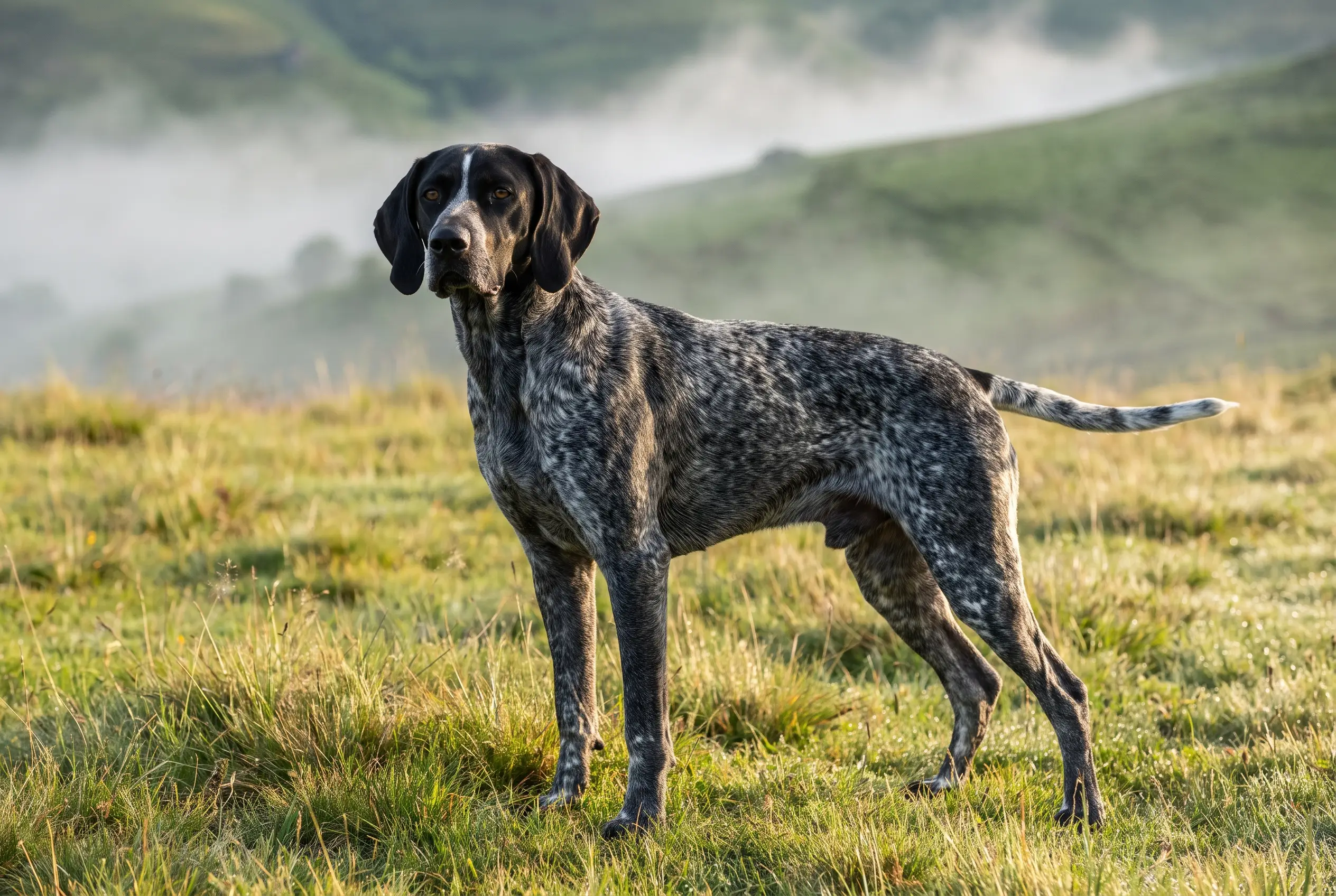
Braque d'Auvergne
The black-and-white pointer of the Cantal, galloping since before anyone wrote standards.
Vital stats
| Size | Medium-large · 57–63 cm (dogs), 53–59 cm (bitches) |
| Weight | 22–28 kg — breed literature; the standard sets none |
| Life expectancy | 12–15 years — breed literature, not survey data |
| Energy | High — 2+ hrs/day, with free running |
| Shedding | Moderate — short coat, a weekly brush |
| Coat | Short, shiny, never hard · black with white markings, flecked or greying |
| Group | Sporting · Continental Pointing Dogs, braque type (FCI №180, Group 7) |
| Origin | Auvergne (Cantal), France |
| FCI group | 7 — Pointing Dogs · FCI 180 |
Breed traits
Friendliness
Care
Mind
The Braque d'Auvergne by the numbers
The Braque d'Auvergne facts owners search for most — price, lifespan, weight, shedding and colours, in one place.
Less common, so expect a waitlist and some travel to a reputable breeder — which pushes the price up. Ongoing costs run high — more food, bigger doses at the vet, and pricier insurance.
We don't quote a single figure: the real price swings with breeder, region, bloodline and health testing — and a rescue costs a fraction of a breeder's litter. Adopting is almost always the cheapest route.
Temperament
Gentle, very affectionate, intelligent and obedient: the standard's behaviour section is four adjectives long, and it closes with the line that matters for households — it adapts well to family life. It is a hunter's dog all the same. The same page asks for a powerful nose and says training consists mainly of developing its natural qualities, which in practice means the pointing, the ranging and the scent obsession arrive pre-installed, and your job is to give them somewhere to go. Breed literature adds two honest notes the standard does not: the Auvergne matures slowly, and it likes to talk — expect commentary when it is excited or under-occupied. It is also a sensitive gundog that works for warmth and rewards; heavy handling shuts it down.
Habits & quirks
Black and white, full stop
The colour section allows exactly one scheme: black with white markings, in two recognised types, flecked or greying — and a judge may not use the difference to split two dogs of equal quality. Entirely black, entirely white, absence of flecking, tawny marks and 'burnt bread' glints all disqualify, along with an unpigmented nose and yellow 'hawk' or wall eyes.
No dewclaws, either way
The standard disqualifies the presence of dewclaws — and also traces of their removal. A dog is expected to be born clean-legged, which is rare wording even among the braques.
Ears low and satiny
Set towards the rear and hanging below the line from nose to eye at rest, slightly turned inward, rounded at the tip, and long enough, drawn forward, to reach the root of the nose. The standard calls the leather supple and slightly satiny; set too high, too short or corkscrewed counts as a severe fault.
A rocking gallop
Its habitual hunting gait is an average gallop, regular and slightly rocking — the standard's own words — at a sustained rhythm the same text credits for the breed's notorious endurance. This is a dog conformed to cover long distances on the most difficult terrain, all day.
Health
There is no breed-wide health survey behind the Braque d'Auvergne, and the breed records flag no widely recognised breed-specific disease — so the honest advice is general rather than a checklist. Buy from a breeder who tests: the French gene pool is small, hip screening is worth asking for at this size, and a deep, healthy pedigree matters more than a quick litter. Two everyday jobs do most of the work. The ears are long, low-set and folded shut against airflow, so they trap damp and want a look and a clean every week and after any day in cover. And this is a deep-chested galloping dog, so guard against bloat: keep meals unhurried and give the stomach time to settle around hard exercise. Keep him lean and keep him working, and the Auvergne is a sound dog.
Nutrition
| Exercise | Two hours a day or more, with genuine free running. This is a pointing breed judged with a working trial and shaped to gallop across hard country from morning to evening; hunting, field trials, canicross or long off-lead hill walks all fit. A nose this good needs employment — scent games count as work. |
| Grooming | A weekly session with a stiff bristle brush keeps the short, shiny coat in order, and shedding stays moderate. The real maintenance is the ears: long, low-hung and folded against airflow, they need a regular look and a clean, especially after a day in cover. |
| Training | The standard says training consists mainly of developing its natural qualities, and that is the honest method: channel the pointing and the nose rather than fight them. Keep sessions short, rewards real and hands soft — this is a sensitive breed — and start recall early, because breed literature has it maturing slowly. |
| Health | Breed literature reports no widely recognised breed-specific problems, and there is no breed-wide survey behind the 12–15 years usually quoted. Outside France the population is small, so ask breeders about hip scoring and pedigree depth — sensible practice for any pointing breed rather than a documented scheme requirement. |
Feed a working braque to the day it has actually had — a full day on the hill and a quiet week at home do not burn the same fuel, so weigh the meals and count the training treats in the day's total. Aim for ribs you can feel under that short, shiny coat, because extra weight on a galloping frame steals the very endurance the breed is built on. And because the Auvergne is deep in the chest, mind the mechanics as much as the amount: split the ration into two calm meals rather than one big gulped bowl, and leave a gap around hard running instead of feeding straight before or after it.
Puppy guide
A Braque d'Auvergne grows up slowly, so spend that first year on patience rather than pressure. Busy the nose early with short scent games and gentle new places, but keep the young joints off repetitive hard galloping and big jumps while they are still forming, and socialise widely so a sharp gundog nose does not tip over into nervousness. Start recall the day the puppy comes home — a nose this good will follow a scent out of the parish long before the brain has finished growing — and, since this is a sensitive dog that likes to talk, teach a calm off switch as deliberately as you teach a sit.
Training
The breed's own standard says the work is mainly to develop the dog's natural qualities, and that is the honest method: channel the pointing and the nose instead of fighting them. The Auvergne is a sensitive gundog that works for warmth and reward, so keep sessions short, the praise real and the hands soft — a heavy correction shuts this breed down and teaches nothing. Build recall early and keep paying for it around game, because the pointing and the wide ranging switch on young and never entirely switch off.
Life expectancy
Braques d'Auvergne live 12–15 years — breed literature, not survey data. This is a hardy country dog with no documented breed-specific disease, and you keep it at the top of its range the same way you keep it happy: lean weight, ears kept clean and dry, parents from a breeder who health-tests, and a life with enough real running and nose work to keep body and mind sound.
Similar breeds
Breeds with a similar build and background — worth a look if this one isn't quite the fit.
Breeds that look like this
Common questions
Why is it nicknamed Bleu d'Auvergne?
Because of the greying coat type — grisonnée in the French standard — where black ticking runs so dense through the white that the whole dog looks blue-grey. The nickname is the same as the region's blue cheese, which confuses search engines and nobody else. The standard itself claims no blue at all: black with white markings, flecked or greying, and the two patterns rank equally in the ring.
How is it different from the other French braques?
France keeps several pointing braques — the Braque français in two sizes, the Bourbonnais, the Saint-Germain, the Ariège — and most of them wear liver, chestnut or orange. The Auvergne alone is strictly black and white, with low-set satiny ears and its own regional history: the standard has it in the Cantal for more than two centuries, from a common pointer stock refined by selection in which, in the standard's careful wording, the Knights of Malta might have participated.
Are they good family dogs?
The standard says it directly: a gentle dog, very affectionate, that adapts well to family life. The caveats are the ones that come with any working pointer — a two-hour daily exercise bill, a nose that will follow a scent out of the county without early recall work, and, per breed literature, a voice it enjoys using.
Does the Braque d'Auvergne shed a lot?
Moderately. The Braque d'Auvergne sheds a fair amount, steadily through the year with heavier seasonal patches. A weekly brush keeps most of the loose hair off your floors and clothes.
Is the Braque d'Auvergne hypoallergenic?
Not really. No dog is truly hypoallergenic, and the Braque d'Auvergne's shedding coat releases plenty of the dander that sets off allergies. If someone at home is allergic, this isn't the easiest breed to live with — spend time around one first.
Is the Braque d'Auvergne easy to train?
Yes. The Braque d'Auvergne is one of the more trainable breeds — quick to learn and keen to work with you, which makes reward-based training straightforward. Start early, keep it positive, and it picks things up fast.