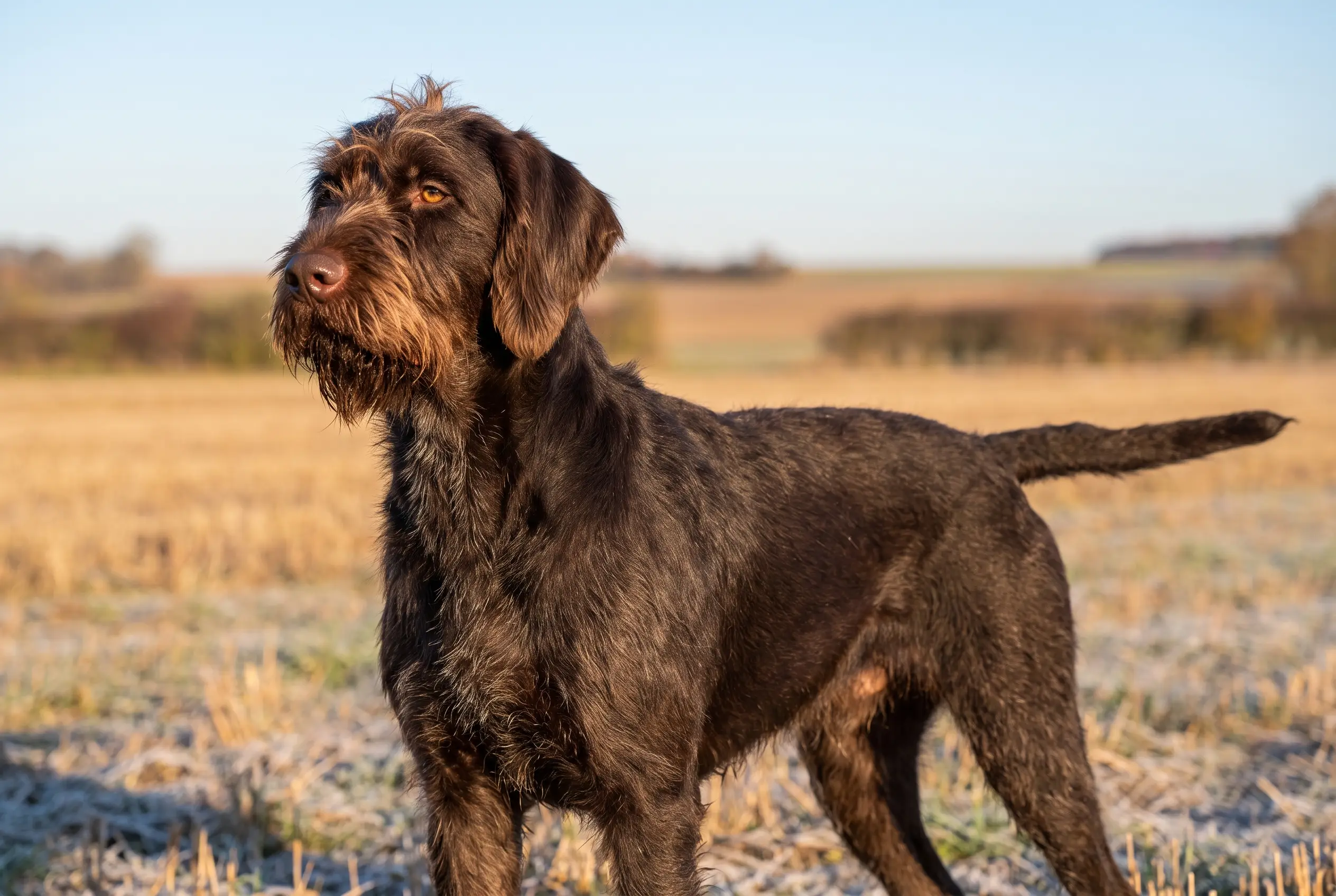
Pudelpointer
Half Poodle, half Pointer, built to work fields, woods and water without changing dogs.
Vital stats
| Size | Large · 60–68 cm (dogs), 55–63 cm (bitches) |
| Weight | 20–30 kg — breed literature; the standard sets none |
| Life expectancy | 12–14 years — breed literature, not survey data |
| Energy | Very high — a versatile gundog built for fields, woods and water |
| Shedding | Low to moderate — dense, hard-wearing coat, not a heavy dropper |
| Coat | Hard, rough, close-lying, medium length (4–6 cm at withers) with dense undercoat, beard and wiry forelock |
| Group | Sporting · Continental Pointing Dogs, braque type (FCI №216, Group 7) |
| Origin | Germany |
| FCI group | 7 — Pointing Dogs · FCI 216 |
Breed traits
Friendliness
Care
Mind
The Pudelpointer by the numbers
The Pudelpointer facts owners search for most — price, lifespan, weight, shedding and colours, in one place.
Less common, so expect a waitlist and some travel to a reputable breeder — which pushes the price up. Ongoing costs run high — more food, bigger doses at the vet, and pricier insurance.
We don't quote a single figure: the real price swings with breeder, region, bloodline and health testing — and a rescue costs a fraction of a breeder's litter. Adopting is almost always the cheapest route.
Temperament
The standard's own behaviour clause runs four short phrases: "Neither shy nor aggressive. Calm, self-controlled, even temperament with distinct hunting instinct, without game or gun shyness." In practice that reads as a dog that works hard without going to pieces over it. The disqualifying faults spell this out further: "aggressive or overly shy dogs," "any kind of weak temperament," and "fear biter" all sit on the same list as a bad bite or the wrong colour. At home the Pudelpointer tends to be attentive and biddable rather than clingy, and the hunting instinct doesn't switch off in a garden: a moving bird, rabbit or squirrel gets the same taut, sudden point the standard asks for in the field.
Habits & quirks
Still visibly part Poodle
The standard calls for a coat with "a beard and a wood shaving like forelock" on the head, plus a close, dense coat over the belly: the Poodle half of the cross, kept on purpose. Its own history section states the breed "has come into being completely isolated from other pointing breeds," with the Poodle used only to found the line, not blended in generation after generation.
Longer than tall, on the nose
The standard fixes the body-to-height ratio at 10 to 9, and asks the skull, from occiput to stop, to match the muzzle, from stop to nose, almost exactly. Neither number is decorative: judges measure both, and a Pudelpointer built off those proportions is marked down for it.
Built not to slobber
"Lips: close-fitting, not overhanging; never slavering" is the standard's own line. Given how much time this dog spends nose-down in cold water, a mouth that doesn't drip matters for more than the sofa.
Three colours, full stop
Brown, dead-leaf colour or black, whole-coloured, with small white markings tolerated: that's the complete list. "Any other colour or markings of different colour than specified in the standard" sits in the disqualifying faults, the same tier as an aggressive temperament or a coat that's grown in too short.
Care
| Exercise | This is a versatile gundog built for fields, woods and water in a single outing, and the exercise bill matches: plan on 1.5 to 2 hours a day of real work, not a lead walk around the block. Retrieving drills, water work and scent games all count toward that total; a Pudelpointer left without a job finds one on its own. |
| Grooming | The hard, rough double coat sheds relatively little but mats without attention. A weekly brush plus an occasional hand-strip keeps it doing the job the standard describes: protection against weather and injury. Check and dry the beard after any water work. |
| Training | Bred to make its own decisions in the field, a Pudelpointer thinks for itself more than a retriever does, so training goes better as a partnership than as pure obedience drilling. Its home club builds that independence-testing into the breed itself, running young dogs through staged performance tests rather than judging temperament by looks alone (see the FAQs below). |
| Health | The standard's own history section names the country of origin's health priority directly: "special emphasis on the prevention of hip dysplasia (HD) and epilepsy in the breed" — two conditions most standards leave for breed clubs to worry about quietly. Ask any breeder for hip results before buying, and expect them to have an answer ready. |
Life expectancy
This breed has a typical life expectancy of 12–14 years — breed literature, not survey data.
Similar breeds
Breeds with a similar build and background — worth a look if this one isn't quite the fit.
Breeds that look like this
Common questions
Is the Pudelpointer actually part Poodle?
Yes, and it isn't a marketing story: it's the breed's founding cross. In 1881, Freiherr von Zedlitz paired Tell, an English Pointer owned by the future Emperor Frederick III, with Molly, his own German hunting poodle. The FCI standard notes that the Poodle "has only been used for creating the foundation breeding stock" but that its characteristics "have been preserved till today," meaning modern Pudelpointers carry Poodle genes from more than a century of selection, not a recent one-off cross. We carry the Poodle itself under FCI №172.
How is it different from the Pointer half of its name?
The Pointer (FCI №1) is a pure bird-finding specialist: gallop, freeze, point, and let the handler take it from there. It isn't built or trained for water and rarely retrieves. The Pudelpointer kept the Pointer's nose and range but added a rough, weatherproof coat and a Poodle's water drive, so it points, tracks, retrieves on land and swims after downed birds before the day is done. It's also heavier-built and coated for cold water, where a Pointer's thin coat leaves it shivering on the bank.
Why do Pudelpointer breeders require a working test before a dog can have puppies?
Because the breed's own German club treats it as a rule, not a suggestion. According to the breed club's site (pudelpointer.de), breeding approval (Zuchtzulassung) is withheld unless a dog is certified free of hip dysplasia and has passed a staged performance test: the VJP puppy test plus either the HZP autumn test or the tougher VGP versatility test, run under Germany's hunting-dog testing body, the JGHV. Conformation wins don't substitute for it; only working results and clean hips do.
Does the Pudelpointer shed a lot?
Yes — the Pudelpointer is a heavy shedder, dropping hair year-round or in big seasonal moults. Brush it several times a week and expect regular vacuuming; it isn't the coat for you if loose fur is a dealbreaker.
Is the Pudelpointer hypoallergenic?
Not really. No dog is truly hypoallergenic, and the Pudelpointer's shedding coat releases plenty of the dander that sets off allergies. If someone at home is allergic, this isn't the easiest breed to live with — spend time around one first.
Is the Pudelpointer good with children?
Generally yes. The Pudelpointer is a friendly, people-loving breed that usually does well with children when raised and socialised well. As with any dog, teach children to be gentle and supervise around toddlers.
Is the Pudelpointer easy to train?
Yes. The Pudelpointer is one of the more trainable breeds — quick to learn and keen to work with you, which makes reward-based training straightforward. Start early, keep it positive, and it picks things up fast.