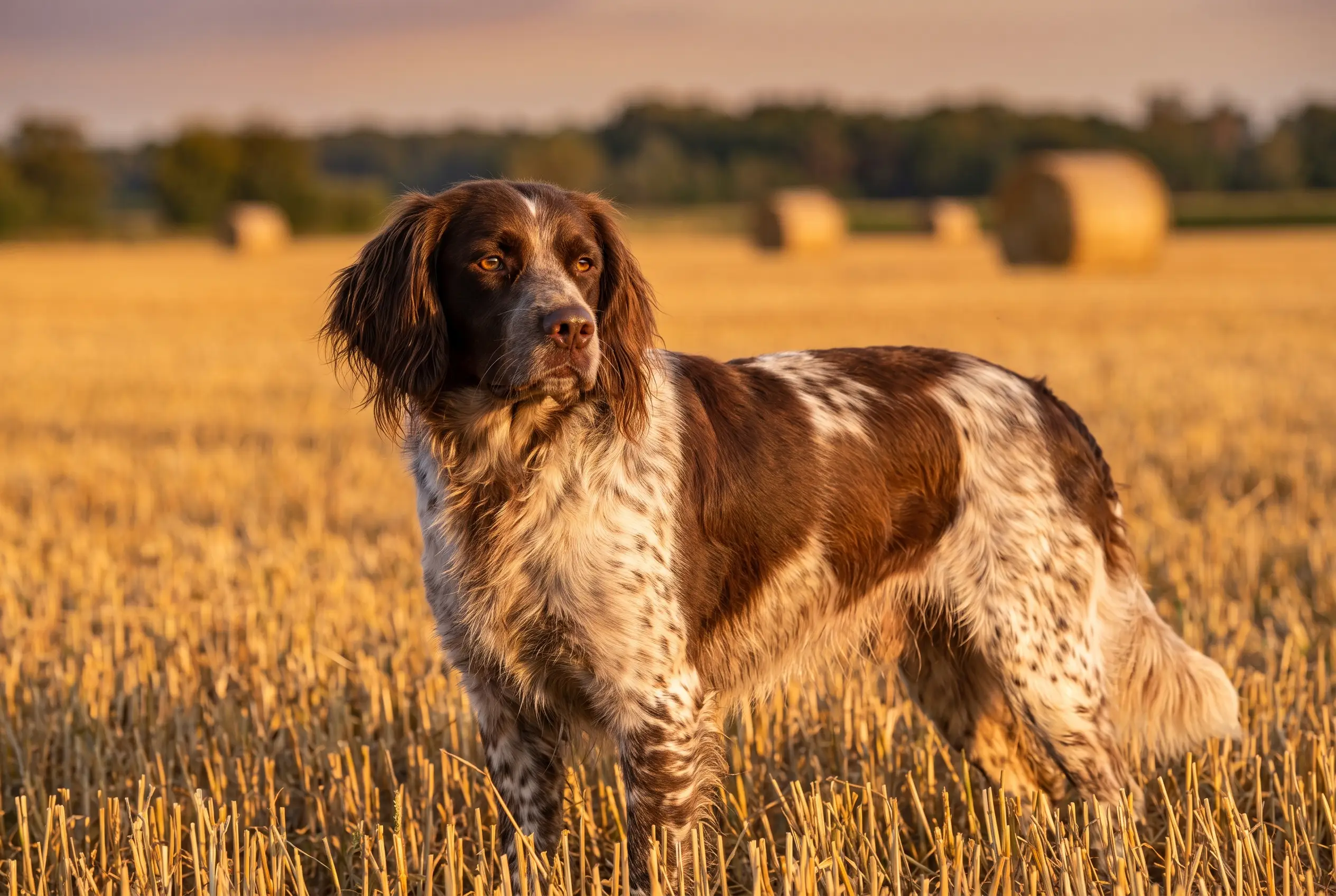
French Spaniel
The tallest of France's spaniels, still pointing the way its 1891 standard describes.
Vital stats
| Size | Large · 56–61 cm (dogs), 55–59 cm (bitches) |
| Weight | 24–26 kg — breed literature; the standard sets none |
| Life expectancy | 12–14 years — breed literature, not survey data |
| Energy | High — 2+ hrs/day, pointing and retrieving work |
| Shedding | Moderate — flat coat, weekly brush |
| Coat | Flat, silky, well feathered · white with brown patches, flecked or roan |
| Group | Sporting · Continental Pointing Dogs, Spaniel type (FCI №175, Group 7) |
| Origin | France |
| FCI group | 7 — Pointing Dogs · FCI 175 |
Breed traits
Friendliness
Care
Mind
The French Spaniel by the numbers
The French Spaniel facts owners search for most — price, lifespan, weight, shedding and colours, in one place.
Less common, so expect a waitlist and some travel to a reputable breeder — which pushes the price up. Ongoing costs run high — more food, bigger doses at the vet, and pricier insurance.
We don't quote a single figure: the real price swings with breeder, region, bloodline and health testing — and a rescue costs a fraction of a breeder's litter. Adopting is almost always the cheapest route.
Temperament
The standard's own words: balanced, frank, gentle, calm and docile, enthusiastic hunter, sociable with other dogs and an ideal companion in all circumstances. Excellent pointing dog, it also has a talent for retrieving. That closing line is doing real work — most continental pointing breeds are built and judged around one job, and this standard names two. In the house it reads as a dog built to work with people rather than around them: gentle with family, easy with other dogs, and generally reserved rather than wary around anyone new. Breed literature adds what the standard doesn't: it attaches hard to its household, and left alone and under-exercised it tends toward separation anxiety and chewed furniture rather than aggression.
Habits & quirks
White and brown, no exceptions
The standard allows exactly one colour scheme: white and brown, in patches running from lightly flecked to heavily roan, with the brown itself ranging cinnamon to dark liver. Any other colour disqualifies outright, and so does an unpigmented nose, lip edge or eyerim.
Born without hind dewclaws
The standard disqualifies dewclaws on the hindlegs — not as a defect to be removed, but as a trait the dog shouldn't carry in the first place. It's one of the more exact structural calls in the document.
Ears that reach the nose
Pulled gently forward, the tip of the ear cartilage should just touch the base of the nose — a concrete, measurable test in place of a vague 'long ears' description. Too short, too triangular or partly white all count as severe faults.
Built to point and to fetch
The standard singles this out by name — an excellent pointing dog that also has a talent for retrieving. Most continental pointing breeds specialise in one skill; this one's own standard credits it with both.
Health
The standard names no breed-specific health concerns, and the lifespan usually quoted is breed literature rather than survey data. One condition is well documented, though — a recessive hereditary sensory neuropathy known as acral mutilation and analgesia, mapped in French Spaniels, in which affected puppies lose pain sensation in the paws and start injuring their own feet from around three and a half months old. A DNA test exists from the research that identified it, so it is a specific, fair question to put to a breeder rather than a vague worry. Beyond that, the long, well-covered ears trap moisture more easily than short ones, so check them regularly.
Nutrition
| Exercise | Two hours a day or more is the usual breed-literature figure, and the standard's working-trial requirement backs it up — this is a dog built to hunt and retrieve, not walk on a lead. Off-lead running, retrieving games and real fieldwork suit it better than a walk-only routine; breed literature is consistent that an under-exercised one turns anxious and destructive. |
| Grooming | The coat is flat, silky and well feathered rather than curly or wiry — a weekly brush keeps the ear fringes, chest, legs and tail free of tangles, with more attention during heavy shedding. The ears themselves are set back and heavily furnished, so check them regularly; long, well-covered ears trap moisture and debris more easily than short ones. |
| Training | The standard's own temperament — docile, an ideal companion in all circumstances — makes it responsive to reward-based work, and breed-club accounts favour short, consistent sessions over long ones. Its job is unusual for a French pointing breed: since the standard credits both pointing and retrieving, training can develop either skill, or both. |
| Health | The standard names no breed-specific health concerns, and the 12–14 years usually quoted is breed literature, not survey data. One condition is documented in veterinary genetics rather than club literature: a recessive hereditary sensory neuropathy — acral mutilation and analgesia — has been mapped in French Spaniels, in which affected puppies lose pain sensation in the paws and self-injure the feet from roughly 3.5 months old. A DNA test exists from the research that identified it, and it's a reasonable, specific question to put to a breeder rather than a generic caution. |
This is a working gundog that wants two hours a day or more of real exercise, so feed to that workload and keep him lean — a spaniel hunting and retrieving through the season needs more than the same dog resting in the off-season. Weigh the meals, count field and training treats in the day's total, and let the dog earn its food in the work it was built for.
Puppy guide
A French Spaniel puppy attaches hard to its household, and how you spend the first year shapes both the gundog and the companion. Socialize him widely, build in short reward-based sessions, and teach him early to settle alone in small doses — breed literature is clear that an under-exercised, under-occupied one drifts toward separation anxiety and chewed furniture. Keep hard exercise light while the joints are forming, and channel the natural urge to point and fetch into gentle games rather than long drills.
Training
The standard's own words — docile, gentle, an ideal companion in all circumstances — describe a dog that works with people rather than around them, and it takes well to reward-based training in short, consistent sessions. Its job is unusual for a French pointing breed: the standard credits it with both pointing and retrieving, so training can build either skill or both. Give it real work for the nose; a French Spaniel with a job to do is an easy dog to live with.
Life expectancy
French Spaniels live 12–14 years — breed literature, not survey data. The French Spaniel's usual lifespan figure comes from breed literature, not a survey, so treat it as a guide. You give one the best chance of a long, sound life the ordinary way — a lean weight, real daily exercise and company — and, before you buy, by asking the breeder about the DNA test for the hereditary neuropathy documented in the breed.
Similar breeds
Breeds with a similar build and background — worth a look if this one isn't quite the fit.
Breeds that look like this
Common questions
Is the French Spaniel the same as the Brittany?
No — different breeds, with different FCI numbers. The Brittany (Epagneul Breton, FCI No. 95) stands roughly 47–52 cm and was developed in the 19th century partly by crossing French Spaniel stock with English setters; the French Spaniel (FCI No. 175) is the older, taller breed it partly descends from, standing 55–61 cm with a full, undocked tail reaching the hock, where Brittanys are commonly born short-tailed or docked.
Is it the same as the Picardy Spaniel?
No. The Picardy Spaniel (Epagneul Picard, FCI No. 108) is a separate breed from further north in France, with a grey-brown ticked coat rather than the French Spaniel's white-and-brown patching. Both are Continental Pointing Dogs of Spaniel type in FCI Group 7 and both trace back to the same medieval bird-dog stock, but they've bred true as distinct breeds for well over a century. The French Spaniel is the largest of the group.
Are French Spaniels good family dogs?
Per the standard, yes in principle — it calls the breed gentle, calm, docile and 'an ideal companion in all circumstances.' In practice that companionship comes with a working dog's needs attached: real daily exercise, work for the nose, and company. Breed literature is consistent that a bored, under-exercised one gets anxious and destructive rather than settled.
Does the French Spaniel shed a lot?
Moderately. The French Spaniel sheds a fair amount, steadily through the year with heavier seasonal patches. A weekly brush keeps most of the loose hair off your floors and clothes.
Is the French Spaniel hypoallergenic?
Not really. No dog is truly hypoallergenic, and the French Spaniel's shedding coat releases plenty of the dander that sets off allergies. If someone at home is allergic, this isn't the easiest breed to live with — spend time around one first.
Is the French Spaniel easy to train?
Yes. The French Spaniel is one of the more trainable breeds — quick to learn and keen to work with you, which makes reward-based training straightforward. Start early, keep it positive, and it picks things up fast.