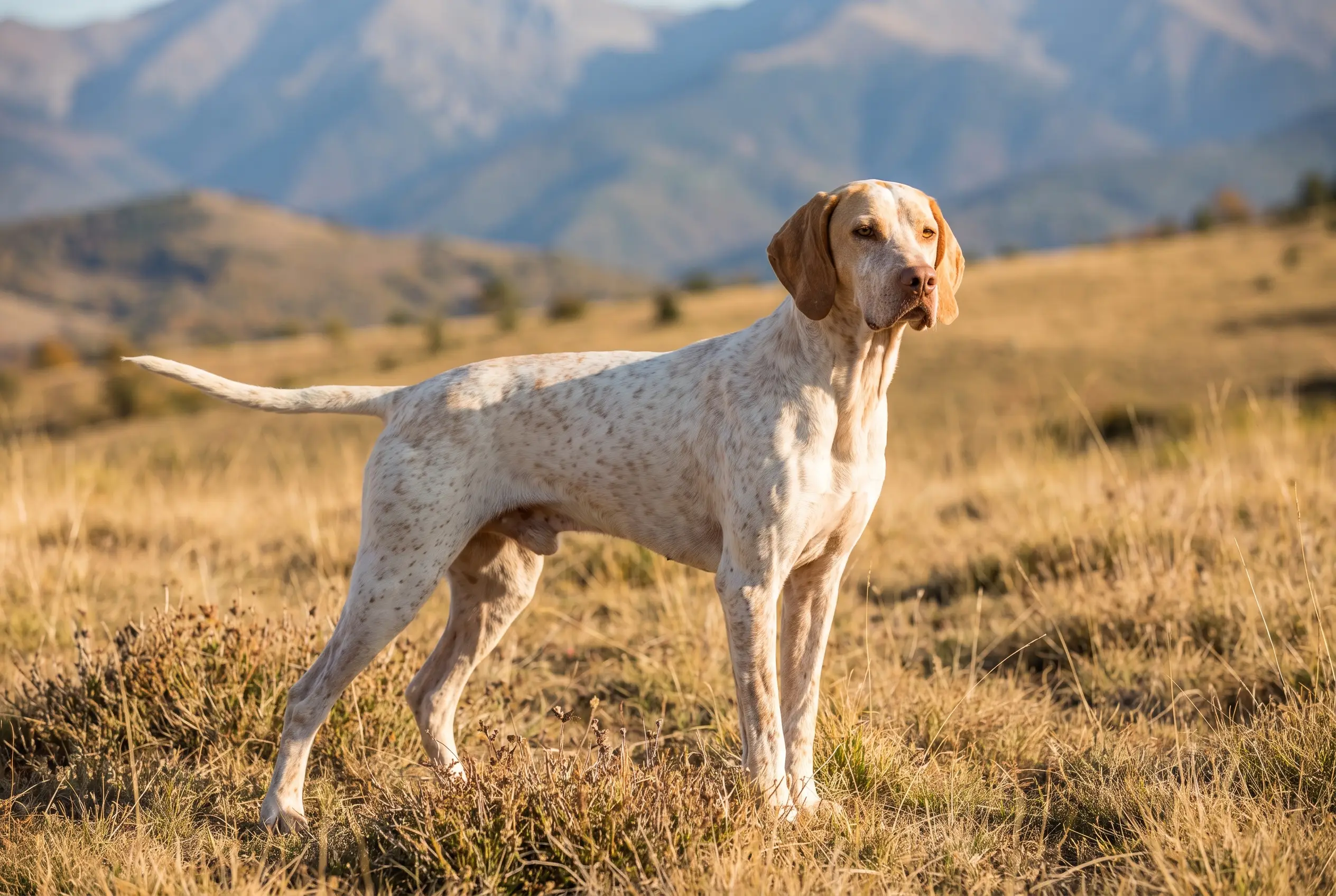
Braque de l'Ariège
The white-and-orange braque of the Pyrenean foothills, kept alive by a handful of huntsmen and rebuilt since 1990.
Vital stats
| Size | Large · 58–65 cm (dogs), 54–63 cm (bitches) |
| Weight | 25–30 kg — breed literature; the standard sets none |
| Life expectancy | 12–15 years — breed literature, not survey data |
| Energy | Very high — a working pointer bred for long days on rough ground |
| Shedding | Low to moderate — a short single coat |
| Coat | Short, thick, glossy · white-dominant over pale to vivid orange-fawn, sometimes ticked · never black |
| Group | Sporting · Continental Pointing Dogs, braque type (FCI №177, Group 7) |
| Origin | Ariège, France |
| FCI group | 7 — Pointing Dogs · FCI 177 |
Breed traits
Friendliness
Care
Mind
The Braque de l'Ariège by the numbers
The Braque de l'Ariège facts owners search for most — price, lifespan, weight, shedding and colours, in one place.
Less common, so expect a waitlist and some travel to a reputable breeder — which pushes the price up. Ongoing costs run high — more food, bigger doses at the vet, and pricier insurance.
We don't quote a single figure: the real price swings with breeder, region, bloodline and health testing — and a rescue costs a fraction of a breeder's litter. Adopting is almost always the cheapest route.
Temperament
'Stable and sociable with humans and other dogs' is the whole behaviour clause of the standard, and for a hunting braque the second half matters: this is a dog written up as easy company in a mixed kennel, not a loner. The same clause calls it adapted to all types of hunting, 'resistant, docile, and easy to train' — hunters' shorthand for a pointer that takes direction and keeps working through a full day on the hill. Beyond the standard there is very little published temperament literature, because there are very few dogs. Expect what the breeding selects for: a high-energy field companion that points, ranges wide, needs open ground and a job, and settles at home only once both are provided. Treat any finer-grained personality claim about this breed with suspicion — the sample size does not exist.
Habits & quirks
White that takes over
The colour clause describes a solid orange-fawn coat overrun by white — 'very extended or invasive white patches', sometimes ticked — in every shade from pale to vivid, with a little brown permitted. The result reads as a white dog wearing orange, most visibly on the head and ears.
Nothing black, anywhere
A black nose, black nails or a single black spot on the coat are each a disqualifying fault. The nose runs from orange to more or less pale brown to match the coat, and even the skin must carry no black patches.
Ears with a curl
The leathers are quite fine, long and curled in, set at eye level and carried away from the head; unstretched, they reach the beginning of the nose. Flat ears set high on the head are eliminatory — the curl is part of the breed's face.
The tail question
The standard has the tail traditionally docked by six-tenths but admits the natural long tail, carried horizontally and never above the topline. In the many European countries where docking is banned, the full tail is what you will see.
Health
The Braque de l'Ariège comes with no breed-wide health survey and no widely recognised breed-specific disease on record, so the useful advice here is about how it was bred, not a list of conditions. The modern dog descends from a small revival begun in 1990, and nearly all of it is still bred in France, so pedigree depth and how a breeder manages a narrow gene pool are fair questions — along with hip results, sensible for any pointer this size. Day to day, the ears carry the maintenance: fine, long, curled inward and folded against airflow, they hold moisture, so check and dry them weekly and after any day in the field. And as a deep-chested dog built to gallop, it earns a bloat precaution: keep meals calm and unhurried around hard exercise. Run it, feed it lean, and it stays a sound gundog.
Nutrition
| Exercise | Budget a couple of hours a day with genuine running in it. This is a breed judged with a working trial and bred to quarter rough Pyrenean foothills; hunting, field-trial training or long off-lead work in safe country suit it best, and a lead walk round the block does not count. |
| Grooming | The short, glossy coat asks for a weekly rub-down with a hound glove and little else. The long, folded leathers are the real job: check and dry them regularly, as with any drop-eared gundog, because a closed ear canal traps moisture. |
| Training | The standard calls it docile and easy to train, and the breed's survival depended on hunters who worked it, so it takes direction well. Start recall early all the same — a wide-ranging pointer follows its nose, and birds are its business. |
| Health | No breed-wide health survey exists, and the modern population descends from a small 1990 rebuild, so pedigree depth deserves real questions. Ask breeders about hip results and general soundness, and treat the 12–15 years in breed literature as a habit of the type rather than study data. |
This is a big, lean pointer bred for long days, so feed it to the work it actually does — a hunting day and a rest day are not the same bowl. Weigh the meals, count the training treats in the daily total, and keep ribs you can just feel under the short, glossy coat, because weight on a galloping frame costs it the stamina the breed exists for. The deep chest adds one rule beyond the amount: split the ration into two unhurried meals rather than one big gulp, and leave a clear gap around hard running rather than feeding right before or after.
Puppy guide
An Ariège puppy is a lot of engine in a young body, so grow it carefully. Lean on the breed's easy sociability from the start — this is a dog written up as good company with people and other dogs — and take a young pup to as many calm new places, surfaces and dogs as you can while keeping the hard galloping and jumping light until the joints have set. Start recall the week it arrives, because a wide-ranging nose is already the strongest thing about it, and teach it to settle indoors as deliberately as you teach it to come, so a working engine learns there is an off position.
Training
Its own standard calls it docile and easy to train, and the breed only survived because hunters kept working it, so it takes direction willingly. Use that: reward-based, consistent, and short enough to stay fun, because a keen worker learns fast when the sessions pay. The one thing to build early and never let lapse is recall — a pointer this wide-ranging will follow its nose to birds three fields away — so keep it steady around game with a long line until you trust it off one.
Life expectancy
Braques de l'Ariège live 12–15 years — breed literature, not survey data. A rustic working breed with no documented breed-specific disease, the Ariège holds the top of its range on the same things that keep it happy: lean condition, ears kept clean and dry, real daily running, and parents from a breeder who health-tests and manages the small gene pool with care.
Similar breeds
Breeds with a similar build and background — worth a look if this one isn't quite the fit.
Breeds that look like this
Common questions
How rare is the Braque de l'Ariège?
Rare enough that its own standard tells the story: numbers collapsed through the World Wars, a few Ariégeois huntsmen kept the breed working, and in 1990 a team of breeders took on its survival and renewal. No reliable current registration count is published, but nearly all breeding remains in France, and finding a puppy elsewhere means a waiting list and a journey.
How is it different from the other French braques?
It is its own breed with its own FCI standard, No. 177, recognised definitively in 1955. Per the standard's history it grew from the old French braques, lightened in the 19th century by crossings with southern braques of white-and-orange coat — and that coat became its signature: white-dominant over orange-fawn with black banned outright, where its cousins commonly carry brown or chestnut. It also stands at the tall end of the family, up to 65 cm.
Is it a good family or first dog?
It is sociable by standard — stable with people and other dogs — and breed sources describe a calm house companion once exercised. But this is a rare working gundog: most puppies go to hunting homes, the exercise bill is a working pointer's, and an under-run one will invent projects. Suit it to an active rural home, ideally one that shoots or does field sports, rather than a first-dog flat.
Does the Braque de l'Ariège shed a lot?
Moderately. The Braque de l'Ariège sheds a fair amount, steadily through the year with heavier seasonal patches. A weekly brush keeps most of the loose hair off your floors and clothes.
Is the Braque de l'Ariège hypoallergenic?
Not really. No dog is truly hypoallergenic, and the Braque de l'Ariège's shedding coat releases plenty of the dander that sets off allergies. If someone at home is allergic, this isn't the easiest breed to live with — spend time around one first.
Is the Braque de l'Ariège easy to train?
Yes. The Braque de l'Ariège is one of the more trainable breeds — quick to learn and keen to work with you, which makes reward-based training straightforward. Start early, keep it positive, and it picks things up fast.