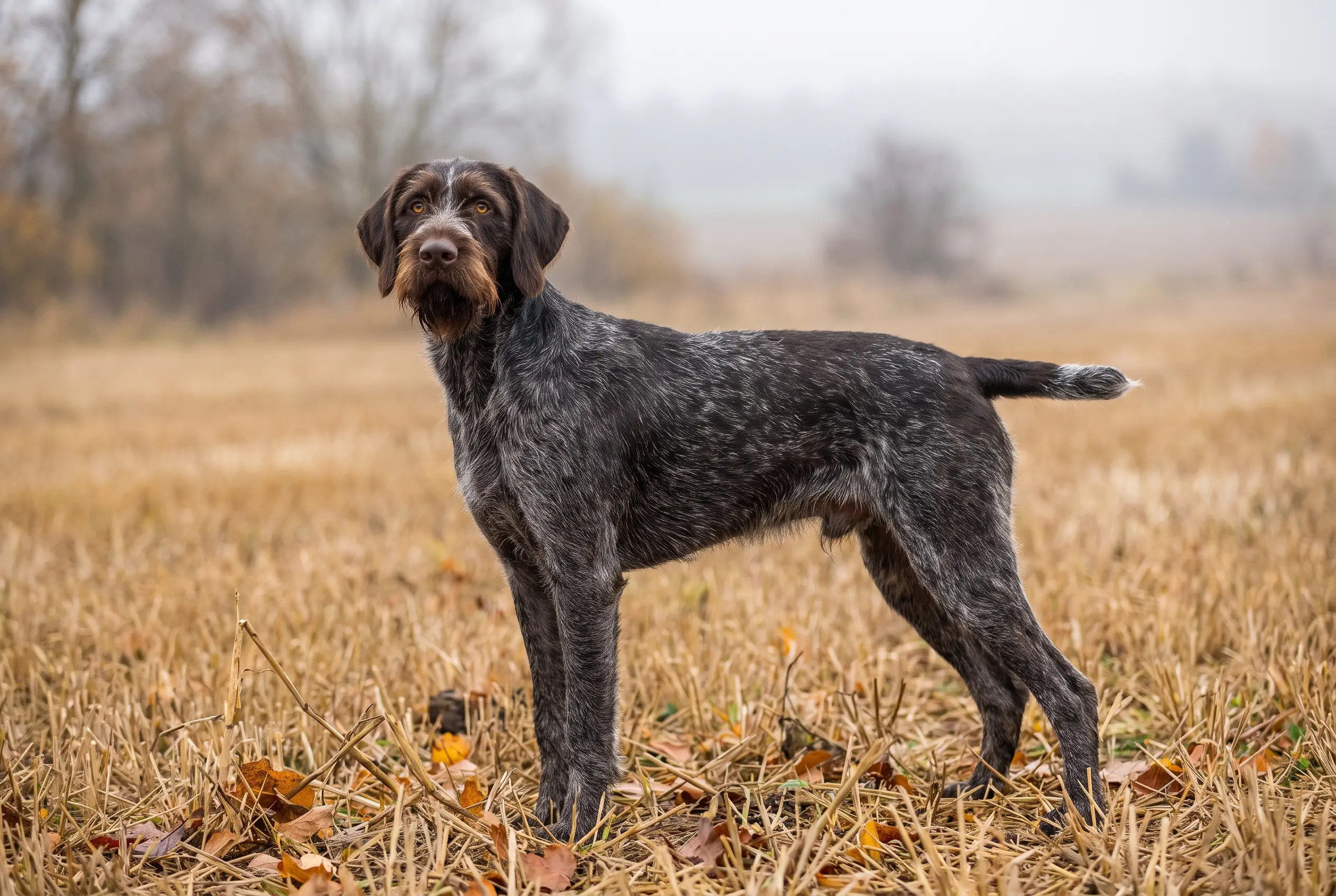
Český Fousek
Bohemia's bearded pointer — nearly gone by the 1920s, rebuilt into its homeland's second gundog.
Vital stats
| Size | Large · 60–66 cm (dogs), 58–62 cm (bitches) |
| Weight | 28–34 kg (dogs), 22–28 kg (bitches) — set by the standard |
| Life expectancy | 12–13 years — breed literature, not survey data |
| Energy | High — a working-trial breed bred for full days afield |
| Shedding | Moderate — the undercoat drops almost completely each summer |
| Coat | Three-layer wire coat with beard and eyebrows · dark roan, brown with ticking, or solid brown |
| Group | Sporting · Continental Pointing Dogs, «Griffon» type (FCI №245, Group 7) |
| Origin | Bohemia, Czech Republic |
| FCI group | 7 — Pointing Dogs · FCI 245 |
Breed traits
Friendliness
Care
Mind
The Český Fousek by the numbers
The Český Fousek facts owners search for most — price, lifespan, weight, shedding and colours, in one place.
Less common, so expect a waitlist and some travel to a reputable breeder — which pushes the price up. Ongoing costs run high — more food, bigger doses at the vet, and pricier insurance.
We don't quote a single figure: the real price swings with breeder, region, bloodline and health testing — and a rescue costs a fraction of a breeder's litter. Adopting is almost always the cheapest route.
Temperament
'Easily trained and very devoted to his master' is the standard's own summary, and it sits in the same sentence as the other half of the dog: 'innate sharpness to vermin.' That pairing is the breed. With its people the fousek is soft — the standard asks for almond eyes with a kind expression that 'denote an astute nature', and the North American club describes a dog that hunts for you and with you, not for itself. Around rats, martens and anything else it was once expected to dispatch, the old fire is still wired in: cats and small pets need careful early introductions, and running wildlife will be tested. This is a pointer judged with a working trial, built to cover field, water and forest in one outing. Give it that work, or a dog sport that imitates it convincingly, and the devoted family dog appears. Skip it and you own a large, bored, bearded problem.
Habits & quirks
Named for the beard
On the lower jaw and lips the hair grows longer and softer into the beard the standard calls typical of the breed, and the eyebrows point obliquely upwards. An insufficiently defined beard is a listed fault — this dog is contractually obliged to look like a wise old forester. Breed literature derives 'fousek' from the Czech for whiskers.
Three coats, one dog
The standard specifies three kinds of hair: a soft 1.5 cm undercoat that keeps water off the skin and is almost completely shed in summer, a harsh close-fitting 3–4 cm topcoat, and 5–7 cm guard hairs standing out on the forechest, topline, flanks and shoulders. The tail, by rule, must carry no brush underneath.
Brown, roan, and nothing else
Three colours are permitted: dark roan with or without brown patches, brown with ticked markings on the forechest and lower legs, and plain brown. A predominance of white is a fault and particolour is not permitted — and the nose leather must always be dark brown.
A ram's nose and webbed toes
The long, lean head carries a moderately arched nasal bridge the standard calls a ram's nose, over deep-set dark amber eyes under pronounced brows. Between the toes sits a noticeable remnant of webbing — the water half of the job description, written into the feet. The standard still specifies a tail docked by three-fifths; where docking is banned, the fousek carries a natural tail roughly level with the back.
Health
The Český Fousek is generally a sound working breed, and its one documented breed-specific quirk is a cosmetic one: atypical recurrent flank alopecia, seasonal patches of hair loss looked at in a 2022 genome study of 216 fouseks — probably polygenic, late in onset, and a matter of looks rather than pain. Ask a breeder about it, and ask for hip results as you would with any large gundog. The drop ears earn a look after every swim, since a water-working coat traps damp. There's no breed-wide health survey, so a breeder who knows their own lines is your best source.
Nutrition
| Exercise | Plan on two hours a day, and make some of it work: this is a hunting breed judged with a working trial, bred for whole days across stubble, reed beds and forest. Retrieving, tracking, swimming and versatile-gundog training all fit; a lead walk round the park is a warm-up, not a day's employment. |
| Grooming | The wire coat largely looks after itself: a thorough weekly brush, plus stripping out dead topcoat a few times a year. The undercoat drops almost completely each summer, so shedding peaks then. Rinse the beard after meals and muddy water, and check the drop ears after swimming. |
| Training | The standard calls it easily trained and it is, in the biddable continental-pointer way: short sessions, clear jobs, real rewards. Start recall on a long line early — the pointing instinct switches on young — and socialise deliberately around cats and small animals, because sharpness to vermin is written into the breed. |
| Health | Generally a sound working breed, with one documented breed-specific issue: atypical recurrent flank alopecia, seasonal patches of hair loss studied in a 2022 genome paper built on 216 fouseks — likely polygenic, late-onset, cosmetic rather than painful. Ask breeders about it, and for hip results as with any large gundog. No breed-wide health survey exists. |
This is a big, high-output gundog, so feed to the work in front of it: a fousek putting in full days afield burns far more than one having a quiet week, and the bowl should follow. Weigh the meals rather than guessing, count the training treats into the day, and keep him lean and hard-muscled — ribs easy to feel under that wiry coat. A working dog carrying extra weight loses exactly the stamina the breed is built on.
Puppy guide
A fousek puppy comes with the pointing instinct already wired in and a sharpness to vermin that's part of the breed, so two things start on day one: recall on a long line, taught early and often, and calm, deliberate introductions to cats and any small pets you keep. Socialise him widely and keep the growing body's work sensible — plenty of free play and exploring, less repetitive hard exercise while the joints are still forming. Give the busy mind small jobs from the start and you shape the willing, devoted adult the breed is known for.
Training
The standard calls the fousek easily trained, and it is, in the biddable continental-pointer way: short sessions, clear jobs and real rewards get you a long way. Put the early work into a reliable recall on a long line, because the pointing instinct switches on young and a self-employed gundog is hard to call back. Socialise deliberately around cats and small animals — the vermin-sharpness is bred in, not a fault to train out but a drive to manage — and give the dog genuine work to aim all that willingness at.
Life expectancy
Český Fouseks live 12–13 years — breed literature, not survey data. The Český Fousek is a hardy working breed with a good working life in it, and you get the most of that range the way the breed was meant to live: real daily work or a convincing substitute, a lean and well-muscled body, and a breeder behind the dog who knows their lines. Keep it fit and employed and a fousek stays a sound, willing companion for years.
Similar breeds
Breeds with a similar build and background — worth a look if this one isn't quite the fit.
Breeds that look like this
Common questions
Is a Český Fousek the same as a Wirehaired Pointing Griffon?
No — related type, separate breeds, separate standards. Korthals built his griffon in the 1870s from a handful of dogs in France and the Netherlands; it carries FCI standard No. 107 and stands 50–60 cm. The fousek is the Czech lands' own wirehaired pointer, FCI standard No. 245 since 1963, and taller at 58–66 cm. The two histories did cross: the North American Griffon club, after decades of importing European Griffons, brought in fousek blood, adopted the Český Fousek standard in 1995 and renamed itself Cesky Fousek North America in 2020.
Why is it so rare outside Czechia and Slovakia?
At home it never was rare — the standard's history places it second among all hunting breeds used in the Czech and Slovak Republics. Abroad it stayed a hunter's dog rather than a pet fashion: small populations, mostly in working homes, with the North American stock descending from a breed-club project rather than commercial breeding. If you meet one outside Central Europe, somebody in the family almost certainly hunts.
Is it a good family dog?
For an active family, yes — devotion to its people is in the standard's own wording, and the breed's kind, attached temperament is why the North American club gave up on improving Griffons and switched to fouseks entirely. The honest caveats: it needs genuine daily work, its vermin-sharpness makes small pets a planning question, the beard redistributes water across your floor, and a bored fousek is a large and inventive one.
Does the Český Fousek shed a lot?
Moderately. The Český Fousek sheds a fair amount, steadily through the year with heavier seasonal patches. A weekly brush keeps most of the loose hair off your floors and clothes.
Is the Český Fousek hypoallergenic?
Not really. No dog is truly hypoallergenic, and the Český Fousek's shedding coat releases plenty of the dander that sets off allergies. If someone at home is allergic, this isn't the easiest breed to live with — spend time around one first.
Is the Český Fousek easy to train?
Yes. The Český Fousek is one of the more trainable breeds — quick to learn and keen to work with you, which makes reward-based training straightforward. Start early, keep it positive, and it picks things up fast.