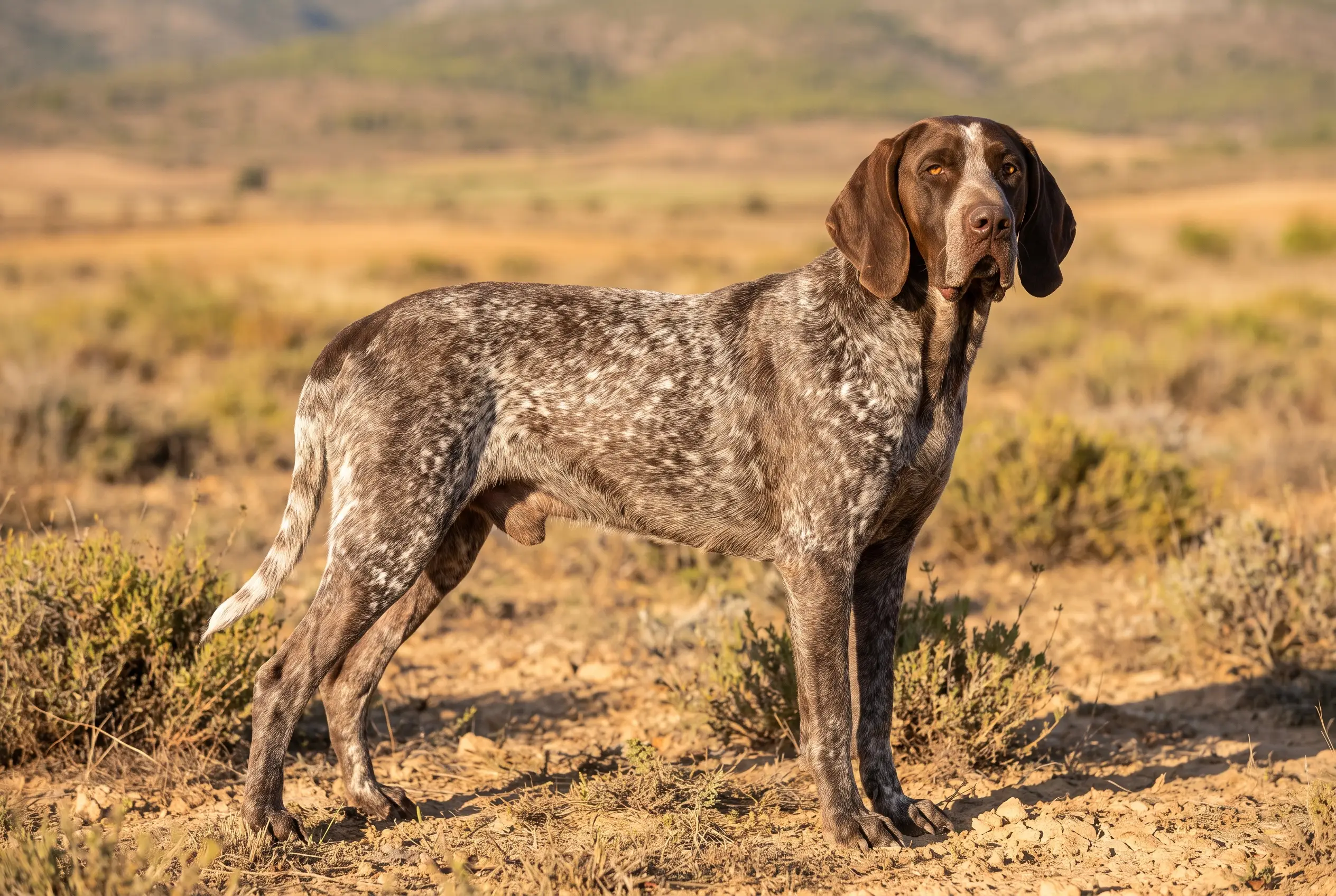
Burgos Pointer
Spain's heaviest pointer, marbled liver and white, with ears that hang in a corkscrew past its lips.
Vital stats
| Size | Large · 62–67 cm (males), 59–64 cm (bitches) |
| Weight | 25–30 kg — breed literature; the standard sets none |
| Life expectancy | 10–14 years — breed literature, not survey data |
| Energy | High — built for a full day's hunting at a steady pace |
| Shedding | Moderate — short, dense coat, sheds year-round in normal amounts |
| Coat | Short, dense and smooth · white and liver, marbled, speckled or greyish liver, never black or tan |
| Group | Sporting · Continental Pointing Dogs, braque type (FCI №90, Group 7) |
| Origin | Burgos, Castile and León, Spain |
| FCI group | 7 — Pointing Dogs · FCI 90 |
Breed traits
Friendliness
Care
Mind
The Burgos Pointer by the numbers
The Burgos Pointer facts owners search for most — price, lifespan, weight, shedding and colours, in one place.
Less common, so expect a waitlist and some travel to a reputable breeder — which pushes the price up. Ongoing costs run high — more food, bigger doses at the vet, and pricier insurance.
We don't quote a single figure: the real price swings with breeder, region, bloodline and health testing — and a rescue costs a fraction of a breeder's litter. Adopting is almost always the cheapest route.
Temperament
The standard's own behaviour clause reads: "Robust, balanced, calm and sedate he is an excellent pointing dog, specializing in hunting feathered and small game. With his soft, very noble expression, it is a breed with an excellent temperament, docility and intelligence." That calm carries over off the field — this isn't a pointer that vibrates in the crate between drives. Breed literature adds that it is gentle, rarely startled and good with children, and that it matures slowly, typical of a large, heavy-boned breed. It still needs a job: the standard's disqualifying faults list "aggressive or overly shy dogs" and "any dog clearly showing physical or behavioural abnormalities," so an unbalanced temperament is judged as harshly as a structural fault.
Habits & quirks
Corkscrew ears, not just floppy
The standard doesn't call the ears merely pendulous — it says they "hang gracefully in corkscrew" and, drawn forward without stretching, should reach the corner of the lips but never the nose. Fine skin, soft leather, visible veins: they're built for hanging, not for standing up.
A double chin by design
The standard specifies a "well defined double dewlap starting from both corners of the lips" along the underline of the neck — loose enough to be visible, without being exaggerated.
A chest measurement written into the standard
The standard gives an exact formula: chest girth should equal the height at the withers plus a quarter of that height. On a 65 cm dog that works out to roughly 81 cm around the chest — deep, round ribs, not the flatter-sided build of a lighter pointer.
Liver and white, never anything else
The standard allows only white and liver, mixed into marbled, speckled or greyish-liver patterns; a white blaze on the forehead is common but not required, and the ears are always solid liver. Black colour or tan markings above the eyes and on the legs are never admitted.
Health
The FCI standard names no breed-specific health problems for the Burgos Pointer and asks only that breeding stock be functionally and clinically healthy — but it is a rare breed even in Spain, so the real work is finding a careful breeder. Ask about hip health and the depth of the pedigree; in a small population, breeding choices matter more than usual. Two everyday points come with the build. The ears are heavy, low-set and hang in a corkscrew, which traps moisture and wax, so check and clean them regularly. And this is a big, deep-chested dog — feed it to a settled routine and let it rest around meals rather than exercising hard on a full stomach. Keep it lean and well-muscled, the way a working gundog should be.
Nutrition
| Exercise | This is a working gundog conformed for a full day in the field at a "steady economical trot" — the standard's own phrase — rather than a sprint. An hour or more of real exercise daily keeps a Perdiguero sane; hunting, tracking games or long hikes suit its pace better than short bursts of fetch. |
| Grooming | The short, dense coat needs only a weekly brush. The hanging corkscrew ears are the real chore — check and clean them regularly, since heavy, low-set ears like these trap moisture and wax more than an upright ear does. |
| Training | The standard credits it with "docility and intelligence," and breed literature backs that up: it picks up hunting work readily. Its calm temperament suits patient, reward-based training better than a high-pressure approach. |
| Health | The standard names no breed-specific health conditions and states only that breeding stock should be "functionally and clinically healthy." Breed literature flags it as a rare breed even in Spain today, so ask about pedigree depth and hip health with any breeder — sound practice for a numerically small population, not a documented health scheme. |
The Burgos Pointer is a large working gundog, so feed it to the job in front of it — a dog hunting full days in season needs more than the same dog resting through summer, and the bowl should follow that. Weigh the meals, count treats into the day's total, and keep it lean and muscled, with ribs you can feel; extra weight is hard on the joints of a heavy, slow-maturing breed. It is deep in the chest, so a steady routine helps: split the day's food across two meals and let the dog settle rather than run hard right after eating.
Puppy guide
A Burgos Pointer puppy becomes a large, heavy-boned dog that matures slowly, and that shapes the first two years. Keep the growing joints in mind — plenty of free play and gentle walks, but go easy on forced running, big jumps and hard exercise until the frame has finished. Socialise widely and gently; the adult is calm and good with children, and early positive experiences keep it that way. Start reward-based training young, since this is a docile, quick-learning breed that takes to it readily, and build the ear-cleaning habit from the start so those heavy corkscrew ears are a routine rather than a fight.
Training
The standard credits the Burgos Pointer with docility and intelligence, and owners find it picks up work readily — this is a genuinely trainable gundog. Its calm, steady temperament suits patient, reward-based training far better than a heavy hand; pressure is wasted on a dog this willing. It matures slowly, so keep expectations age-appropriate and sessions varied and positive. Above all it needs a job: bred for a full day in the field, a Perdiguero given real work — hunting, tracking, long structured walks — is easy to live with, while one left idle is not.
Life expectancy
Burgos Pointers live 10–14 years — breed literature, not survey data. The Burgos Pointer is a robust breed with no documented breed-specific disease, and you keep it at the top of the range the plain way: a lean, well-muscled weight, real daily exercise for a dog built to work, those heavy ears kept clean and dry, and a breeder who guards the health and diversity of a numerically small population. The life figures in breed literature come from general sources rather than a survey, so treat them as a guide.
Similar breeds
Breeds with a similar build and background — worth a look if this one isn't quite the fit.
Breeds that look like this
Common questions
Is the Burgos Pointer the same as the English Pointer?
No — different breeds, distant relatives at most. Historians tie the old Spanish pointing dogs of the Burgos region to the foundation stock behind several European pointers, the English Pointer included, but today they are separate breeds with separate standards: the Perdiguero de Burgos is a heavier, square-built dog with corkscrew ears and a liver-marbled coat, carried on the FCI standard as No. 90 out of Spain, against the English Pointer's FCI No. 1 out of England.
Why is it also called the Spanish Pointer?
"Spanish Pointer" is the loose English nickname for Spain's own FCI breed, the Perdiguero de Burgos — but the same name is also used historically for the Old Spanish Pointer, an earlier, now-extinct type credited with helping found several European pointing breeds. The two aren't documented as the same dog, so treat "Spanish Pointer" as a nickname for the modern breed, not a claim of unbroken descent from the old one.
Are they good family dogs?
Yes, if there's room and work to give them. The standard describes a calm, docile, intelligent temperament, and breed literature adds that they're gentle and good with children. What they don't suit is apartment life — bred for open countryside, a Perdiguero needs space, daily exercise and, ideally, an actual hunting or tracking outlet.
Does the Burgos Pointer shed a lot?
Moderately. The Burgos Pointer sheds a fair amount, steadily through the year with heavier seasonal patches. A weekly brush keeps most of the loose hair off your floors and clothes.
Is the Burgos Pointer hypoallergenic?
Not really. No dog is truly hypoallergenic, and the Burgos Pointer's shedding coat releases plenty of the dander that sets off allergies. If someone at home is allergic, this isn't the easiest breed to live with — spend time around one first.
Is the Burgos Pointer easy to train?
Yes. The Burgos Pointer is one of the more trainable breeds — quick to learn and keen to work with you, which makes reward-based training straightforward. Start early, keep it positive, and it picks things up fast.