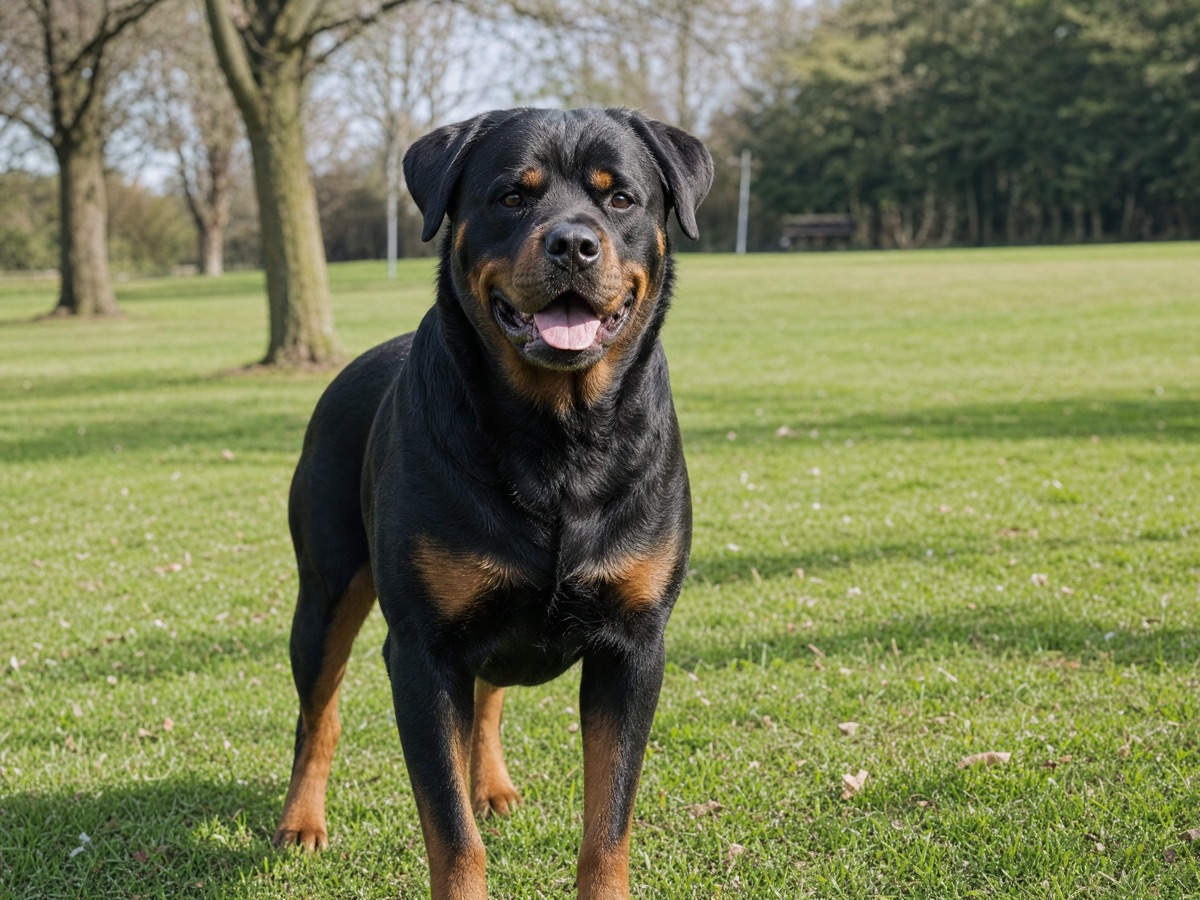
Rottweiler
A calm, confident guardian — steady of nerve, devoted to its family.
On these lists: Guard dogs · Protection dogs
Vital stats
| Size | Large · 56–69 cm |
| Weight | 35–60 kg |
| Life expectancy | 9–10 years |
| Energy | Moderate-high — 60+ min/day |
| Shedding | Moderate, year-round |
| Coat | Short double coat · black with tan markings |
| Group | Working · FCI №147 / AKC |
| Origin | Rottweil, Germany |
| FCI group | 2 — Pinscher and Schnauzer, Molossoid and Swiss Mountain Dogs · FCI 147 |
Breed traits
Friendliness
Care
Mind
The Rottweiler by the numbers
The Rottweiler facts owners search for most — price, lifespan, weight, shedding and colours, in one place.
Widely bred, so you can usually find a litter from a registered breeder without a long wait. Ongoing costs run high — more food, bigger doses at the vet, and pricier insurance.
We don't quote a single figure: the real price swings with breeder, region, bloodline and health testing — and a rescue costs a fraction of a breeder's litter. Adopting is almost always the cheapest route.
Temperament
Bred to drive cattle to market and guard the proceeds home, the Rottweiler carries centuries of working judgement: watchful, self-assured and slow to startle. With its family it is affectionate to the point of clinginess; with strangers it observes first and decides later. Give it structure, work and leadership, and its steadiness is remarkable.
Habits & quirks
The Rottie lean
Fifty kilos of guardian pressed warmly against your legs — an ancient droving habit turned love language.
The doorway audit
It settles where it can see every entrance; nothing crosses the threshold unlogged.
The rumbling purr
Contented Rottweilers produce a low grumble easily mistaken for growling — it's the breed's happy noise.
Velcro shadowing
Guardian breeds guard best at close range; expect an escort between rooms.
Health
The Rottweiler is a powerful, heavy-boned dog, and its main health concerns sit in the joints and the heart. Hips and elbows can develop dysplasia, and the breed carries a risk of heart disease, including dilated cardiomyopathy (DCM). Buy from a breeder who screens hips, elbows and hearts, keep your Rottweiler lean so those big joints aren't carrying extra load, and stay on top of vet checks as he grows and ages. A well-bred, lean Rottweiler is a robust dog; a heavy one is asking its joints for trouble.
Nutrition
| Training | Begin socialisation and obedience in puppyhood and never stop — a Rottweiler's power demands lifelong good manners. |
| Exercise | An hour or more daily, plus a job: carting, obedience, tracking or nosework keep mind and muscle honest. |
| Health | Screen for hip and elbow dysplasia and heart conditions; keep it lean to spare the joints. |
| Feeding | Measure meals and grow puppies slowly — rapid weight gain stresses a heavy-boned frame. |
Feed a Rottweiler to stay lean and to grow slowly, because rapid weight gain is exactly what a heavy-boned frame doesn't need. Weigh the meals rather than free-feeding, count treats in the daily total, and keep ribs you can feel under all that muscle. Puppies especially should come up slowly on a large-breed food — pushing a Rottweiler puppy to grow fast stresses joints that are still forming and stores up trouble for later.
Puppy guide
A Rottweiler puppy grows into a lot of dog, and the work you put in early decides what kind of adult you get. Start socialization and basic obedience the day he arrives and never really stop — a breed this powerful has to have lifelong good manners, and they are far easier to build in a puppy than to fix in an adult. Grow him slowly on large-breed food, keep the exercise joint-friendly while he's developing, and introduce him calmly and often to people, dogs and everyday life so he grows up steady and confident.
Training
A Rottweiler is clever, loyal and genuinely trainable, and because of its strength that training is not optional: it's the whole job. Begin obedience and socialization in puppyhood and keep them going for life, using calm, consistent, reward-based methods that this thoughtful breed responds to well. Give him a real job to do — carting, obedience, tracking or nosework — because a Rottweiler with work and structure is steady and devoted, while one left with neither is simply a very strong dog with nothing to think about.
Known health issues
No breed is problem-free. These are the conditions most worth knowing about for this breed — with what a good breeder screens for and what an owner watches. General guidance, not a substitute for your vet.
Hip dysplasia
A poorly fitting hip joint that wears early and can cause pain and arthritis, most common in larger breeds. Good breeders screen: Hip-scored parents (BVA/OFA/FCI). Watch for: Stiffness, a bunny-hop run, or reluctance on stairs.
Elbow dysplasia
A developmental fault in the elbow that leads to lameness and arthritis, seen in fast-growing large breeds. Good breeders screen: Elbow-scored parents. Watch for: Front-leg limping that worsens after exercise.
Heart muscle disease (DCM)
A weakening of the heart muscle that enlarges the heart, seen in several large and giant breeds. Good breeders screen: Heart-screened parents (echo/Holter where advised). Watch for: Tiring, coughing, fainting, or a swollen belly.
Life expectancy
Rottweilers live 9–10 years. Like most big, heavy breeds the Rottweiler is shorter-lived than a small dog, but you can push toward the better end of that range: keep him lean to spare the joints, buy from lines that screen hips, elbows and hearts, and don't let a powerful dog become a heavy one. Steady weight and good breeding are the two things most within your control.
Popular Rottweiler mixes
Rottador
A big, powerful, people-loving mix that needs early training and real daily exercise.
Rottle
A large, clever, lower-shedding cross that wants both a job and firm, kind guidance.
Pitweiler
A strong, muscular, loyal dog that lives for its family and demands committed socialization.
Boxweiler
A big, bouncy, protective mix with energy to burn and a goofy streak.
Rotterman
A powerful, alert guardian cross: smart, devoted, and a lot of dog for a confident, experienced hand.
Similar breeds
Breeds with a similar build and background — worth a look if this one isn't quite the fit.
Breeds that look like this
Common questions
Are Rottweilers dangerous?
Not by nature — they're calm and steady when well bred and socialised. Like any powerful breed, temperament comes down to breeding, training and responsible ownership.
Are Rottweilers good with children?
Yes with their own family, when raised together — they're affectionate and protective. Supervise around small children given the size and strength.
How much exercise does a Rottweiler need?
At least an hour a day of walks and purposeful activity, plus mental work. A bored, under-exercised Rottweiler is a large problem in the making.
Does the Rottweiler shed a lot?
Moderately. The Rottweiler sheds a fair amount, steadily through the year with heavier seasonal patches. A weekly brush keeps most of the loose hair off your floors and clothes.
Is the Rottweiler hypoallergenic?
Not really. No dog is truly hypoallergenic, and the Rottweiler's shedding coat releases plenty of the dander that sets off allergies. If someone at home is allergic, this isn't the easiest breed to live with — spend time around one first.
Is the Rottweiler easy to train?
Yes. The Rottweiler is one of the more trainable breeds — quick to learn and keen to work with you, which makes reward-based training straightforward. Start early, keep it positive, and it picks things up fast.