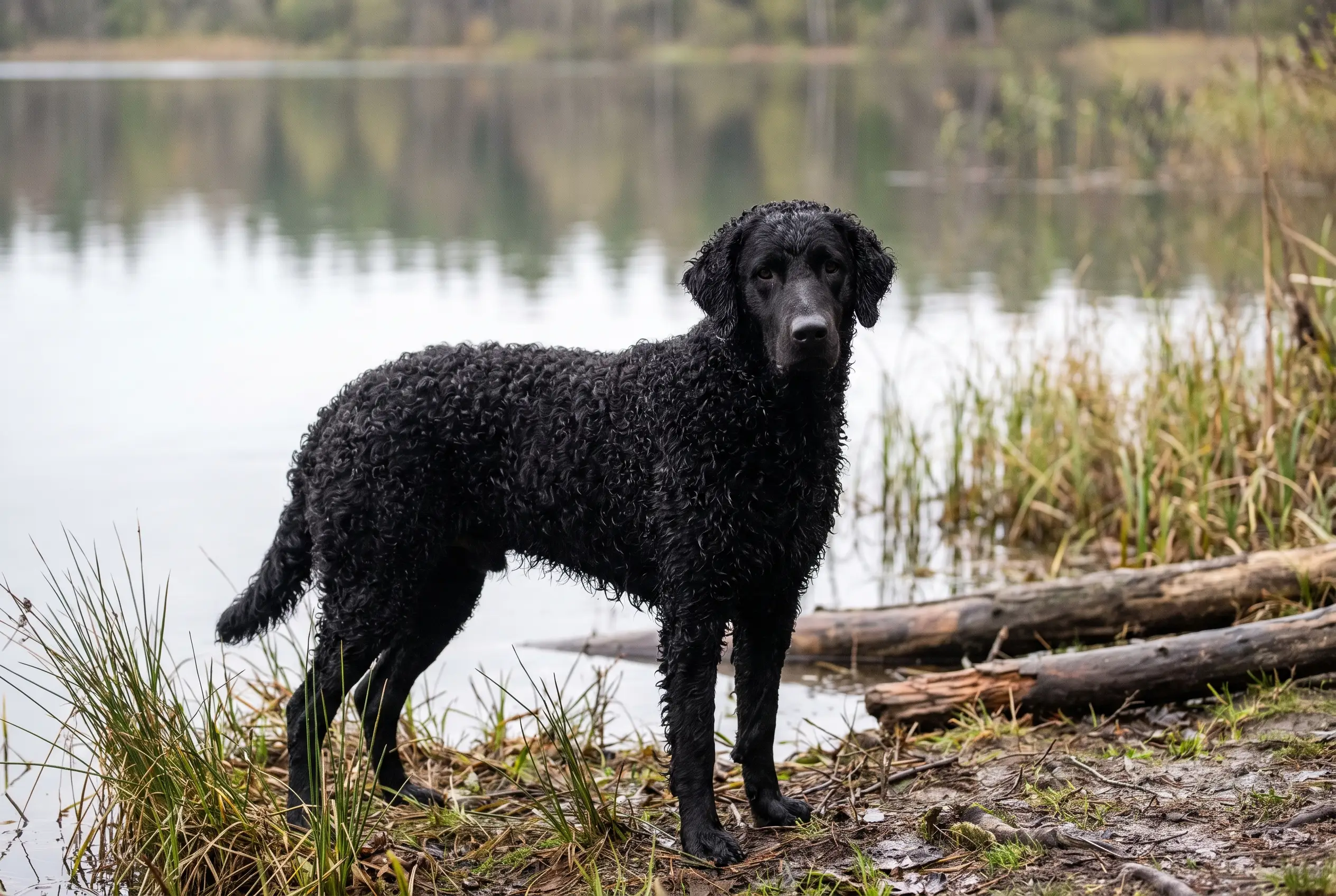
Curly-Coated Retriever
The oldest of the retrievers — a curl-armoured water dog with a mind of its own.
Vital stats
| Size | Large · 58–69 cm |
| Weight | 29–41 kg |
| Life expectancy | 10–12 years |
| Energy | High — 60–90 min/day |
| Shedding | Low–moderate, seasonal |
| Coat | Tight waterproof curls · black or liver |
| Group | Sporting · FCI №110 / AKC |
| Origin | England |
| FCI group | 8 — Retrievers, Flushing Dogs and Water Dogs · FCI 110 |
Breed traits
Friendliness
Care
Mind
The Curly-Coated Retriever by the numbers
The Curly-Coated Retriever facts owners search for most — price, lifespan, weight, shedding and colours, in one place.
Less common, so expect a waitlist and some travel to a reputable breeder — which pushes the price up. Ongoing costs run high — more food, bigger doses at the vet, and pricier insurance.
We don't quote a single figure: the real price swings with breeder, region, bloodline and health testing — and a rescue costs a fraction of a breeder's litter. Adopting is almost always the cheapest route.
Temperament
Bred as a gamekeeper's retriever to work long days at a distance, the Curly thinks before it obeys — a trait admirers call intelligence and trainers call negotiation. Aloof with strangers and devoted at home, it matures slowly, clowns with its family, and holds a lifelong conviction that every body of water needs testing.
Habits & quirks
Slow to grow up
Curlies stay puppyish well past two — budget patience accordingly.
The independent streak
It hears you; it's just weighing the offer.
Water finds it
Puddle, pond or sea — the curls demand testing.
Aloof, then all in
Reserved with new people, a comedian with its own.
Health
The Curly is a deep-chested breed, and that shape carries a real risk worth understanding before it ever happens: bloat, where the stomach fills with gas and can twist, is a genuine emergency. Learn the early signs — a swollen, hard belly, unproductive retching, obvious distress — and know your out-of-hours vet, because minutes matter. Split the daily food into two meals rather than one big bowl, and don't run hard on a full stomach. Beyond that, buy from a breeder who screens hips and eyes, and you have covered the breed's main watch-points.
Nutrition
| Exercise | A solid hour-plus daily, ideally with swimming and retrieving — a bored Curly invents hobbies. |
| Grooming | Never brush the curls dry; wet, scrunch and air-dry, with the odd tidy-up trim. |
| Health | A deep-chested breed — learn the signs of bloat, split meals, and screen hips and eyes. |
| Training | Keep sessions short and inventive; this retriever bores of repetition faster than its cousins. |
Feed a Curly as two meals a day rather than one, and keep the big bowl and the hard exercise well apart — for a deep-chested breed that habit is about the stomach, not just the waistline. This is a large, athletic retriever that does real work, so match the food to the day's activity and weigh it rather than eyeballing it. Keep the dog lean: you should feel ribs under the curls, and a lean retriever carries less strain on hips and joints for life. A good complete food suited to a large active breed is all it needs — the meal timing matters more here than the brand.
Puppy guide
A Curly puppy grows up slowly — expect a dog that stays puppyish well past two, so patience is part of the plan. Socialise widely and early while the mind is open, because this breed is naturally reserved with strangers, and the difference between aloof-but-fine and genuinely wary is made in the first year. Go easy on the joints of a big-boned puppy: build exercise up steadily rather than pounding a growing frame, and let swimming take some of the load, since water is where this dog is happiest anyway. Feed two smaller meals a day from the start, both for the growing dog and to build the deep-chested breed's habit early.
Training
The Curly thinks before it obeys — a trait its admirers call intelligence and its trainers call negotiation — so training it is a conversation, not a drill. It bores of repetition faster than a Labrador or a Golden, and a bored Curly quietly stops trying, so keep sessions short, varied and worth its while. Make the reward good and the task interesting and this clever retriever works with real willingness; grind the same exercise ten times and you'll watch it check out. Patience helps, because the dog matures slowly and takes its manners with it.
Life expectancy
Curly-Coated Retrievers live 10–12 years. Curly-Coated Retrievers live a fair span for a large breed, and you hold a dog at the top of it with the ordinary things that matter most here: lean weight, two meals a day rather than one for a deep-chested dog, and parents screened for hips and eyes. Keep the exercise real and the waistline honest across the years — a lean, fit Curly asks far less of its joints than a heavy one, and this is a retriever that stays young in spirit long after it has grown up.
Similar breeds
Breeds with a similar build and background — worth a look if this one isn't quite the fit.
Breeds that look like this
Common questions
Are Curly-Coated Retrievers rare?
Yes — despite being the oldest retriever breed, it is far scarcer than the Labrador or Golden. Expect a waiting list and a careful vetting chat with one of its few dedicated breeders.
Do Curly-Coated Retrievers shed?
Less than the other retrievers, mostly in seasonal bursts. The curls are scrunched with water rather than routinely brushed, which would frizz them.
Are Curlies good family dogs?
Yes, for active families: gentle with children they know and calmer indoors than a Labrador. They're more reserved with strangers and mature slowly, so patience helps.
Is the Curly-Coated Retriever hypoallergenic?
No dog is truly hypoallergenic, but the Curly-Coated Retriever comes closer than most: its low-shedding coat releases less of the dander that triggers allergies. Many allergy sufferers manage well with this breed, but spend time around one before committing.
Is the Curly-Coated Retriever easy to train?
Reasonably. The Curly-Coated Retriever is trainable with consistency and rewards, though it isn't the quickest study. Keep sessions short and positive, and be patient with the basics like recall.