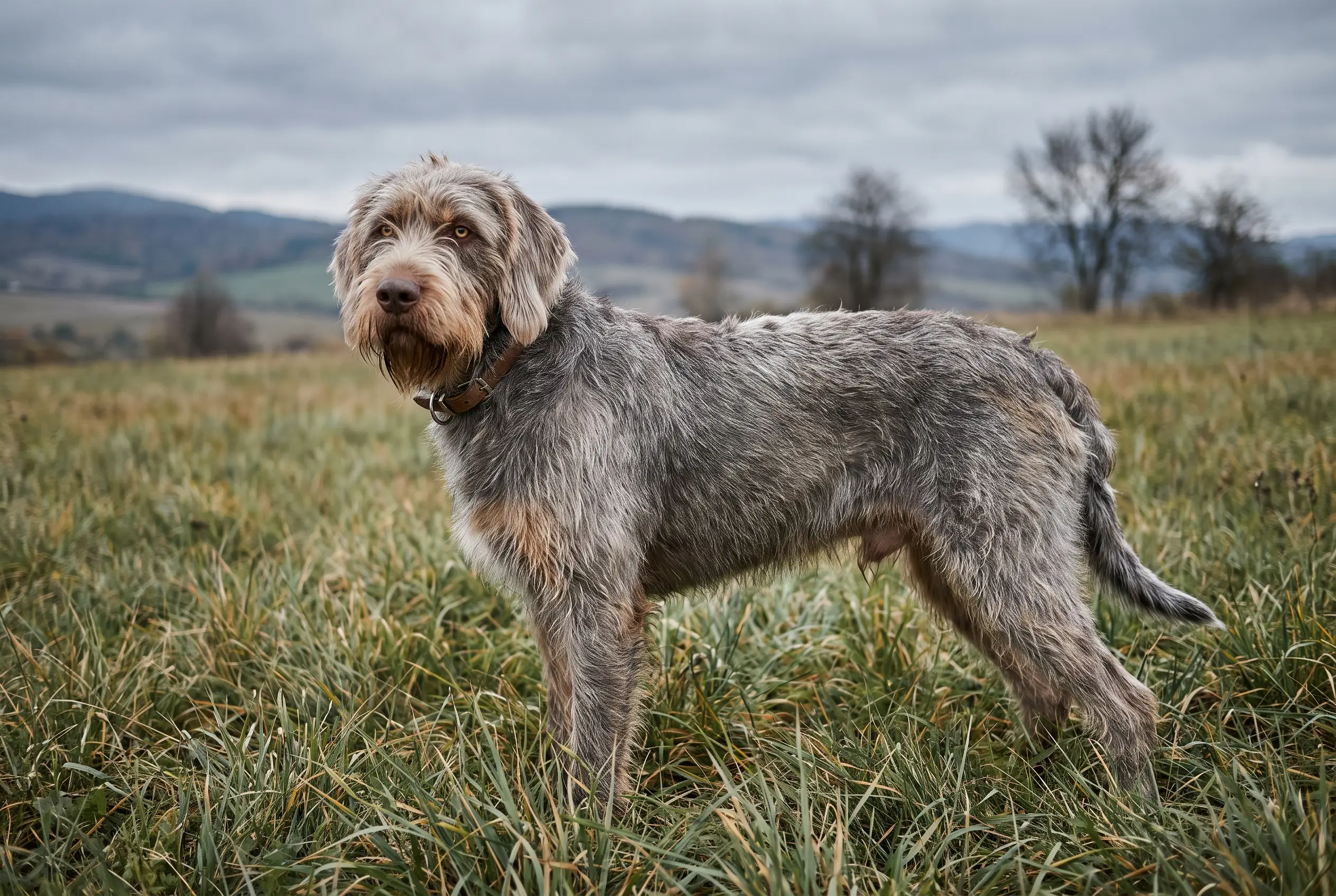
Slovakian Rough-haired Pointer
The standard allows exactly one coat colour, grey, and disqualifies every other one.
Vital stats
| Size | Large · 62–68 cm (dogs), 57–64 cm (bitches) |
| Weight | 25–35 kg — breed literature; the standard sets none |
| Life expectancy | 10–14 years — breed literature, not survey data |
| Energy | High — a working-trial pointer built for plain, forest and water in one day |
| Shedding | Moderate — the fine undercoat normally drops each summer |
| Coat | Harsh, straight topcoat about 4 cm, with moustache · grey is the standard's only permitted colour |
| Group | Sporting · Continental Pointing Dogs, Braque type (FCI №320, Group 7) |
| Origin | Slovakia |
| FCI group | 7 — Pointing Dogs · FCI 320 |
Breed traits
Friendliness
Care
Mind
The Slovakian Rough-haired Pointer by the numbers
The Slovakian Rough-haired Pointer facts owners search for most — price, lifespan, weight, shedding and colours, in one place.
Less common, so expect a waitlist and some travel to a reputable breeder — which pushes the price up. Ongoing costs run high — more food, bigger doses at the vet, and pricier insurance.
We don't quote a single figure: the real price swings with breeder, region, bloodline and health testing — and a rescue costs a fraction of a breeder's litter. Adopting is almost always the cheapest route.
Temperament
The standard folds temperament into general appearance rather than giving it its own clause: 'he is obedient and easy to train.' That is the whole of it, five words, sitting beside the demand that the dog be fit enough to work plain, forest and water in one outing and, in the standard's phrase, 'work after the shooting, searching and retrieving wounded game.' A steady mind matters enough to be enforced at the disqualification level: 'aggressive or overly shy dogs' fail outright, alongside any dog 'clearly showing physical or behavioural abnormalities.' Breed literature fills in what the standard leaves out: owners describe a loyal, eager-to-please dog that does well with children under supervision and, unlike some intense continental pointers, is not typically reported as prone to separation anxiety. It is still a working gundog bred for full days afield, and one with no job tends to invent its own.
Habits & quirks
Grey, full stop
The colour clause names exactly one base colour, brown shaded sable, said grey, allowed with lighter or darker shading, with or without white on the legs and chest, or more heavily marked and even speckled. Every other base colour is a disqualifying fault, not merely a severe one; a coat 'going to nearly white' is already a severe fault before it gets anywhere near that.
Blue-eyed as a puppy
Adult eyes are almond-shaped and amber. The standard separately notes that puppies and young dogs carry bluish, azure eyes that darken with age, one of the few FCI standards to write a colour change into the breed description.
A tail cut to the standard's own ruler
The tail is 'shortened (docked) at half length', carried down at rest and horizontal in action. Where docking is banned by local law, breeders keep it natural; the standard itself gives no fallback length for that case.
Angles, not adjectives
Most FCI standards describe front and rear construction in prose. This one gives numbers: a 110° shoulder angle, 135° at the elbow, 80–85° at the hip, 125–130° at the stifle, 125–135° at the hock, reading more like an engineering drawing than most breed standards ever do.
Care
| Exercise | An hour and a half to two hours a day, spread across more than one terrain. The standard built this dog to work plain, forest and water in a single outing, and a flat park walk uses none of that range. Retrieving from water, tracking and genuine field work all fit; dog sports that imitate them are the next best thing. |
| Grooming | The harsh, roughly 4 cm topcoat and soft moustache need a weekly brush and an occasional hand-strip to clear dead hair. The fine undercoat normally drops each summer, so expect a heavier few weeks then, and the beard drags water and mud indoors after any work near cover or water. |
| Training | The standard calls it obedient and easy to train, and breed owners generally agree. Short, purposeful sessions with a real job attached suit it better than repetition for its own sake. Socialise early around the same skills the breed was built for; pointing and retrieving switch on young. |
| Health | No health issue is written into the standard beyond its own faults list, and there is no breed-wide survey behind the life-expectancy figures quoted for it. The standard requires two normally descended testicles in males and states only functionally and clinically healthy dogs should be bred from; ask about hip screening too, as you would for any large working pointer. |
Life expectancy
This breed has a typical life expectancy of 10–14 years — breed literature, not survey data.
Similar breeds
Breeds with a similar build and background — worth a look if this one isn't quite the fit.
Breeds that look like this
Common questions
What breeds went into the Slovakian Rough-haired Pointer?
Three. Slovak cynologist Koloman Slimák built the breed in the 1950s by crossing the Weimaraner (FCI No. 99), for the grey coat and elegant build; the Český Fousek (FCI No. 245), for the working nose and rough, weatherproof coat; and the German Wirehaired Pointer, to fix the coat type and add resilience. The result was filed as its own FCI standard, No. 320, recognised on a definitive basis in 1982.
Is it the same dog as the Wirehaired Pointing Griffon?
No, same job description, unrelated pedigree, and a name close enough to cause real confusion. The Wirehaired Pointing Griffon (FCI No. 107) is Eduard Korthals's breed, built in France and the Netherlands in the 1870s, standing smaller at 50–60 cm with a longer coat. The Slovakian Rough-haired Pointer (FCI No. 320) is a separate, 1950s Slovak breed built from the Weimaraner and Český Fousek, not from Korthals's dog at all, and stands taller: 57–68 cm depending on sex.
Is it a good family dog?
For an active household, yes. Breed literature describes it as loyal and eager to please, and unlike some intense continental pointers it is not typically flagged as separation-anxious. It still needs genuine daily work beyond a lead walk, supervision with young children given its size and energy, and an owner willing to put a nose this good to use.
Does the Slovakian Rough-haired Pointer shed a lot?
Moderately. The Slovakian Rough-haired Pointer sheds a fair amount, steadily through the year with heavier seasonal patches. A weekly brush keeps most of the loose hair off your floors and clothes.
Is the Slovakian Rough-haired Pointer hypoallergenic?
Not really. No dog is truly hypoallergenic, and the Slovakian Rough-haired Pointer's shedding coat releases plenty of the dander that sets off allergies. If someone at home is allergic, this isn't the easiest breed to live with — spend time around one first.
Is the Slovakian Rough-haired Pointer easy to train?
Yes. The Slovakian Rough-haired Pointer is one of the more trainable breeds — quick to learn and keen to work with you, which makes reward-based training straightforward. Start early, keep it positive, and it picks things up fast.