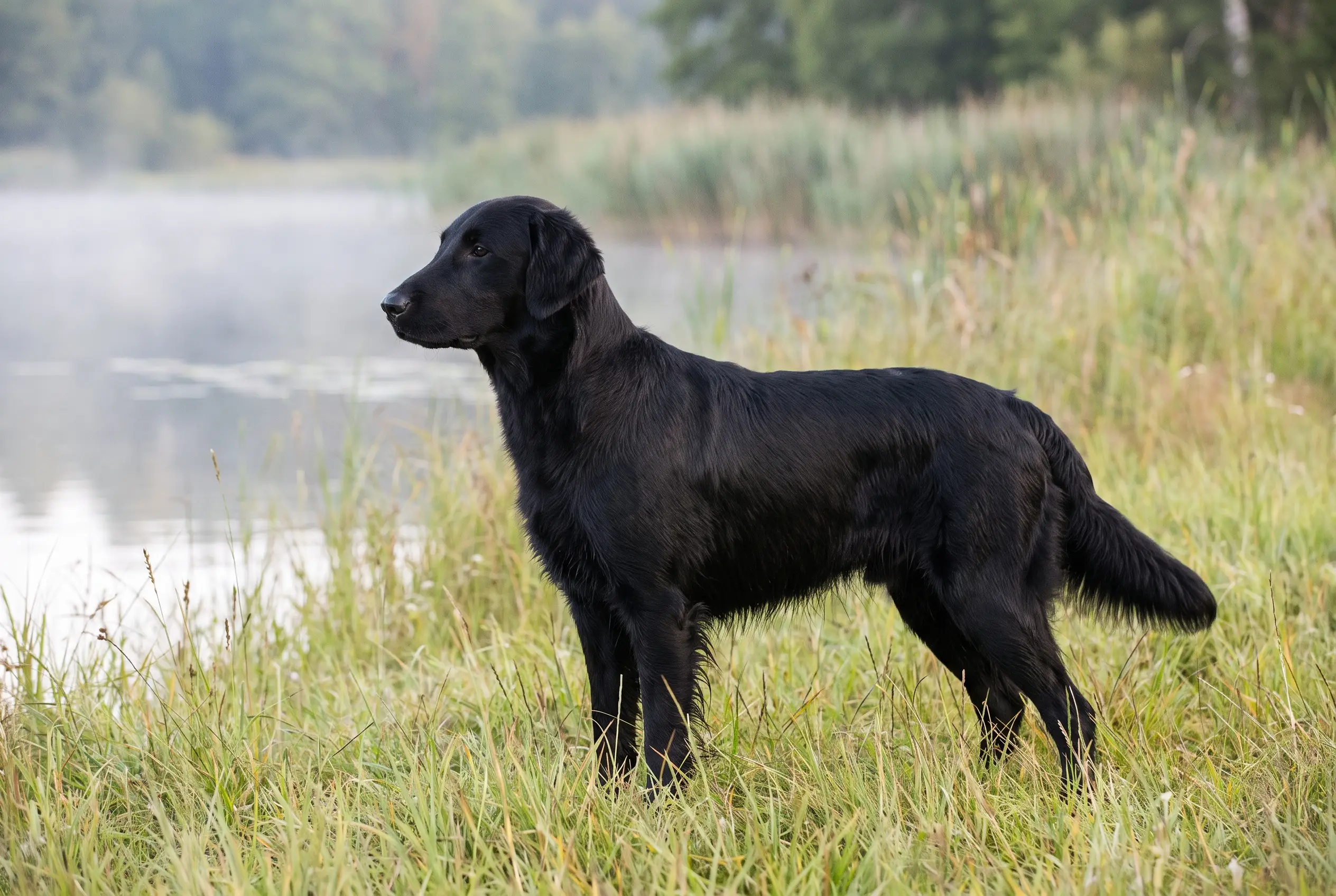
Flat-Coated Retriever
The Peter Pan of retrievers — a gleam of black feathering that refuses to grow up.
On these lists: Family dogs
Vital stats
| Size | Large · 56–62 cm |
| Weight | 25–36 kg |
| Life expectancy | 8–10 years |
| Energy | High — 90+ min/day |
| Shedding | Moderate, year-round |
| Coat | Sleek, feathered · solid black or liver |
| Group | Sporting · FCI №121 / AKC |
| Origin | England |
| FCI group | 8 — Retrievers, Flushing Dogs and Water Dogs · FCI 121 |
Breed traits
Friendliness
Care
Mind
The Flat-Coated Retriever by the numbers
The Flat-Coated Retriever facts owners search for most — price, lifespan, weight, shedding and colours, in one place.
Widely bred, so you can usually find a litter from a registered breeder without a long wait. Ongoing costs run high — more food, bigger doses at the vet, and pricier insurance.
We don't quote a single figure: the real price swings with breeder, region, bloodline and health testing — and a rescue costs a fraction of a breeder's litter. Adopting is almost always the cheapest route.
Temperament
Bred as the Victorian gamekeeper's all-purpose retriever on land and water, the Flat-Coat works with a wagging, almost giggling enthusiasm it never outgrows. It greets strangers as overdue friends, retrieves anything portable, and treats every day as a festival. Maturity arrives late, if at all — which is precisely the charm.
Habits & quirks
The welcome committee
Guests, postmen, total strangers: all are received as guests of honour, possibly with a gift in mouth.
Forever puppy
The bouncing greeting of a one-year-old is still in service at eight.
Water first
Ponds, puddles and questionable ditches exert a magnetic pull on that feathered coat.
The head tilt
Talk to a Flat-Coat and it listens with its whole face, head cocked, tail already agreeing.
Health
The Flat-Coat's health is overshadowed by one hard fact: cancer. The breed carries a high cancer risk, histiocytic sarcoma above all, and its lifespan runs shorter than most retrievers because of it. There is no screening test for that, so your best defence is a breeder who talks openly about the ages and causes of death in their lines, and who also screens hips and eyes. Keep your Flat-Coat lean and fit, learn what is normal for your dog so you catch changes early, and keep up regular vet checks as it ages.
Nutrition
| Exercise | Ninety minutes daily with retrieving and, ideally, swimming — this dog was built for both halves of a shoot. |
| Health | The breed carries a high cancer risk, notably histiocytic sarcoma; choose breeders who are open about longevity in their lines and screen hips and eyes. |
| Grooming | Brush the sleek coat and feathering weekly, more after wet or brambly outings. |
| Training | Eager and quick but easily bored by drilling — keep it playful and the Flat-Coat will work all day for you. |
A Flat-Coat is a big, active retriever with a real appetite, so measure every meal and count treats into the day's total — ribs you can feel but not see. Through the first year, feed a large-breed puppy formula so the dog grows slowly and the joints have time to form. Lean is the goal at every age: extra weight loads the joints and does a hard-working dog no favours.
Puppy guide
A Flat-Coat puppy is sociable, bouncy and slow to grow up — it will still greet you like a puppy at eight. Keep exercise gentle while the joints are forming, roughly five minutes of walk per month of age, and go easy on stairs and long runs. Socialise early and often, because a well-met Flat-Coat stays confident and friendly for life, and start on a calm greeting before the bouncing hello becomes a habit that flattens visitors.
Training
Flat-Coats are quick, eager students who live to please, but they bore fast when a lesson turns into drilling. Keep it playful and varied, reward generously, and this dog will work with you all day. Give a young one a job and something to carry, and teach recall early — an off-lead Flat-Coat left to its own devices will invite the whole park to play.
Life expectancy
Flat-Coated Retrievers live 8–10 years. Cancer is what shortens most Flat-Coat lives, and there is no test to screen it out — which puts the weight on the breeder you choose. Ask directly about longevity and causes of death in their lines, keep your dog lean and fit, and learn its body well enough to catch a new lump or a change early, with regular vet checks as it ages. None of that removes the risk, but it gives your Flat-Coat the best shot at the top of that range.
Similar breeds
Breeds with a similar build and background — worth a look if this one isn't quite the fit.
Breeds that look like this
Common questions
Are Flat-Coated Retrievers good family dogs?
Wonderful ones for active households — gentle, playful and endlessly sociable. Their bouncy, slow-to-mature energy can be a lot around toddlers.
Why are Flat-Coated Retrievers less common than Labradors?
Fashion moved on: the Labrador and Golden overtook it after the World Wars and never looked back. Devotees consider the relative obscurity a well-kept secret.
What health problems affect Flat-Coated Retrievers?
Cancer is the breed's great sorrow, with histiocytic sarcoma notably over-represented, and lifespans are shorter than most retrievers. Ask breeders directly about the ages and causes of death in their lines.
Does the Flat-Coated Retriever shed a lot?
Moderately. The Flat-Coated Retriever sheds a fair amount, steadily through the year with heavier seasonal patches. A weekly brush keeps most of the loose hair off your floors and clothes.
Is the Flat-Coated Retriever hypoallergenic?
Not really. No dog is truly hypoallergenic, and the Flat-Coated Retriever's shedding coat releases plenty of the dander that sets off allergies. If someone at home is allergic, this isn't the easiest breed to live with — spend time around one first.
Is the Flat-Coated Retriever easy to train?
Yes. The Flat-Coated Retriever is one of the more trainable breeds — quick to learn and keen to work with you, which makes reward-based training straightforward. Start early, keep it positive, and it picks things up fast.