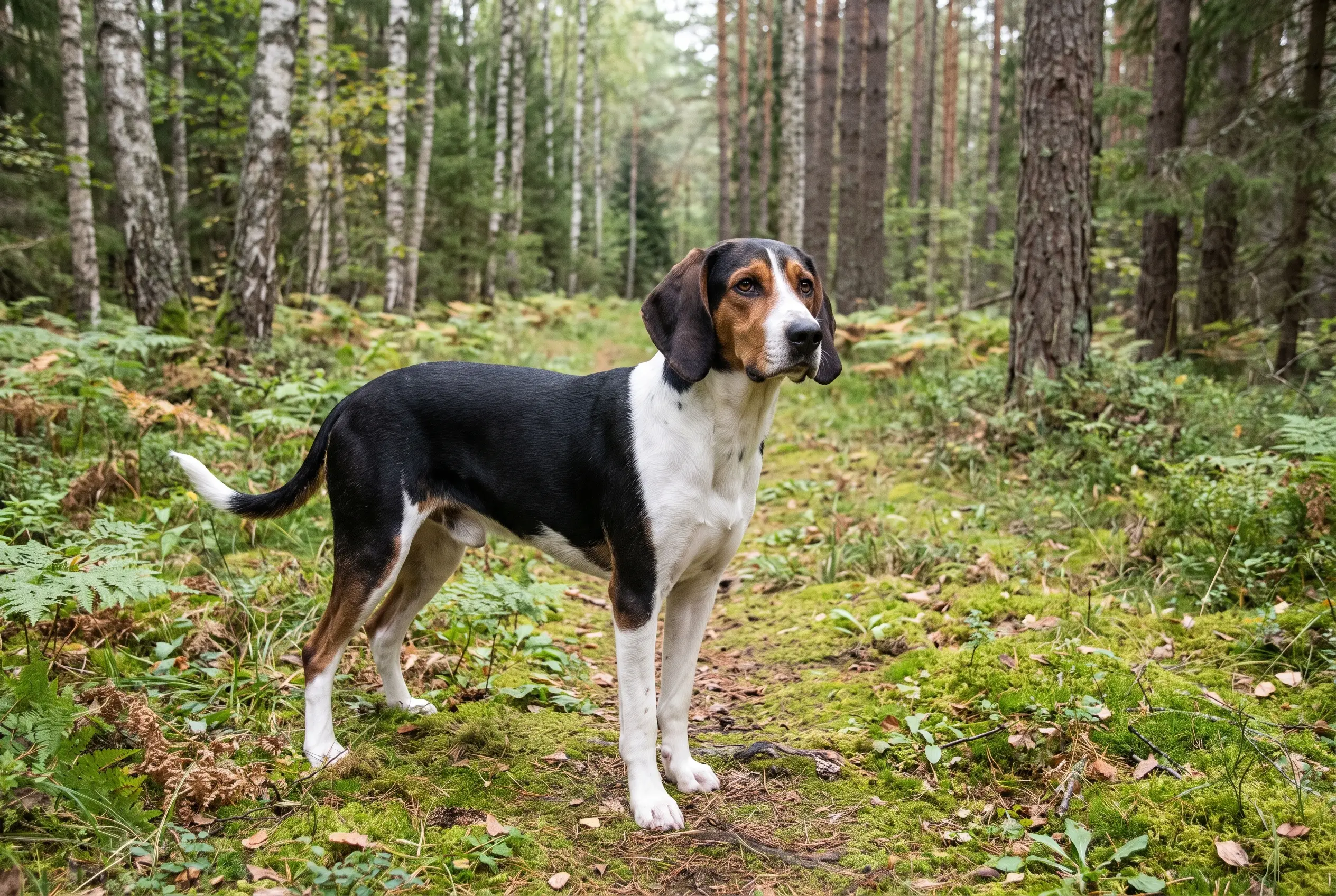
Eesti Hagijas
The only dog Estonia can call its own, built to a legal height limit instead of a breeder's eye.
Vital stats
| Size | Medium · 45–52 cm (males), 42–49 cm (females) |
| Weight | 15–20 kg — breed literature; the standard sets none |
| Life expectancy | 12–14 years — breed literature, not survey data |
| Energy | High — built for hours of scent-tracking stamina |
| Shedding | Low to moderate — short coat, moderate undercoat |
| Coat | Short, harsh, glossy · tricolour (black/tan/white) or bicolour (lemon-tan/white) |
| Group | Hound · Medium-sized Hounds (FCI №366, Group 6) |
| Origin | Estonia |
| FCI group | 6 — Scent hounds and related breeds · FCI 366 |
Breed traits
Friendliness
Care
Mind
The Eesti Hagijas by the numbers
The Eesti Hagijas facts owners search for most — price, lifespan, weight, shedding and colours, in one place.
Less common, so expect a waitlist and some travel to a reputable breeder — which pushes the price up. Plan for steady ongoing costs — mid-range food, routine vet care and insurance.
We don't quote a single figure: the real price swings with breeder, region, bloodline and health testing — and a rescue costs a fraction of a breeder's litter. Adopting is almost always the cheapest route.
Temperament
The standard's behaviour clause is short and reads like a job description: “Even-tempered, agile and friendly. Very well-developed sense of scent and detection of game and a pronounced passion for hunting guarantee good results in finding prey and tracking in difficult terrain. Resonant voice helps to locate the dog at long distance.” That resonant voice is not incidental — a hunter following on foot through forest is meant to track the dog by ear as much as by sight, and the standard treats a carrying voice as correct conformation, not a fault to breed out. At home the friendliness holds: this is not a wary or reserved hound the way some other FCI scent hounds are written, and it is built to work alongside other dogs in a pack. The one instinct owners in Estonia specifically have to manage is the one the breed was created to suppress — a strong nose that, without training, will still follow a deer.
Habits & quirks
A height limit wrote the breed
Independent Estonia banned hunting with hounds taller than 45 cm at the withers on 15 October 1937, specifically so packs couldn't run down roe deer; breeders who could prove a dog left deer and foxes alone got a reprieve to 55 cm in 1940. The current FCI standard still carries the logic in its own words, citing a lower height at the withers as the breed's founding measure, meant to keep hounds from tracking game too fast.
Built by government decree, not by fanciers
A 1947 Soviet ministry order required every Soviet republic to field its own hunting-dog breed. Estonian officials spent seven years evaluating roughly 2,460 hounds before narrowing the field to 48 dogs uniform enough to found a breed; the standard, drafted by Sergei Smelkov, was approved by ministry decree on 27 December 1954. The FCI granted its own recognition — provisional, not definitive — 65 years later, in 2019.
White feet and a white tail tip, no exceptions
The standard names two coat patterns, tricolour (black patches with tan and white) and bicolour (lemon-to-golden patches on white, no black), and ranks them as equals in the ring. What it won't allow either way: a dog without white on all four feet and the tip of the tail. Too little white, or too much solid colour, disqualifies outright.
A voice meant to be followed, not silenced
The standard calls the breed's voice resonant and credits it with helping a hunter locate the dog at long distance through forest. That's a working feature, not a flaw to breed down — expect a hound that gives tongue on a scent trail and has real opinions about visitors at the door.
Health
There's no breed-wide health survey behind the Estonian Hound, so honesty matters more than a checklist here. The 12–14 years usually quoted is breed literature, not study data, and the standard asks only that breeding dogs be functionally and clinically sound. The real thing to weigh is the gene pool: the population is small and concentrated in Estonia, and the national kennel union has flagged that many recent litters share close relatives, so ask a breeder about pedigree depth as seriously as you'd ask about hips. Beyond that it's a working hound's routine — keep him lean, keep the drop ears clean and dry after forest runs, and let a strong body do what it was built for.
Nutrition
| Exercise | This is a stamina scent hound bred to trail hare and fox for hours through forest terrain, not a dog satisfied by a lead walk around the block. Off-lead time on secured land, scent games or real hunting work suit it best; in its home country, owners also have to train the one instinct it was engineered to lack — leaving roe deer alone. |
| Grooming | The coat is short, harsh and glossy with a moderate undercoat. A weekly brush is enough outside of shedding season, and there's no long fur or feathering to manage. |
| Training | The standard's own words — even-tempered, agile, friendly — describe a biddable dog by scent-hound standards, but the nose still runs the show on a trail. Start recall early, keep sessions short and reward-based, and expect instinct-led hunting work to come easiest. |
| Health | The standard's only health clause requires breeding stock to be functionally and clinically healthy; there's no breed-wide health survey behind the 12–14 years usually quoted. The population is small and concentrated in Estonia, and the national kennel union has flagged that many recent litters share close relatives — ask breeders about pedigree depth as much as about hips. |
This is a stamina hound built to trail for hours, so feed to the work he actually does — a hunting weekend and a quiet week don't burn the same fuel. Weigh the meals, count the scent-game and training treats in the day's total, and keep ribs you can feel under that short coat. A lean Estonian Hound covers ground all day; carrying extra weight steals the endurance the whole breed is for.
Puppy guide
An Estonian Hound puppy comes wired to follow its nose, and that instinct is the thing to shape early. Start recall the day he comes home and make coming back the best deal on offer, because a nose on a fresh trail stops listening fast. Keep the hard running light while the joints are still forming, socialize him widely so a friendly hound stays friendly, and get him used to other dogs — this is a pack breed and happier for the company. Outside Estonia the breed is genuinely rare, so expect a wait and a real conversation with the breeder before a pup is even yours.
Training
By scent-hound standards this is a biddable dog — the standard's own words are even-tempered, agile and friendly — but on a trail the nose still runs the show. Start recall early, keep sessions short and reward-based, and expect instinct-led work like tracking to come easiest of all. The one job that takes real effort is the one the breed was built to lack: teaching it to leave deer alone. Give it scent work to pour that drive into and the manners come far easier.
Life expectancy
Estonian Hounds live 12–14 years — breed literature, not survey data. The Estonian Hound is a hardy, working-built hound with no formal survey behind its numbers, so you keep it at the top of the range the plain way: lean weight, plenty of real exercise, and a breeder chosen as much for pedigree depth as for tested hips. It's a small gene pool, and a well-bred, well-worked dog is your best odds of a long one.
Similar breeds
Breeds with a similar build and background — worth a look if this one isn't quite the fit.
Breeds that look like this
Common questions
Is the Estonian Hound a new breed?
Depends what you're counting. As a breed, no — Estonian officials approved its standard by ministry decree on 27 December 1954, after seven years spent evaluating thousands of hounds. As an FCI breed, yes: the FCI didn't grant it even provisional recognition until 4 September 2019, which makes it one of the newest breeds in the FCI's nomenclature despite having existed, formally, since the Soviet era.
How is it different from the Drever and other small Nordic hounds?
Mostly in the legs. The Drever (FCI No. 130) is a short-legged, dachshund-built hound standing 30–38 cm, developed in Sweden as a low, slow-moving trailer. The Estonian Hound (FCI No. 366) is a leggier, conventionally proportioned medium hound at 42–52 cm depending on sex — closer in silhouette to a small Foxhound than to a Dachsbracke — even where the coat colours land in similar territory. Both are Group 6 hounds shaped by local hunting rules, but they're not close relatives and don't look alike standing side by side.
Are Estonian Hounds good family dogs?
For an active household, yes — the standard calls the breed even-tempered and friendly, with no wariness-of-strangers clause the way some other FCI scent hounds carry. The trade-offs are the ones that come with any working scent hound: a resonant voice the standard treats as correct rather than excessive, and a nose-driven streak that needs real exercise and early recall training. Outside Estonia the breed is genuinely rare, so finding a breeder, or even meeting one, takes real effort.
Does the Eesti Hagijas shed a lot?
Moderately. The Eesti Hagijas sheds a fair amount, steadily through the year with heavier seasonal patches. A weekly brush keeps most of the loose hair off your floors and clothes.
Is the Eesti Hagijas hypoallergenic?
Not really. No dog is truly hypoallergenic, and the Eesti Hagijas's shedding coat releases plenty of the dander that sets off allergies. If someone at home is allergic, this isn't the easiest breed to live with — spend time around one first.
Is the Eesti Hagijas easy to train?
Reasonably. The Eesti Hagijas is trainable with consistency and rewards, though it isn't the quickest study. Keep sessions short and positive, and be patient with the basics like recall.