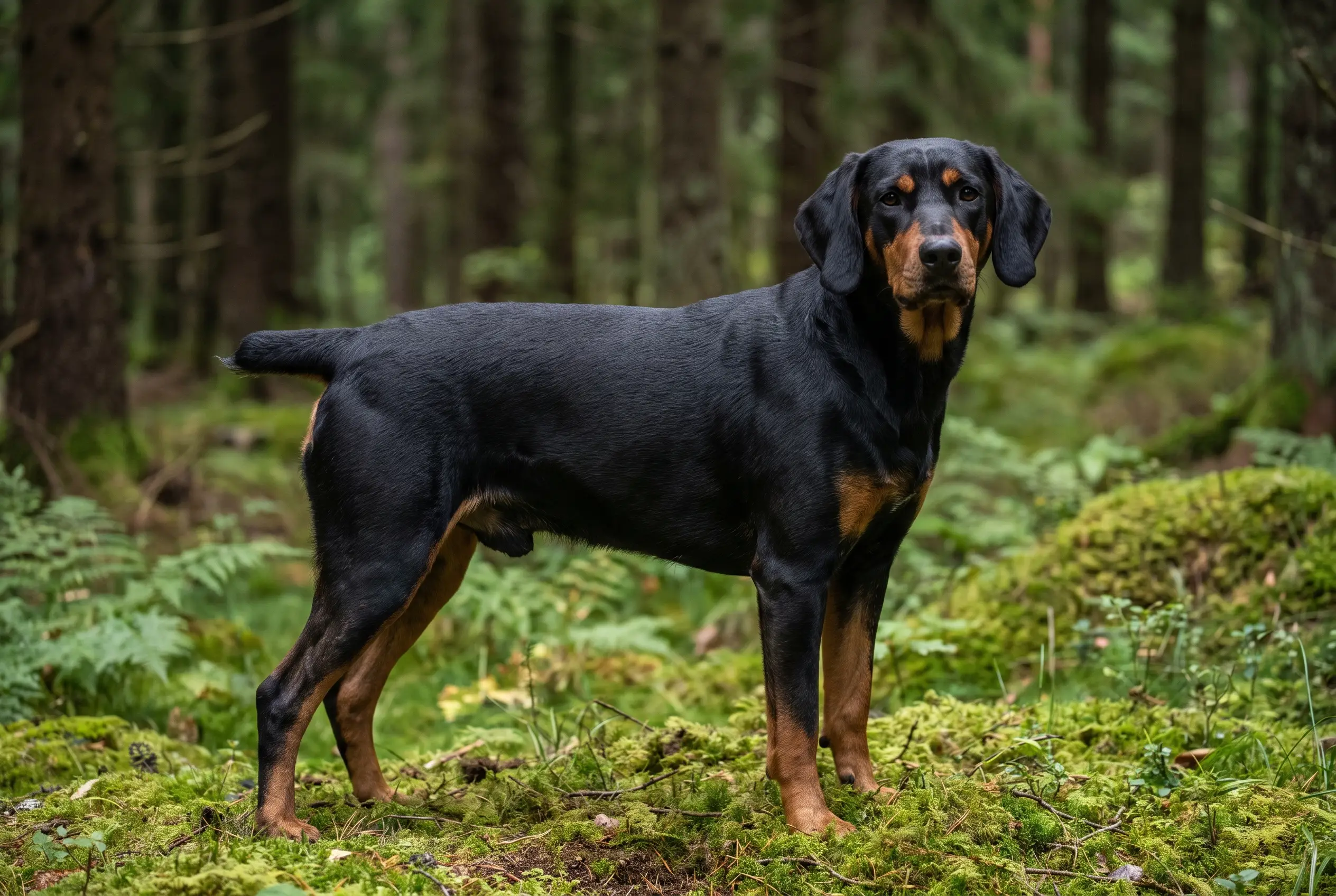
Smålandsstövare
Sweden's oldest hound — black-and-tan, genuinely rare, and often born with half a tail.
Vital stats
| Size | Medium · 46–54 cm (males), 42–50 cm (females) |
| Weight | 15–20 kg — breed literature; the standard sets none |
| Life expectancy | 12–15 years — breed literature, not survey data |
| Energy | High — built to trail hare and fox on foot all day |
| Shedding | Moderate — harsh, close double coat |
| Coat | Medium length, harsh and close-fitting · black or liver-brown with tan markings |
| Group | Hound · Medium-sized Hounds (FCI №129, Group 6) |
| Origin | Småland, Sweden |
| FCI group | 6 — Scent hounds and related breeds · FCI 129 |
Breed traits
Friendliness
Care
Mind
The Smålandsstövare by the numbers
The Smålandsstövare facts owners search for most — price, lifespan, weight, shedding and colours, in one place.
Less common, so expect a waitlist and some travel to a reputable breeder — which pushes the price up. Plan for steady ongoing costs — mid-range food, routine vet care and insurance.
We don't quote a single figure: the real price swings with breeder, region, bloodline and health testing — and a rescue costs a fraction of a breeder's litter. Adopting is almost always the cheapest route.
Temperament
The standard gives the breed's character in one line: calm, friendly dog with a faithful and keen temperament. It backs that up with an unusual list of disqualifying faults for a hunting breed — aggressive or overly shy dogs are struck out, and so, by name, is aloofness, a standoffishness most hound standards let pass without comment. In the field that keenness shows as a hound that works with real drive and gives tongue steadily on a line; at home it settles in as an attached, steady companion rather than one that keeps its distance. Breed literature adds that it can be watchful with strangers at the door, which sits alongside rather than against the standard's ban on true aloofness — alert is fine, checked-out is not.
Habits & quirks
Born with half a tail
Some Smålandsstövare arrive with a naturally short, stumpy tail rather than the standard long one, and the FCI standard rates both equally: "naturally born short tail (stumpy tail), bear-tail also permissible." Early-20th-century breeders leaned into the bobtailed dogs specifically to rebuild the breed, and that history still shows up in litters today.
Hunts alone, not in a pack
The standard states it plainly: "It is not a pack hound and is not used for hunting deer." It works hare and fox solo or with just a handful of others at most, trailing on foot with the hunter following the voice rather than riding behind a pack.
Loud the moment it's on a scent
Its listed job is a "scenthound that give tongue," meaning it bays continuously while working a line — the sound is how the hunter follows it out of sight. A bored or under-exercised one carries that same voice into the yard.
One of the rarest hounds with a real standard
Breed literature puts Swedish Kennel Club registrations at around sixty puppies a year, and the dog is close to unknown outside Scandinavia. Numbers thinned enough in the mid-20th century that the closed studbook was briefly reopened to unregistered dogs of the right type just to keep the gene pool viable.
Care
| Exercise | This is a hunting hound built for a full day on foot trailing hare and fox; a walk around the block does not come close. Give it real trailing time — an hour or more daily with scent work, tracking, or an actual hunting outing — and expect it to vocalise once it's on a line. |
| Grooming | The harsh, close-fitting coat needs a weekly brush and sheds moderately rather than in one dramatic blow; the longer hair under the tail and behind the thighs picks up burrs after a day in cover. Check the low-set, flat-hanging ears regularly. |
| Training | The standard calls it faithful and keen, a decent trainability baseline, but the nose still runs the show once a trail opens up. Keep sessions short and reward-based, and start socialisation early — the standard disqualifies aloofness as firmly as it disqualifies aggression, so a shut-down or standoffish adult is a training gap, not just a personality quirk. |
| Health | The standard requires only that breeding stock be functionally and clinically healthy with breed-typical conformation; it names no breed-specific conditions, and breed literature reports none widely documented either. The population is small enough, and was thin enough in the mid-20th century, that asking a breeder about pedigree depth and genetic diversity is sensible rather than optional. |
Life expectancy
This breed has a typical life expectancy of 12–15 years — breed literature, not survey data.
Similar breeds
Breeds with a similar build and background — worth a look if this one isn't quite the fit.
Breeds that look like this
Common questions
How rare is the Smålandsstövare?
Very. Breed literature puts Swedish Kennel Club registrations at around sixty puppies a year, and the breed is close to unknown outside Scandinavia, with no meaningful population in North America or the rest of Europe. It isn't recognised by the AKC. The FCI standard itself doesn't track population, so these are club and breed-literature figures, not an official census.
What's the difference between the Smålandsstövare, Hamiltonstövare, and Schillerstövare?
All three are Swedish stövare hounds with neighbouring FCI numbers, but they're separate breeds. The Smålandsstövare (FCI №129) is the smallest of the three and has the strongest claim to being the oldest, black or liver-brown with tan and sometimes a natural short tail. The Hamiltonstövare (FCI №132) is the largest and tricolour, black, tan and white. The Schillerstövare (FCI №131) sits in between in size and runs red-brown with a black saddle. A compact, black-and-tan hound missing part of its tail is the Smålandsstövare, not one of the other two.
Why do some Smålandsstövare have short tails?
It's a natural, inherited trait, not docking — the FCI standard explicitly permits a "naturally born short tail (stumpy tail)" alongside the standard long tail and scores them as equally correct. Tail length varied in the breed's 19th-century foundation stock, and the early-20th-century breeders who rebuilt the Smålandsstövare specifically favoured the short-tailed type, which is why it's still common today.
Does the Smålandsstövare shed a lot?
Moderately. The Smålandsstövare sheds a fair amount, steadily through the year with heavier seasonal patches. A weekly brush keeps most of the loose hair off your floors and clothes.
Is the Smålandsstövare hypoallergenic?
Not really. No dog is truly hypoallergenic, and the Smålandsstövare's shedding coat releases plenty of the dander that sets off allergies. If someone at home is allergic, this isn't the easiest breed to live with — spend time around one first.
Is the Smålandsstövare good with children?
Generally yes. The Smålandsstövare is a friendly, people-loving breed that usually does well with children when raised and socialised well. As with any dog, teach children to be gentle and supervise around toddlers.
Is the Smålandsstövare easy to train?
Reasonably. The Smålandsstövare is trainable with consistency and rewards, though it isn't the quickest study. Keep sessions short and positive, and be patient with the basics like recall.