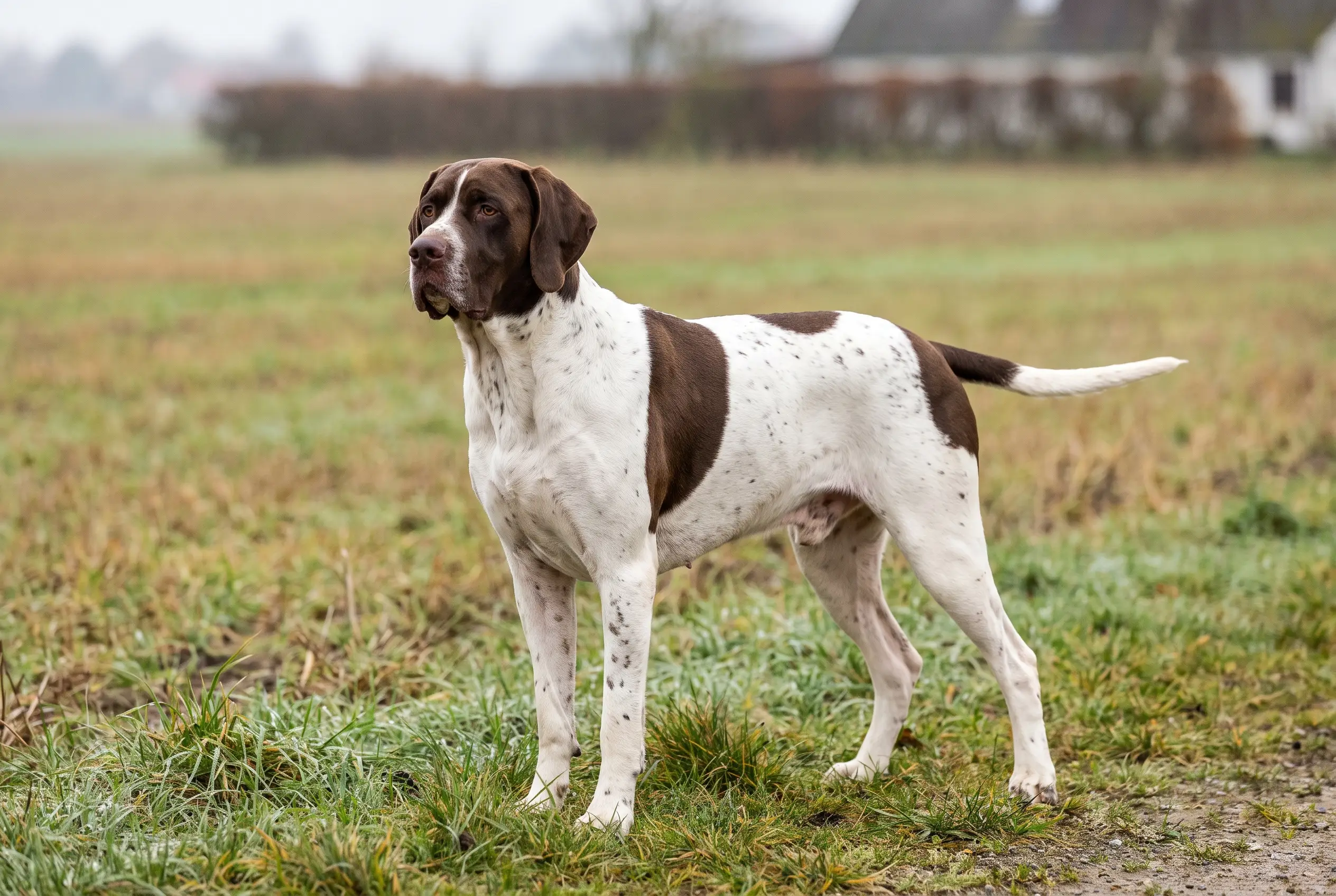
Old Danish Pointer
A deliberate Danish pointer built so differently by sex it reads like two breeds.
Vital stats
| Size | Medium · 54–60 cm (dogs), 50–56 cm (bitches) |
| Weight | 30–35 kg (dogs) · 26–31 kg (bitches) |
| Life expectancy | 12–14 years — breed literature, not survey data |
| Energy | Moderate-high — daily outdoor exercise, worked at a deliberate pace |
| Shedding | Moderate — short, dense coat |
| Coat | Short, dense, somewhat hard to the touch · white with brown markings and freckles |
| Group | Sporting · Continental Pointing Dogs, braque type (FCI №281, Group 7) |
| Origin | Jutland, Denmark |
| FCI group | 7 — Pointing Dogs · FCI 281 |
Breed traits
Friendliness
Care
Mind
The Old Danish Pointer by the numbers
The Old Danish Pointer facts owners search for most — price, lifespan, weight, shedding and colours, in one place.
Less common, so expect a waitlist and some travel to a reputable breeder — which pushes the price up. Ongoing costs run high — more food, bigger doses at the vet, and pricier insurance.
We don't quote a single figure: the real price swings with breeder, region, bloodline and health testing — and a rescue costs a fraction of a breeder's litter. Adopting is almost always the cheapest route.
Temperament
The standard's own words: it "conveys the impression of a quiet and stable dog showing determination and courage," and in the field it works "progressing rather slowly, always maintaining contact with the hunter and accomplishing its task as a pointing dog without creating unnecessary disturbance of the ground." That's a different job than the wide-ranging gallop of many continental pointers — a close, methodical hunter the standard says suits both small and large hunting grounds. The same document treats weak, timid behaviour as a severe fault and disqualifies anything aggressive or overly shy, which lines up with what owners report: a calm, patient dog, described in breed literature as good with children and other animals, that still needs a real outdoor job or its stillness turns into boredom.
Habits & quirks
Built to look unrelated
The standard names the gap between sexes as one of the breed's most charming features: the dog powerful and substantial, the bitch lighter, more spirited and capricious. Breeders and judges treat the split as a feature, not an inconsistency.
Hunts like it's in no rush
Its working style in the field is described as progressing rather slowly, staying in constant contact with the hunter and working the ground without unnecessary disturbance — a close, methodical approach rather than a wide gallop.
The dewlap is a feature
Loose skin under the throat, called throatiness in the standard, is "considered a hallmark of the breed" rather than a flaw, alongside deep flews and a fold at the corners of the lips. Only exaggeration counts against it.
The tail stays whole
Docking is explicitly not allowed. The tail is fairly wide at the base, tapering toward the end, reaching almost to the hocks, and carried low in a natural droop rather than up over the back.
Care
| Exercise | Real outdoor exercise every day — hunting, long walks, or scent work. It's a working gundog built for the field, not an apartment dog; breed sources describe it as needing outdoor space to do well. |
| Grooming | The short, dense, somewhat hard coat needs only a weekly brush. Check the deep flews and throat skin for trapped debris after it works through cover. |
| Training | The standard rewards a quiet, stable temperament and disqualifies anything aggressive or overly shy, so early, consistent, low-pressure work suits it best. Its slow, close hunting style makes it a patient pupil rather than a hard-driving one. |
| Health | The standard sets no breed-specific health clause beyond disqualifying physical or behavioural abnormalities; breed literature notes occasional hip dysplasia and otherwise calls it a hardy breed. With a small, largely Danish population, ask breeders about hip screening and pedigree depth. |
Life expectancy
This breed has a typical life expectancy of 12–14 years — breed literature, not survey data.
Similar breeds
Breeds with a similar build and background — worth a look if this one isn't quite the fit.
Breeds that look like this
Common questions
Is the Old Danish Pointer related to the English Pointer?
Not closely, despite the shared word. The Old Danish Pointer (FCI №281) is a continental braque-type pointing dog from Denmark, first fixed around 1710 by crossing dogs kept by Roma travellers with local farm dogs; the English Pointer (FCI №1) developed separately in Britain. Both breeds' histories point to old Spanish pointing dogs somewhere upstream, but that's where the overlap ends — different countries, different standards, different builds.
Is the Old Danish Pointer recognized by the AKC?
Not fully. The AKC added it to its Foundation Stock Service in April 2026, a record-keeping program for breeds working toward eventual recognition, not full breed status. The FCI has recognised it on a definitive basis since 1969.
Is it a good family dog?
Yes, if it gets real work. The standard calls it quiet, stable and determined rather than showy, and breed sources describe it as patient with children and other animals. It still needs a genuine outdoor job — hunting, long exercise, scent work — or a calm dog with nothing to do gets restless.
Does the Old Danish Pointer shed a lot?
Moderately. The Old Danish Pointer sheds a fair amount, steadily through the year with heavier seasonal patches. A weekly brush keeps most of the loose hair off your floors and clothes.
Is the Old Danish Pointer hypoallergenic?
Not really. No dog is truly hypoallergenic, and the Old Danish Pointer's shedding coat releases plenty of the dander that sets off allergies. If someone at home is allergic, this isn't the easiest breed to live with — spend time around one first.
Is the Old Danish Pointer easy to train?
Reasonably. The Old Danish Pointer is trainable with consistency and rewards, though it isn't the quickest study. Keep sessions short and positive, and be patient with the basics like recall.