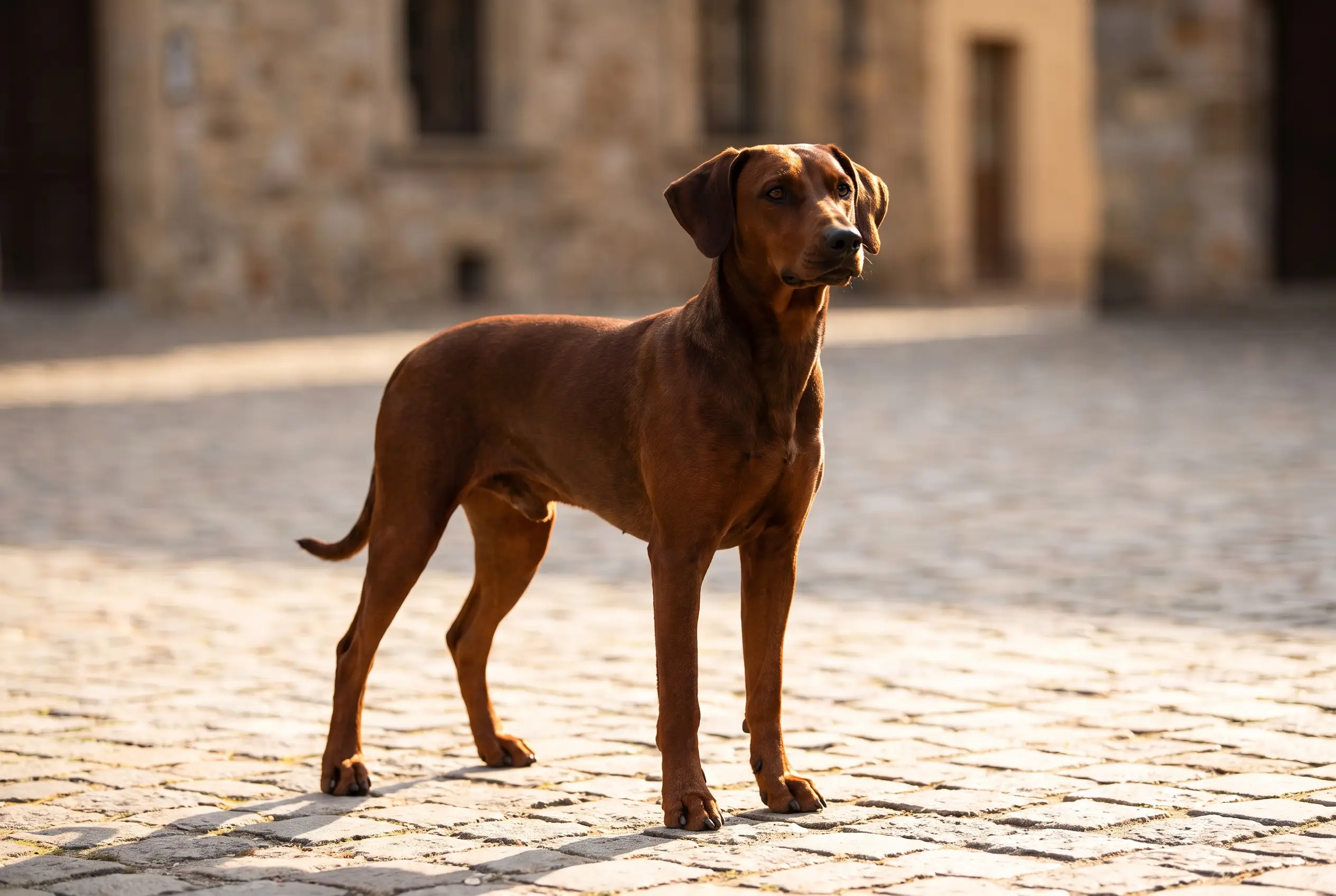
German Pinscher
The pinscher the others came from, and it never stopped working.
Vital stats
| Size | Medium · 45–50 cm |
| Weight | 14–20 kg |
| Life expectancy | 12–14 years |
| Energy | High — a daily hour plus work for the brain |
| Shedding | Low — short single coat, light drop year-round |
| Coat | Short, smooth and glossy · black-and-tan or shades of red |
| Group | Working · Pinscher (FCI №184, Group 2) |
| Origin | Germany |
| FCI group | 2 — Pinscher and Schnauzer, Molossoid and Swiss Mountain Dogs · FCI 184 |
Breed traits
Friendliness
Care
Mind
The German Pinscher by the numbers
The German Pinscher facts owners search for most — price, lifespan, weight, shedding and colours, in one place.
Widely bred, so you can usually find a litter from a registered breeder without a long wait. Plan for steady ongoing costs — mid-range food, routine vet care and insurance.
We don't quote a single figure: the real price swings with breeder, region, bloodline and health testing — and a rescue costs a fraction of a breeder's litter. Adopting is almost always the cheapest route.
Temperament
The German Pinscher is alert, self-assured and permanently switched on. It was kept to notice things — rats in the feed, strangers in the yard — and it still notices everything. It learns fast and works with real drive, but it also thinks for itself, so training has to stay interesting or the dog starts improvising. The prey drive is genuine: small animals that run will be chased. With its family it is affectionate and playful, often attached to one person above the rest; with strangers it holds back and watches. Without early training and enough to do, the watching turns into announcing.
Habits & quirks
Perimeter check
Every trip to the garden starts with a patrol of the fence line. Ratting was the original job, and the shift never officially ended.
Under the blanket
The coat is short with almost no undercoat, so on a cold evening the dog is inside the duvet, not on top of it.
The announcer
Doorbells, delivery vans, the neighbour's cat — everything gets reported. Training teaches it what counts as news; nothing makes it stop broadcasting.
One eye open
Even flat out on the sofa it tracks the room. Guarding was half the job description, and it takes that half seriously.
Health
The German Pinscher is a hardy, long-lived breed overall, and a responsible breeder is the best health insurance you can buy. Ask for the screening the breed clubs advise: hips, eyes and heart, plus a test for von Willebrand's disease, a bleeding disorder some lines carry. Beyond that the everyday care is simple — keep it lean and well-exercised, stay on top of teeth and nails, and remember that a coat this short with almost no undercoat feels the cold, so a winter layer earns its place.
Nutrition
| Exercise | An hour a day at minimum, with running and games that use the nose or the brain. A worked German Pinscher is fine in a flat; an underworked one redecorates it. |
| Training | Start early, keep sessions short and rewarding, and be more consistent than the dog. Recall needs lifelong practice — prey drive beats obedience the day a squirrel runs. |
| Grooming | A weekly rub-down with a hound glove keeps the short coat glossy. Shedding is light and baths are rare; nails and teeth need more attention than the coat does. |
| Health | A hardy breed overall. Ask breeders for hip, eye and cardiac screening, and for von Willebrand's disease testing — some lines carry it. |
A German Pinscher is a compact, athletic dog that does best kept lean and hard-muscled, so feed to the working body rather than to the begging. Match the amount to how much the dog actually does — an hour of real exercise a day burns more than a quiet one — weigh the meals, and count the training treats in the daily total, because this is a breed you train often. Ribs you can feel under a glossy coat is the target; a heavy pinscher loses the very quickness the breed is about.
Puppy guide
A German Pinscher puppy is sharp, busy and switched on from day one, so start training early and keep it short, fair and rewarding — this is a clever dog that will train itself in the wrong direction if you leave a gap. Socialise widely so the natural wariness of strangers settles into good judgement rather than noise, and begin a recall now, knowing the prey drive that comes with the breed will test it for life. Give the brain real jobs, not just walks. And with so little coat, a young pinscher wants somewhere warm to sleep.
Training
Start early, keep the sessions short and rewarding, and aim to be more consistent than the dog — a German Pinscher learns fast but thinks for itself, and a bored one improvises. Recall is the lifelong homework: the prey drive is real, and the day a squirrel bolts it will beat obedience unless the recall has been built and rebuilt over years. Keep the work varied and worth its while and this is a very trainable dog; let it get repetitive and it will tell you so.
Life expectancy
German Pinschers live 12–14 years. The German Pinscher is a hardy, long-lived breed, and you keep it at the top of that range the same way you keep it happy: lean weight, parents screened for hips, eyes, heart and von Willebrand's disease, teeth kept clean, and enough daily exercise and thinking to keep a working dog sound.
Similar breeds
Breeds with a similar build and background — worth a look if this one isn't quite the fit.
Breeds that look like this
Common questions
Is the German Pinscher just a bigger Miniature Pinscher?
It is the other way round: the German Pinscher is the original, and the Miniature Pinscher was bred down from it. The Doberman also began with foundation stock from this breed, selected upward in size for guard work. All three share the outline; the German Pinscher is the mid-size the family started from.
Do German Pinschers make good apartment dogs?
Yes, if the flat comes with an active owner. The breed is compact, clean and nearly odour-free, and it settles well once exercised. What a flat does not fix is the voice — an untrained German Pinscher announces the whole stairwell, so daily outings and training are part of the rent.
Why are German Pinschers so hard to find?
The breed nearly disappeared after the Second World War, and Werner Jung re-founded it in the late 1950s from oversized Miniature Pinschers. Numbers recovered but never grew large — the AKC only recognised the breed in 2003. Expect a waiting list, and a breeder who interviews you right back.
Does the German Pinscher shed a lot?
Not much. The German Pinscher is a low-shedding breed, so loose hair around the home stays minimal. It still needs regular grooming, but you won't be fighting drifts of fur.
Is the German Pinscher hypoallergenic?
No dog is truly hypoallergenic, but the German Pinscher comes closer than most: its low-shedding coat releases less of the dander that triggers allergies. Many allergy sufferers manage well with this breed, but spend time around one before committing.
Is the German Pinscher good with children?
They can be. The German Pinscher is reasonably sociable and can be good with children in the right home, especially when socialised early. Supervise around young kids and teach dog and child to respect each other.
Is the German Pinscher easy to train?
Reasonably. The German Pinscher is trainable with consistency and rewards, though it isn't the quickest study. Keep sessions short and positive, and be patient with the basics like recall.