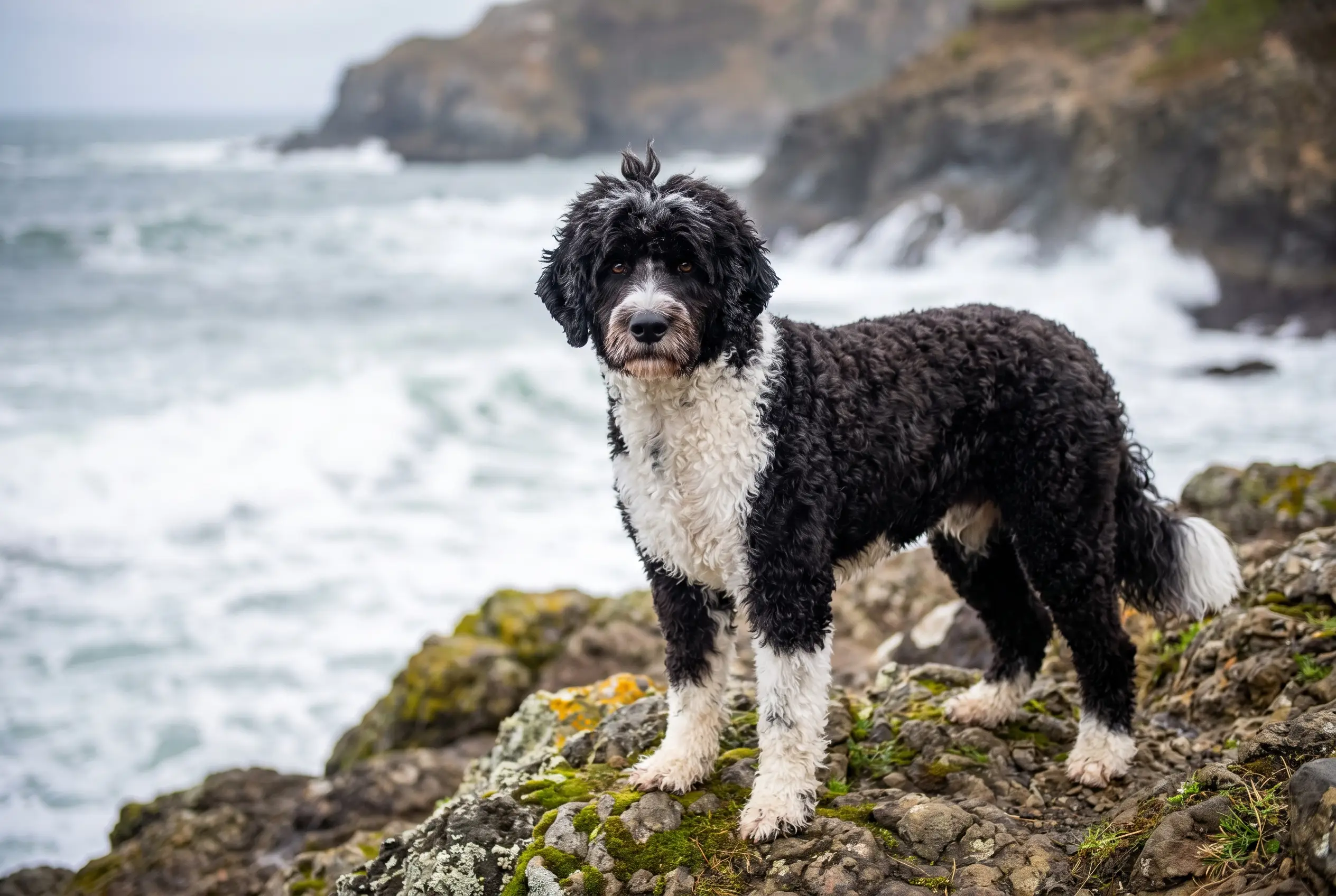
Portuguese Water Dog
A fisherman's crewmate in a wetsuit of curls — happiest halfway into the water.
On these lists: Low-shedding dogs · Truffle-hunting dogs · Dogs for allergies
Vital stats
| Size | Medium · 43–57 cm |
| Weight | 16–27 kg |
| Life expectancy | 11–13 years |
| Energy | High — 60+ min/day |
| Shedding | Minimal — coat grows continually |
| Coat | Curly or wavy single coat · black, brown, white |
| Group | Working · FCI №37 / AKC |
| Origin | Algarve, Portugal |
| FCI group | 8 — Retrievers, Flushing Dogs and Water Dogs · FCI 37 |
Breed traits
Friendliness
Care
Mind
The Portuguese Water Dog by the numbers
The Portuguese Water Dog facts owners search for most — price, lifespan, weight, shedding and colours, in one place.
Widely bred, so you can usually find a litter from a registered breeder without a long wait. Plan for steady ongoing costs — mid-range food, routine vet care and insurance. Its coat also needs a professional groom every few weeks — a real line in the budget.
We don't quote a single figure: the real price swings with breeder, region, bloodline and health testing — and a rescue costs a fraction of a breeder's litter. Adopting is almost always the cheapest route.
Temperament
Bred to work all day beside Algarve fishermen — retrieving lost tackle, herding fish, swimming messages boat to boat — the PWD is tireless, clever and profoundly people-oriented. At home that means a quick, willing student who wants a job and your company in equal measure, and sulks handsomely when short of either.
Habits & quirks
The counter-surfing dive
A retrieving mouth plus athletic hindquarters — nothing on a worktop is truly safe.
Velcro with curls
It follows you room to room; solitude is simply not in the job description.
Any water will do
Sea, lake, paddling pool, suspicious puddle — if it's wet, the dog is in it.
The expressive paw
PWDs famously use their paws to ask, insist and negotiate.
Health
The Portuguese Water Dog is a robust, fairly long-lived breed by pedigree-dog standards, but a few inherited problems run in the lines, so the work is choosing a well-tested breeder. Ask for hip scores against dysplasia, an eye certificate for PRA, and DNA results for juvenile dilated cardiomyopathy — a heart condition that can take a young pup suddenly. A responsible breeder tests for all three and shares the paperwork. Beyond that, keep your dog lean and active, and the PWD is generally a healthy companion.
Nutrition
| Grooming | Clip every six to eight weeks and comb through weekly — the coat grows like human hair and mats if ignored. |
| Exercise | An hour or more daily, with swimming and retrieving the gold standard. |
| Training | Bright and eager — channel it early into obedience, water work or agility before it invents its own projects. |
| Health | Choose breeders who test for hip dysplasia, PRA and juvenile dilated cardiomyopathy. |
The PWD is an athletic working dog that burns real energy, so feed for the exercise it actually gets and measure meals rather than leaving the bowl down — ribs you can feel but not see. Count treats into the daily total, especially through training, where a food-keen dog racks them up fast. A lean water dog swims and works better and carries less strain on the joints.
Puppy guide
A PWD puppy is bright, busy and bonded to you from day one, and it wants a job as much as it wants company. Keep exercise gentle while the joints are forming — short walks and play rather than long runs — and start swimming calmly once your vet is happy. Socialise early and get the grooming routine going in puppyhood: a pup taught young to enjoy the comb and clippers saves you years of wrestling a matted coat. Give the busy mind something to do before it invents its own project.
Training
Portuguese Water Dogs are clever, eager and quick to learn, which is a gift and a warning: an under-occupied PWD trains itself in habits you won't like. Channel that brain early into obedience, water work or agility, keep sessions short and rewarding, and give it a real job to do. Teach recall and calm manners before the athletic body outpaces the manners, and this is one of the most willing partners you'll find.
Known health issues
No breed is problem-free. These are the conditions most worth knowing about for this breed — with what a good breeder screens for and what an owner watches. General guidance, not a substitute for your vet.
Hip dysplasia
A poorly fitting hip joint that wears early and can cause pain and arthritis, most common in larger breeds. Good breeders screen: Hip-scored parents (BVA/OFA/FCI). Watch for: Stiffness, a bunny-hop run, or reluctance on stairs.
Inherited eye disease
Progressive retinal atrophy and cataracts run in several breeds and can dim or take sight over time. Good breeders screen: Eye-tested parents and, where available, a DNA test for PRA. Watch for: Night-time bumping, cloudy eyes, or hesitation in dim light.
Life expectancy
Portuguese Water Dogs live 11–13 years. This is a fairly long-lived breed, and most of what shapes those years is settled before you bring the puppy home: choose a breeder who tests hips, eyes and heart, since juvenile dilated cardiomyopathy is the one that can strike a young dog. After that, the ordinary levers do the work — keep your PWD lean, active and well-groomed, and stay ahead of problems with regular vet checks as it ages.
Similar breeds
Breeds with a similar build and background — worth a look if this one isn't quite the fit.
Breeds that look like this
Common questions
Are Portuguese Water Dogs hypoallergenic?
No dog truly is, but their low-shedding single coat bothers many allergy sufferers less. Spend time with the breed before committing.
Do Portuguese Water Dogs need to swim?
They don't strictly need it, but they love it deeply and it's their ideal exercise. Land-based running and retrieving can substitute.
Are Portuguese Water Dogs good family dogs?
Excellent ones for active households — affectionate, playful and patient. They struggle in homes where they're often left alone or under-exercised.
Does the Portuguese Water Dog shed a lot?
Not much. The Portuguese Water Dog is a low-shedding breed, so loose hair around the home stays minimal. It still needs regular grooming, but you won't be fighting drifts of fur.
Is the Portuguese Water Dog easy to train?
Yes. The Portuguese Water Dog is one of the more trainable breeds — quick to learn and keen to work with you, which makes reward-based training straightforward. Start early, keep it positive, and it picks things up fast.