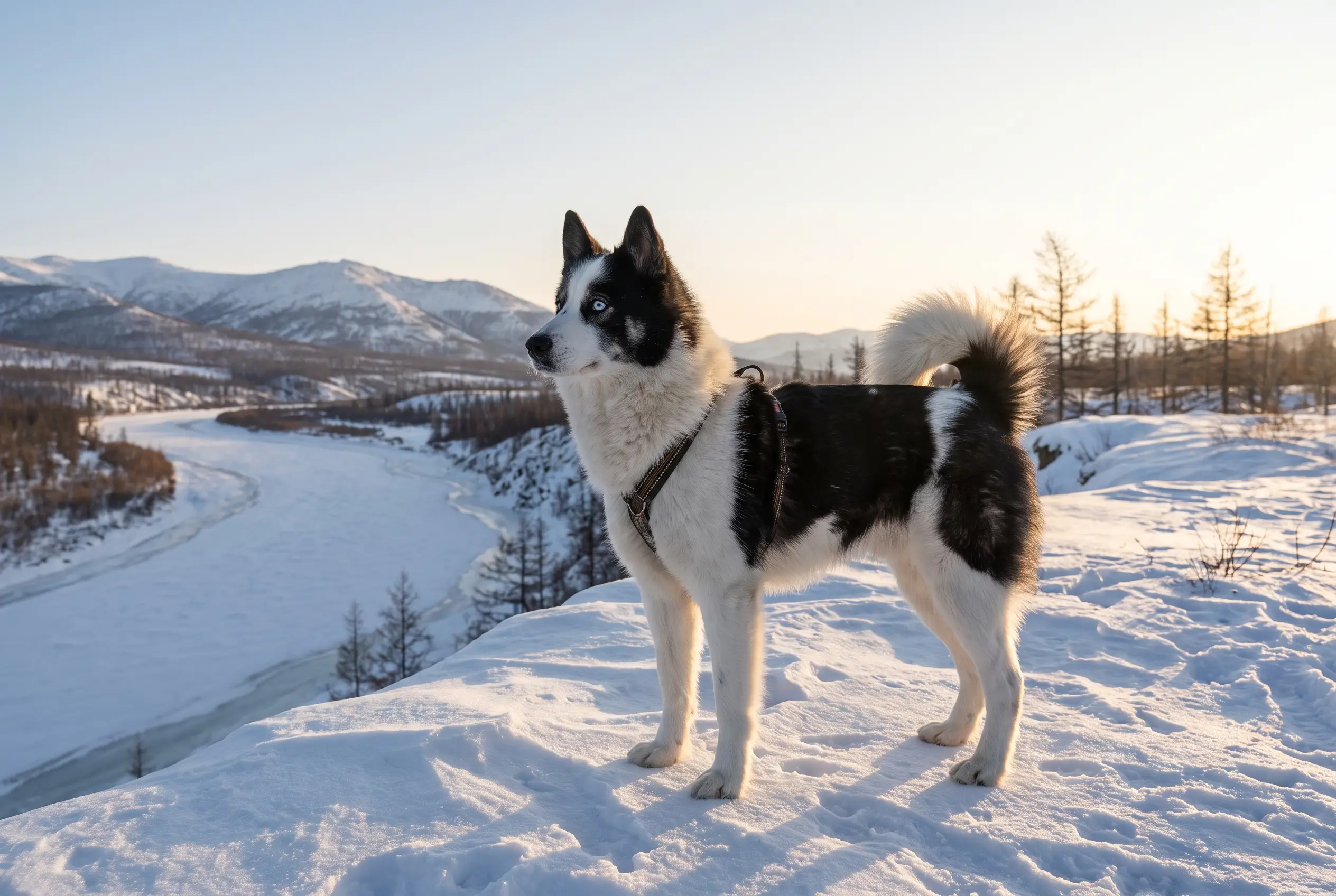
Yakutian Laika
Yakutia's piebald sledge dog, often blue-eyed, and the laika bred to live close to man.
Vital stats
| Size | Medium · 55–59 cm (dogs), 53–57 cm (bitches) |
| Weight | 18–25 kg — breed literature; the standard sets none |
| Life expectancy | 10–12 years — breed literature, not survey data |
| Energy | High — 2 hrs/day, ideally in harness |
| Shedding | Heavy, with two seasonal blows |
| Coat | Thick, glossy double coat with a mane · white with patches, bicolour or tricolour |
| Group | Working · Nordic Sledge Dogs (FCI №365, Group 5) |
| Origin | Yakutia (Sakha Republic), Russia |
| FCI group | 5 — Spitz and primitive types · FCI 365 |
Breed traits
Friendliness
Care
Mind
The Yakutian Laika by the numbers
The Yakutian Laika facts owners search for most — price, lifespan, weight, shedding and colours, in one place.
Less common, so expect a waitlist and some travel to a reputable breeder — which pushes the price up. Plan for steady ongoing costs — mid-range food, routine vet care and insurance. Its coat also needs a professional groom every few weeks — a real line in the budget.
We don't quote a single figure: the real price swings with breeder, region, bloodline and health testing — and a rescue costs a fraction of a breeder's litter. Adopting is almost always the cheapest route.
Temperament
Bold, lively, close to man, friendly, sociable and energetic: six words from the standard, and 'close to man' is the one that separates this laika from the others. The hunting laikas were bred to range far ahead of a single hunter and tend to hold strangers at a distance; the Yakutian lived in the middle of the settlement, pulled the family sledge, watched the house and shared the yard with the children, and it shows. Expect a dog that greets visitors, wants to be in the room where things happen, and does poorly left alone. The engine underneath is real. This is a breed judged with a working trial, made to pull all day in cold that stops machinery, and a bored one digs, chews and sings about it. It keeps a hunting side too — the standard's utilization line reads 'sledge and hunting dog' — so small running animals are a temptation and recall needs early, patient work, in the husky manner if not to the husky extreme.
Habits & quirks
White first, then patches
The colour section is one line: white and any patching, bicolour or tricolour. Solid white is allowed; any other solid colour is a disqualifying fault. A self-black or self-red Yakutian Laika cannot be shown at all.
Blue eyes, in writing
Dark brown, blue, odd eyes with one of each, or blue segments on a brown iris — the standard permits all four, and a depigmented eye rim is excused where it sits against white.
Dressed for Yakutia
Thick, glossy, coarse hair over a dense undercoat, a mane on the neck that is heavier in males, feathering down the backs of the legs, and a brush of hair between the toes. On the move, the ears fold back.
The whole settlement's dog
The standard's history lists the jobs in a single sentence: help hunt, watch the home, herd reindeer, transport goods. Sledding was the headline work — the 1958 standard it grew from was written for the 'North-East Sled Dog' — but this was the keeper of the household, and its manners still are.
Care
| Exercise | Two hours a day, and pulling is the shortcut. This is a sledge breed judged with a working trial, and harness sports — canicross, bikejoring, a rig or a sled in winter — meet it where it was made. Long hikes and running partnership work too; a walk round the block does not. |
| Grooming | A thorough weekly brush, then daily raking through the two seasonal blows, when the undercoat leaves in handfuls. Never clip the coat: it insulates against heat as well as cold, which matters, because this dog was built for deep frost and needs shade, water and early walks in a warm summer. |
| Training | Quicker to please than the hunting laikas and friendlier with strangers, and still a spitz: short sessions, real rewards, early socialisation. Start recall young and keep a long line around wildlife. The standard calls it a sledge and hunting dog, and the hunting half surfaces exactly when a rabbit does. |
| Health | A hardy village breed with no breed-wide health survey. Outside Russia the population is young and small, so pedigree depth deserves real attention; ask breeders for hip and eye results, and treat the 10–12 years in breed literature as a habit of the type rather than study data. |
Life expectancy
This breed has a typical life expectancy of 10–12 years — breed literature, not survey data.
Similar breeds
Breeds with a similar build and background — worth a look if this one isn't quite the fit.
Breeds that look like this
Common questions
Is a Yakutian Laika the same as a Siberian Husky?
No — a separate breed with its own standard, though the FCI files both in Nordic Sledge Dogs. The Husky was standardised in America from Chukchi dogs a century ago; the Yakutian was rebuilt in Yakutia from local sled dogs, given a Russian standard in 2005 and accepted provisionally by the FCI in 2019. In the ring the colour rule splits them: a Husky may be any colour, a Yakutian must be white with patches, and it stands a touch taller with a heavier coat.
How is it different from the other laikas?
The Russo-European, West Siberian and East Siberian Laikas are hunting dogs in a different FCI section, bred to range ahead of a hunter and bark game to a standstill, and they tend to be reserved with strangers. The Yakutian is the sledge dog of the family: same northern Russia, same spitz outline, but a team animal that lived inside the settlement, and its standard asks for a dog close to man, friendly and sociable.
Are they good family dogs?
Made for it. The standard wants a dog close to man, friendly and sociable, and the breed's history is household history: it pulled, watched and herded for the same family it lived with. The honest caveats are the exercise bill of a sledge breed, two heavy moults a year, a hunting streak around small animals, and a coat that makes hot climates hard work.
Does the Yakutian Laika shed a lot?
Yes — the Yakutian Laika is a heavy shedder, dropping hair year-round or in big seasonal moults. Brush it several times a week and expect regular vacuuming; it isn't the coat for you if loose fur is a dealbreaker.
Is the Yakutian Laika hypoallergenic?
Not really. No dog is truly hypoallergenic, and the Yakutian Laika's shedding coat releases plenty of the dander that sets off allergies. If someone at home is allergic, this isn't the easiest breed to live with — spend time around one first.
Is the Yakutian Laika easy to train?
Reasonably. The Yakutian Laika is trainable with consistency and rewards, though it isn't the quickest study. Keep sessions short and positive, and be patient with the basics like recall.