Why is my dog peeing in the house? Causes and how to stop it
A house-trained adult dog that starts peeing indoors has a reason, and the reason is almost never the one owners fear. Spite isn't in the canine repertoire, and defiance doesn't produce puddles — but bladder infections, hormones, phobias of wet grass and gaps in long-ago training all do, each with its own signature. Work through them in the right order and most indoor peeing resolves; work through them in the wrong order and you end up punishing a dog for a urinary tract infection.
Sudden accidents in an adult dog: medical first
When a reliably clean dog starts going indoors, the body gets checked before the behaviour. Urinary tract infections are the classic cause: frequent, urgent, small-volume accidents, sometimes with straining, blood-tinged urine or licking afterwards. Incontinence is different from conscious peeing and easy to distinguish — the dog leaks while relaxed or asleep, leaving wet patches on bedding it would never soil deliberately; it's especially common in spayed females, where a weakened urethral sphincter is the usual culprit, and it's very treatable with medication. Drinking more means peeing more, so kidney disease, diabetes and hormonal conditions announce themselves as accidents too — a dog that's also emptying the water bowl faster than usual is telling you which test to run. And in seniors, add cognitive decline: an old dog that stands at the wrong side of the door, or seems to forget why it went outside, isn't untrained — it's ageing, and the senior dog care guide covers what helps. One urine sample at the vet sorts most of this list in a day.
Marking or emptying? Read the volume
A full-bladder accident and a scent mark are different behaviours wearing the same crime scene. Marking is small volumes, aimed high — a lifted leg against furniture, door frames or new objects — repeated across several spots, from a dog whose bladder is otherwise well managed. It runs on hormones and real estate: intact males do most of it, and the trigger is usually social novelty — a visiting dog, a new sofa that smells of the shop, a guest's bag, a new baby's kit. Neutering sharply reduces urine marking in most male dogs, though a long-practised habit can outlast the hormones that started it. Emptying, by contrast, is a puddle on the floor from a dog whose routine, bladder or training failed somewhere — and that's the problem the rest of this guide solves. Mopping tells you nothing; where and how much tells you everything.
The training gaps nobody mentions
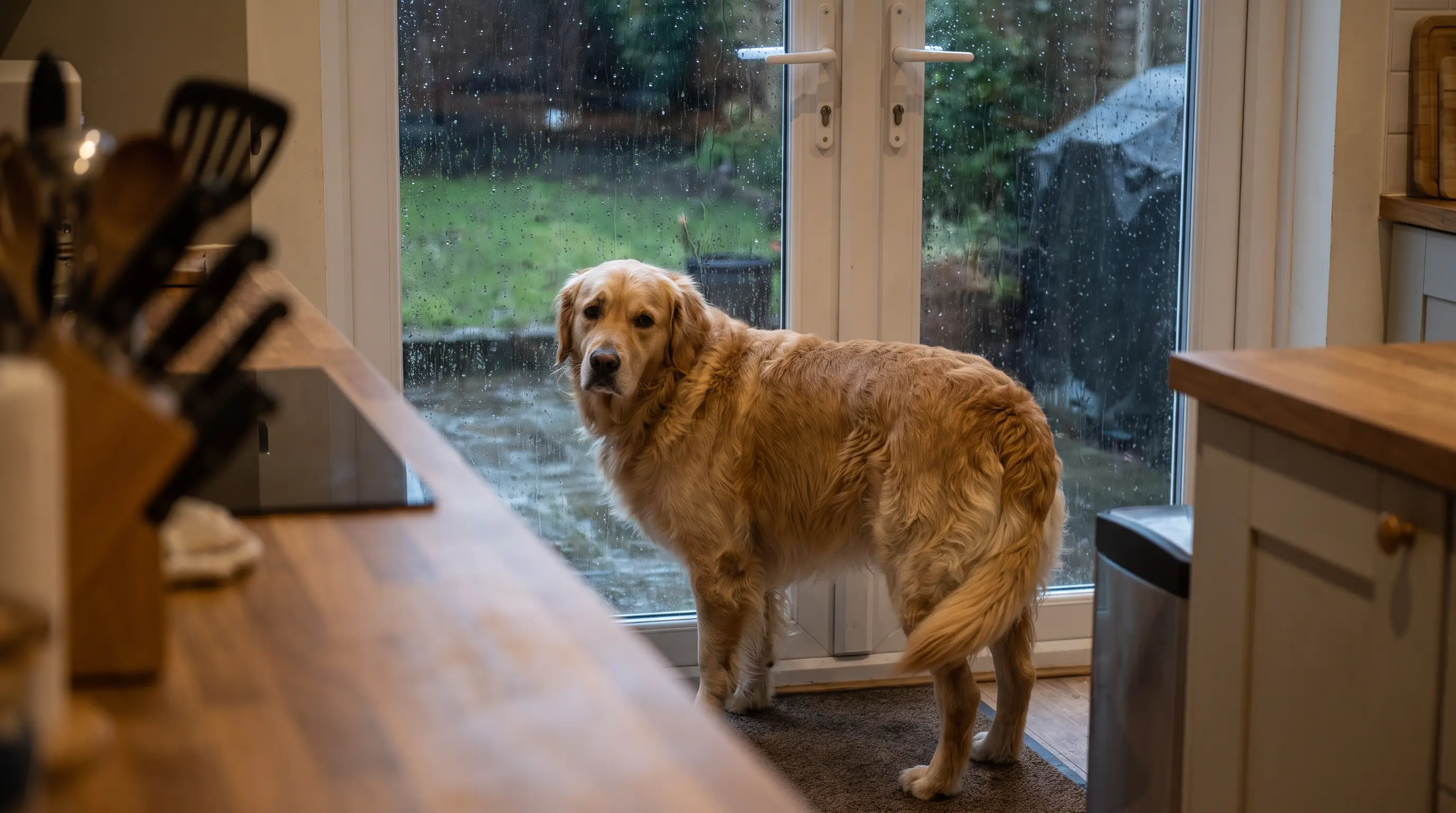
Plenty of adult dogs were never actually finished. A rescue may have lived its whole life in a kennel or yard where indoors-versus-outdoors meant nothing — and a newly adopted dog having accidents in week one is adjusting, not broken, as the 3-3-3 rule explains. Then there are the quieter gaps. Substrate preference: a dog raised on puppy pads learned that soft, absorbent flooring is the toilet, and your rug qualifies perfectly. Weather phobia: a dog that hates rain steps outside, holds everything, comes back in and relieves itself on the carpet — the walk happened, the toilet trip didn't. The empty-outside problem: a dog too busy sniffing and patrolling to finish its business outdoors, which then remembers its bladder ten minutes after coming home. None of these are defiance; all of them are trainable, with the same method that works on puppies.
The involuntary leaks: excitement, appeasement and panic
Some indoor urine was never a decision. Excitement urination happens mid-greeting in young dogs — a puddle appearing while the whole back end wags — and appeasement urination happens when a dog is leaning away from pressure: a looming posture, a raised voice, direct eye contact from a stranger. Both are involuntary, both are made dramatically worse by scolding (which adds pressure to the exact moment the dog can't handle pressure), and both fade with low-key greetings — come in, ignore the dog for two minutes, say hello outside, crouch sideways instead of looming. Panic empties bladders too: a dog that soils only during fireworks, storms, or when left alone isn't having a toileting problem at all — the alone-time version is a hallmark of separation anxiety, and it's the anxiety that needs treating, not the puddle.
The plan: retrain like a puppy, without the shame
Once the vet has cleared the body, run the same protocol that builds a puppy — it works at any age. Supervise indoors or use a smaller space; take the dog out on a generous schedule and after meals, naps and play; go out with it, wait out the sniffing, and pay the correct performance handsomely on the spot, because a reward delivered outdoors at the moment of production is the entire engine of house-training — the full method is in house training a puppy. Clean every accident with an enzymatic cleaner so no scent invitation survives, and retire the folklore completely: rubbing a dog's nose in it, shouting, or dragging it to the scene teaches exactly one thing — that humans near urine are dangerous — which is how you get a dog that still pees indoors, but behind the sofa. A clean dog that keeps failing after medical clearance and honest retraining is carrying anxiety or a habit that's outgrown home methods; that's the point to ask your vet for a behaviourist referral rather than more folklore.
Common questions
Why is my dog suddenly peeing in the house?
A sudden change in a house-trained adult points first at the body: a urinary tract infection, incontinence (leaks during sleep, common in spayed females), or a condition that increases drinking, like kidney disease or diabetes. The vet visit comes before any training plan — one urine test rules most of it in or out in a day.
Why does my dog pee in the house after going outside?
Usually the trip happened but the toilet didn't: the dog was too busy sniffing to finish, hates the weather and held everything, or prefers indoor surfaces because it was raised on pads. Go out with the dog, wait past the sniffing, and reward heavily the moment it goes outdoors — an empty walk isn't the same as an empty bladder.
How do I stop my dog peeing inside?
Vet first to rule out infection, incontinence and thirst-driving illness. Then retrain like a puppy: supervision indoors, a generous outdoor schedule, going out with the dog, and a big on-the-spot reward for going outside. Clean accidents with an enzymatic cleaner, and never punish — it teaches hiding, not holding.
Why does my dog pee when excited or scared?
That's excitement or appeasement urination — an involuntary reflex, common in young dogs, triggered by greetings, looming postures, direct eye contact or raised voices. Scolding makes it worse because it adds pressure to the moment the dog can't manage pressure. Keep greetings low-key, say hello outdoors, crouch sideways, and most dogs grow out of it.
Do dogs pee inside out of spite?
No. Spite requires a plan to punish you, and that's not in the canine toolkit — what reads as revenge is a medical problem, a training gap, marking, or anxiety that happens to leave evidence you care about. The 'guilty look' is appeasement to your body language, not a confession, and punishing based on it only adds fear.
Why is my old dog peeing in the house?
Age brings specific causes: kidney decline and other thirst-driving illnesses, weakening sphincters that leak during sleep, arthritis that makes the trip outside harder, and cognitive decline that scrambles the old routine. All of these are manageable and some are very treatable, so a senior having accidents earns a vet work-up, not a rolled-up newspaper.
More in Dogs
Autumn dangers for dogs: acorns, conkers and mushrooms
Autumn puts three scavenging hazards on the ground — acorns, conkers and wild mushrooms — plus rat bait and fermenting fruit. What's toxic, what the warning signs are, and when to call the vet.
Winter pet dangers: antifreeze, road salt and chocolate season
Antifreeze is the winter emergency — sweet, deadly and quick. Plus gritted-salt paws, the festive-food gauntlet and cats sheltering in warm car engines. What to watch and when it's urgent.
The pet danger calendar: what to watch, month by month
Most pet hazards are seasonal and many are regional. Here's the year mapped out — when heatstroke, grass seeds, processionary caterpillars, antifreeze and the rest actually peak, and which ones your area even has.
Snake bites in dogs: first aid, symptoms and prevention
A calm, fast response is what actually saves a bitten dog. What to do in the first minutes, the myths that cost time, and which snakes matter across Europe.
Why is my dog vomiting? Causes and when to see a vet
The common reasons dogs are sick, what you can safely do at home for a one-off, and the warning signs that mean call the vet now rather than wait.
Why is my dog limping? Causes and when to see a vet
From a stone in the paw to a cruciate injury — the common reasons dogs go lame, what rest can and cannot fix, and the signs that mean see a vet.