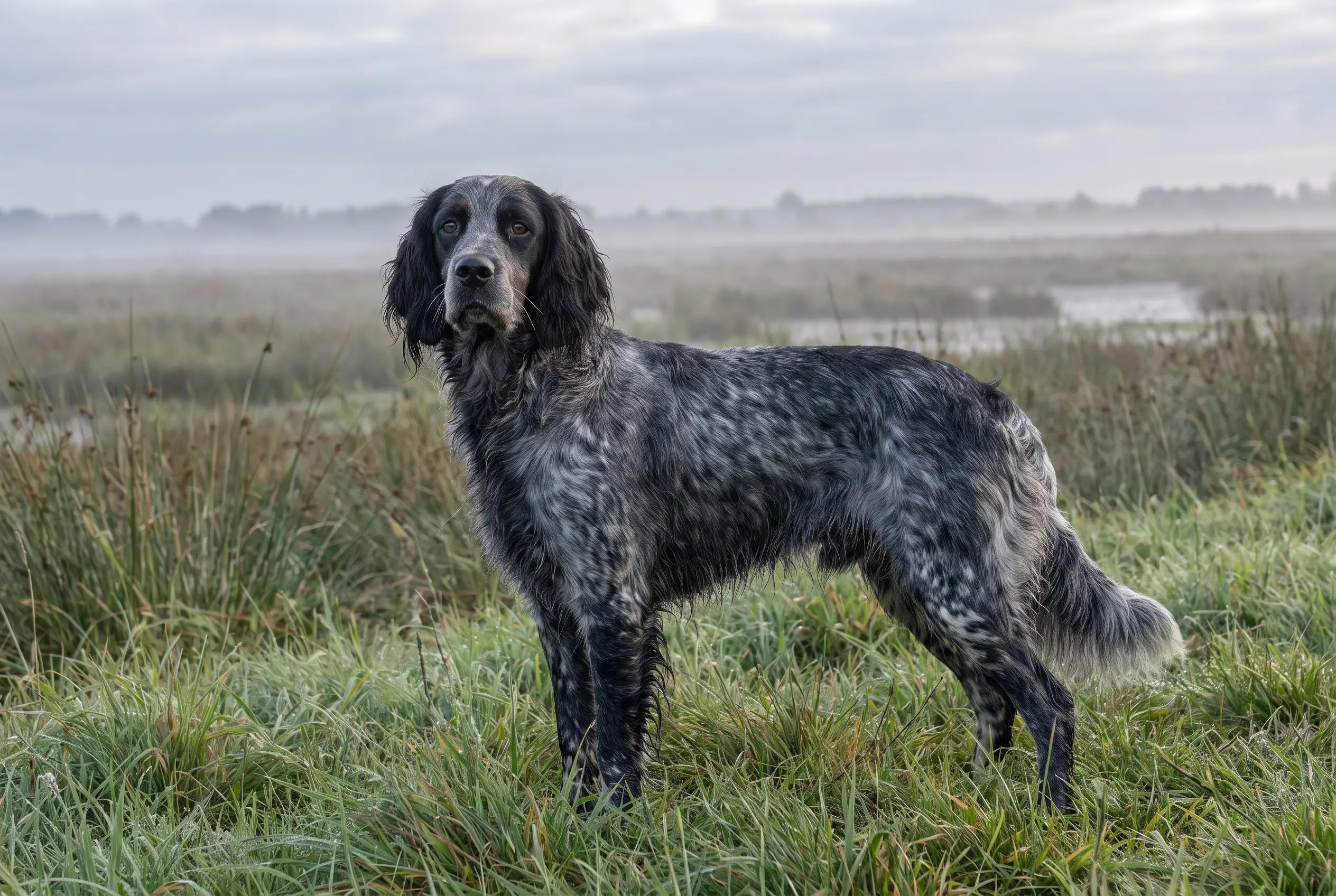
Blue Picardy Spaniel
Picardy's blue-speckled woodcock dog — placid in the house, tireless in the marsh.
Vital stats
| Size | Medium-large · 57–62 cm (dogs), 55–60 cm (bitches) |
| Weight | 18–23 kg — breed literature; the standard sets none |
| Life expectancy | 12–14 years — breed literature, not survey data |
| Energy | High — the standard itself prescribes a daily walk |
| Shedding | Moderate — a weekly brush keeps ahead of it |
| Coat | Flat or slightly wavy, fringed legs and tail · grey-black speckle forming a bluish shade |
| Group | Sporting · Continental Pointing Dogs, 'Spaniel' type (FCI №106, Group 7) |
| Origin | Picardy (Somme estuary), France |
| FCI group | 7 — Pointing Dogs · FCI 106 |
Breed traits
Friendliness
Care
Mind
The Blue Picardy Spaniel by the numbers
The Blue Picardy Spaniel facts owners search for most — price, lifespan, weight, shedding and colours, in one place.
Less common, so expect a waitlist and some travel to a reputable breeder — which pushes the price up. Plan for steady ongoing costs — mid-range food, routine vet care and insurance.
We don't quote a single figure: the real price swings with breeder, region, bloodline and health testing — and a rescue costs a fraction of a breeder's litter. Adopting is almost always the cheapest route.
Temperament
The standard's temperament clause reads like a family reference: flexible and gentle, an even temperament, well adapted to family life, placid and never aggressive. Breed literature agrees — gentle with children, easy with other dogs, quiet in the house, more likely to announce a stranger than to mind one. The other half of the same clause calls it an athletic dog that needs a daily walk to work off its energy, and that half is just as binding. This is a gundog judged with a working trial, bred to quarter marshland within gun range all day, and a bored one invents work. It hunts in contact with its handler rather than ranging far, which makes it more biddable than many pointing breeds; it also means the dog wants to be where you are, and long days alone sit badly with it.
Habits & quirks
Blue is a speckle, not a colour
The colour section allows one pattern: silver grey to grey black speckling forming a bluish shade, with or without black patches. White or brown patches are a disqualifying fault, and a nose any colour other than black is a severe one.
Ears that reach the muzzle
Set at about eye level, quite thick, framing the head in wavy silky hair — and long enough that the leather, stretched out, must reach the tip of the muzzle. Handsome in the ring, and a moisture trap after a swim.
Works within gun range
The standard calls it a contact dog for hunts within firing range: it quarters close instead of ranging far, adapts to all sorts of small game and is, in the standard's words, particularly skilled in woodcock hunting.
The standard prescribes cuddles
Few FCI texts commit to this in writing: the history section says a daily walk is necessary to keep him fit, and that he 'will always find his way to a happy cuddle'. Owners report both halves are accurate.
Health
The Blue Picardy Spaniel is a hardy gundog with no breed-wide health survey behind it, so the honest guidance is about the population as much as the dog. It is a small breed outside France and Canada, which makes pedigree depth worth real attention — ask a breeder how closely related the parents are and what they screen for, hips included. Ear health is the day-to-day job: the leathers are long enough to reach the tip of the muzzle, and ears that size block airflow and trap damp, so check and dry them after every swim or wet outing and clean them on a weekly routine. Treat the 12–14 years in breed literature as a habit of the type rather than a promise, keep the dog lean and well-exercised, and most of its care is the ordinary kind done well.
Nutrition
| Exercise | An hour or more of real exercise a day — the standard names the daily walk as a necessity, and the dog underneath was made to work marshes from dawn. Field training, swimming and retrieving games fit it; a turn around the garden does not. |
| Grooming | A weekly brush keeps the flat, slightly wavy coat tidy, more often when the fringes on legs and tail collect burrs and mud. Check and dry the ears after every wet outing: leathers that reach the muzzle tip block airflow, and damp ears breed infections. |
| Training | A contact hunter that works with its handler, not off on its own — so it takes to training readily. Keep it soft: the standard wants a placid, gentle dog, and reward-based methods get far more from that temperament than pressure does. |
| Health | A hardy breed with no breed-wide health survey; the population is small outside France and Canada, so pedigree depth deserves attention. Ask breeders about hip screening and ear health, and treat the 12–14 years in breed literature as a habit of the type rather than study data. |
This is an athletic pointing dog built to quarter marshland within gun range all day, and it eats to match the work it actually does — a hard day in the field and a quiet week at home are not the same ration. Feed the dog in front of you: weigh the meals rather than filling the bowl by eye, fold any treats and field rewards into the day's total, and aim for ribs you can feel under the flat, slightly wavy coat. Keep it lean, because a working gundog carries condition better on a light frame, and the fringed legs and low ears are easier to keep clean on a dog that isn't overweight.
Puppy guide
A Blue Picardy puppy is a gentle, biddable gundog in the making, and the temperament is mostly on your side from the start. Socialise it widely all the same — people, places, other dogs — so the easy nature the standard asks for has room to settle, and get it used to having those long ears and feathered legs handled, brushed and dried early, because that is a lifelong routine best learned young. Keep the growing body's exercise sensible rather than punishing while the joints form, and teach it to be left alone in small, calm doses: this is a contact breed that wants to be where you are, and long empty days sit badly with it, so building tolerance for time alone early saves trouble later. Reward the calm, and the placid adult follows.
Training
The Blue Picardy is one of the more biddable pointing breeds, because it was bred to hunt in contact with its handler rather than range off on its own — it wants to work with you, which is half the battle. Keep it soft: the standard asks for a placid, gentle dog, and reward-based methods get far more out of that temperament than pressure ever will. Start early, keep sessions varied and rewarding, and channel the drive into real work — field training, retrieving games and swimming all suit it — because an athletic gundog with nothing to do invents its own jobs. The one thing it dislikes is being ignored, so make training the good part of its day and it will meet you more than halfway.
Life expectancy
Blue Picardy Spaniels live 12–14 years — breed literature, not survey data. The Blue Picardy Spaniel is a hardy breed with a good working lifespan, and you keep it at the top of the range the same way you keep it happy: real daily exercise for a dog built to work marshes from dawn, a lean weight it carries easily, ears checked and dried after every wet outing, and enough company that it is never left alone for long. Buy from a breeder who watches pedigree depth in a small population and screens for hips, give it the work and the closeness it was made for, and it stays sound for years.
Similar breeds
Breeds with a similar build and background — worth a look if this one isn't quite the fit.
Breeds that look like this
Common questions
Is the Blue Picardy Spaniel a spaniel or a setter?
Officially neither in the English sense: the FCI classifies it as a continental pointing dog of 'Spaniel' type — a pointing breed, not a flushing spaniel like the Cocker. Breed literature credits English Setter blood from British hunters' dogs boarded around the Somme estuary in the late 1800s, which would account for the setter-like legs and coat; the standard's own history records only the black and black-and-white 'épagneuls du Nord' of 19th-century Picardy.
How is it different from the Picardy Spaniel?
The standard answers in one line: the main difference between the two Picardy breeds is the colour of their coat. The Spaniel of Picardy carries brown in its coat; the Blue carries the grey-black speckle that reads blue — and on a Blue, any white or brown patch is a disqualifying fault. Same country, same work, different dress.
Are they good family dogs?
The standard writes family life into the breed: even-tempered, placid, never aggressive, and breed literature adds gentle with children and easy with other dogs. The honest caveats are a working gundog's exercise bill and a dislike of being left alone. The practical hurdle is finding one — the strongholds are France and Canada, litters are few, and the AKC does not recognise the breed.
Does the Blue Picardy Spaniel shed a lot?
Moderately. The Blue Picardy Spaniel sheds a fair amount, steadily through the year with heavier seasonal patches. A weekly brush keeps most of the loose hair off your floors and clothes.
Is the Blue Picardy Spaniel hypoallergenic?
Not really. No dog is truly hypoallergenic, and the Blue Picardy Spaniel's shedding coat releases plenty of the dander that sets off allergies. If someone at home is allergic, this isn't the easiest breed to live with — spend time around one first.
Is the Blue Picardy Spaniel easy to train?
Yes. The Blue Picardy Spaniel is one of the more trainable breeds — quick to learn and keen to work with you, which makes reward-based training straightforward. Start early, keep it positive, and it picks things up fast.