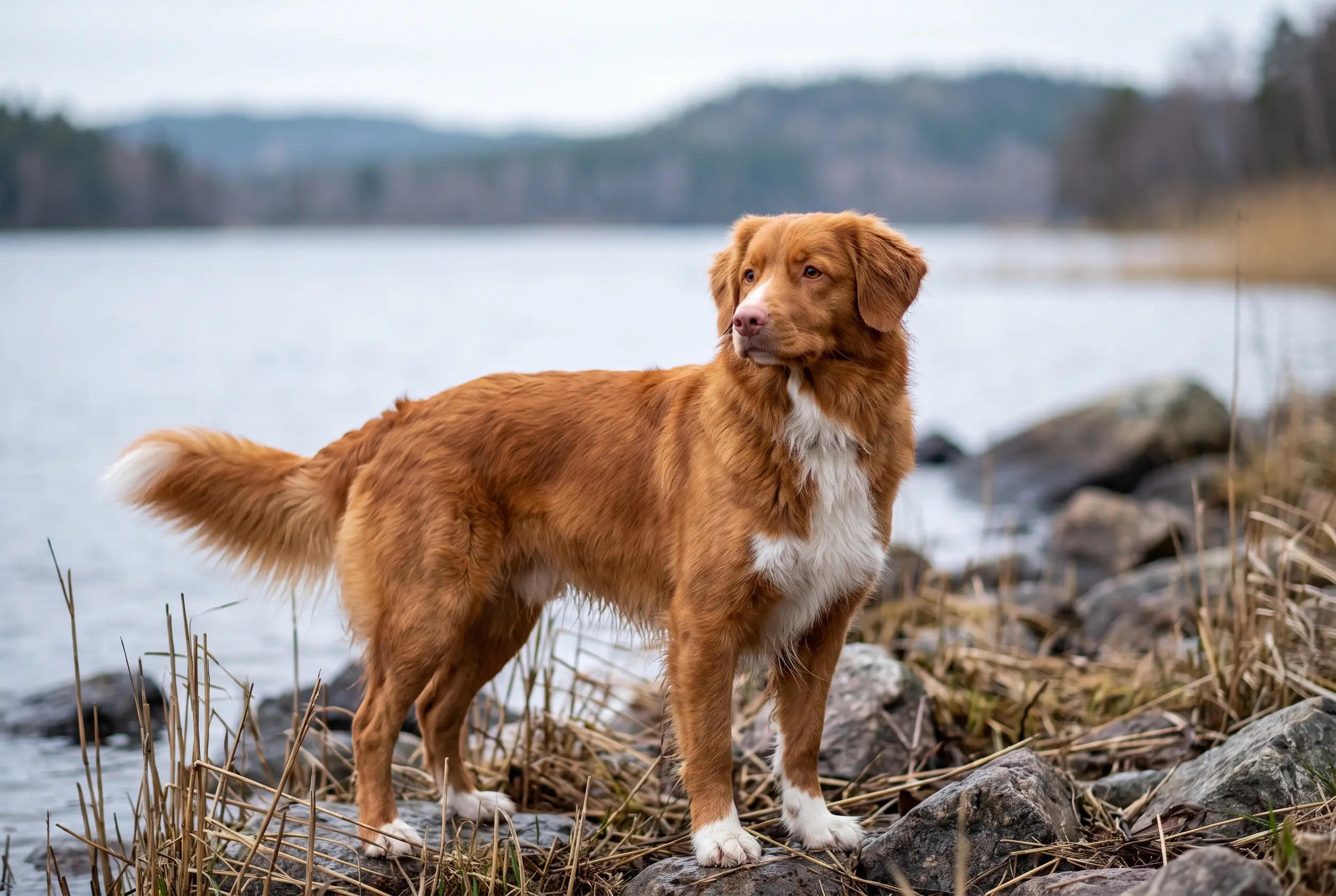
Nova Scotia Duck Tolling Retriever
The little red decoy — a retriever that dances ducks within range.
Vital stats
| Size | Medium · 45–51 cm |
| Weight | 17–23 kg |
| Life expectancy | 12–14 years |
| Energy | Very high — 60–90+ min/day |
| Shedding | Moderate, seasonal blows |
| Coat | Water-repellent double coat · shades of red with white markings |
| Group | Sporting · FCI №312 / AKC |
| Origin | Nova Scotia, Canada |
| FCI group | 8 — Retrievers, Flushing Dogs and Water Dogs · FCI 312 |
Breed traits
Friendliness
Care
Mind
The Nova Scotia Duck Tolling Retriever by the numbers
The Nova Scotia Duck Tolling Retriever facts owners search for most — price, lifespan, weight, shedding and colours, in one place.
Widely bred, so you can usually find a litter from a registered breeder without a long wait. Plan for steady ongoing costs — mid-range food, routine vet care and insurance.
We don't quote a single figure: the real price swings with breeder, region, bloodline and health testing — and a rescue costs a fraction of a breeder's litter. Adopting is almost always the cheapest route.
Temperament
Bred on Nova Scotia's shores to 'toll' — frolicking at the water's edge like a fox until curious ducks drift within range — the Toller is a retriever with a showman's streak. It is quick, driven and endlessly playful with its people, a shade more independent than a Labrador, and politely reserved with strangers.
Habits & quirks
The eternal fetch
One more throw is always required; the ball decides when walks end, not you.
The Toller scream
Peak excitement produces a piercing, warbling shriek unique to the breed.
Water magnetism
Any body of water within sensing range will be entered, whatever the season.
The toy census
Its collection is gathered, inventoried, and presented to guests.
Care
| Exercise | An hour or more of genuine daily work — fetch, swimming, agility, hunting games; a walk alone won't touch the sides. |
| Training | Brilliant with upbeat, varied, reward-based sessions; mindless repetition switches this quick brain off. |
| Grooming | Weekly brushing, daily during moults, and a rinse after swims; the coat otherwise cares for itself. |
| Health | A generally sound breed — choose parents screened for eyes, hips and autoimmune conditions. |
Life expectancy
This breed has a typical life expectancy of 12–14 years.
Similar breeds
Breeds with a similar build and background — worth a look if this one isn't quite the fit.
Breeds that look like this
Find a Nova Scotia Duck Tolling Retriever breeder in Italy →
Common questions
Do Tollers really scream?
Yes — when highly excited, many produce a piercing, warbling shriek unlike any bark. It is charming at the lake and less so in a terraced house.
How is a Toller different from a Golden Retriever?
Smaller, redder, and busier: the Toller carries more hunting intensity and independence than the famously mellow Golden. It suits owners who want a project as much as a companion.
Are Tollers good first dogs?
Only for committed, active first-timers — the intelligence and energy that make them brilliant sport dogs make them exhausting underemployed. Meet adult Tollers before deciding.
Does the Nova Scotia Duck Tolling Retriever shed a lot?
Moderately. The Nova Scotia Duck Tolling Retriever sheds a fair amount, steadily through the year with heavier seasonal patches. A weekly brush keeps most of the loose hair off your floors and clothes.
Is the Nova Scotia Duck Tolling Retriever hypoallergenic?
Not really. No dog is truly hypoallergenic, and the Nova Scotia Duck Tolling Retriever's shedding coat releases plenty of the dander that sets off allergies. If someone at home is allergic, this isn't the easiest breed to live with — spend time around one first.
Is the Nova Scotia Duck Tolling Retriever good with children?
They can be. The Nova Scotia Duck Tolling Retriever is reasonably sociable and can be good with children in the right home, especially when socialised early. Supervise around young kids and teach dog and child to respect each other.
Is the Nova Scotia Duck Tolling Retriever easy to train?
Yes. The Nova Scotia Duck Tolling Retriever is one of the more trainable breeds — quick to learn and keen to work with you, which makes reward-based training straightforward. Start early, keep it positive, and it picks things up fast.