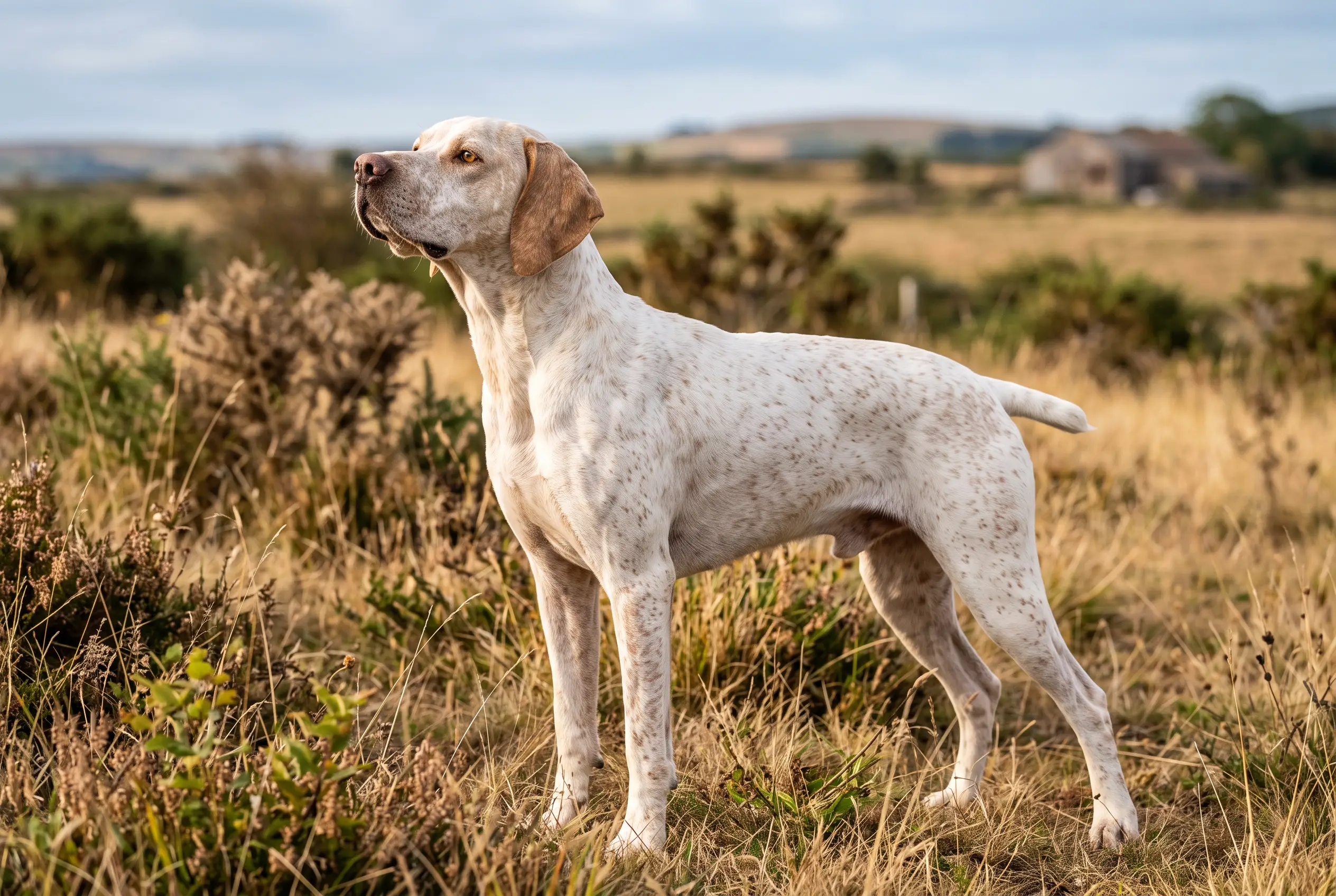
Braque du Bourbonnais
France's pear-headed pointer in a peach-blossom coat, often born without a tail.
Vital stats
| Size | Medium · 51–57 cm (dogs), 48–55 cm (bitches) |
| Weight | 16–25 kg — breed literature; the standard sets none |
| Life expectancy | 12–15 years — breed literature, not survey data |
| Energy | High — a working pointer; 1–2 hrs/day |
| Shedding | Light to moderate — short coat, year-round |
| Coat | Fine, short and dense · white with brown ('wine dregs') or fawn ('peach blossom') ticking |
| Group | Sporting · Continental Pointing Dogs, 'braque' type (FCI №179, Group 7) |
| Origin | Province of Bourbonnais, France |
| FCI group | 7 — Pointing Dogs · FCI 179 |
Breed traits
Friendliness
Care
Mind
The Braque du Bourbonnais by the numbers
The Braque du Bourbonnais facts owners search for most — price, lifespan, weight, shedding and colours, in one place.
Less common, so expect a waitlist and some travel to a reputable breeder — which pushes the price up. Plan for steady ongoing costs — mid-range food, routine vet care and insurance.
We don't quote a single figure: the real price swings with breeder, region, bloodline and health testing — and a rescue costs a fraction of a breeder's litter. Adopting is almost always the cheapest route.
Temperament
'In the home he is kind and affectionate' — the standard opens its temperament clause indoors, which tells you what kind of hunting dog this is. The old authors described the Bourbonnais as the pleasant companion of the hunter, hardy and healthy, and the standard asks for passion and intelligence that adapt easily to the most varied terrains and game. On the search it naturally carries its head high to find scent, and it points with precision rather than theatre. At home that reads as a gentle, people-centred gun dog, softer-edged than many pointing breeds and poor at being left out of things. It is still a braque under the manners: without a daily outlet for legs and nose it will invent projects, and a running rabbit will outrank you mid-walk unless recall was built early and kept paid.
Habits & quirks
A pear for a head
The standard names the pear-shaped head as the essential characteristic of the breed: a skull round from every angle, well-developed cheekbones, and a strong muzzle tapering to a truncated cone. Get the head wrong and it is not a Bourbonnais.
Short of a tail
Some are born with no tail at all — in the 1930s being born bobtailed was briefly an obligation, and the trait stayed in the breed. The standard wants a short tail set rather low; where docking is illegal, the long tail is carried below the topline.
Wine dregs and peach blossom
The colour names are old French breeders' terms, written into the standard: fine brown ticking was 'lie de vin', wine dregs; fawn flecking was 'fleur de pêcher', peach blossom. White must invade the whole coat — large patches are a serious fault, an entirely white coat disqualifies, and so does any black, hair or nose.
Head up, reading the air
On the search it carries its head high to take scent from the wind rather than the ground, and the hunting gait is a sustained gallop, balanced and supple. The FCI judges the breed with a working trial: the shape exists in service of the job.
Health
There is no breed-wide health survey for the Braque du Bourbonnais, and it has a hardy reputation rather than a list of known problems — but its history changes the health conversation. The whole modern population came through a bottleneck narrow enough that one writer in 1967 reported seeing the two last of the breed, so the real question for a breeder is how they manage relatedness across a small gene pool, on top of the hip results worth asking any pointer for. The routine care is light. The coat is fine, short and dense and looks after itself; the hanging ears do not, so give them a weekly check and a clean, especially after cover. One last precaution belongs to the shape: a deep-chested dog earns calm, unhurried meals around exercise to guard against bloat.
Nutrition
| Exercise | An hour or two a day with real running in it, and the nose employed — field work if you hunt, otherwise scent games, dummy searches or tracking. This is a breed judged with a working trial, and a walked-but-unworked pointer stays restless. |
| Grooming | About as easy as dog coats get: fine, short and dense, kept tidy with a weekly rubber-mitt pass. Check the hanging ears regularly, and check the coat over after cover work — short hair does little to stop seeds and thorns. |
| Training | A soft, willing braque that answers better to patience and reward than to pressure. Start recall young and keep a long line around game; the pointing instinct switches on early and does not switch off. |
| Health | A hardy breed by reputation, with no breed-wide health survey. The whole population passed through a bottleneck narrow enough that a writer in 1967 reported seeing the two last of the breed, so ask breeders how they manage relatedness, and ask for hip results as a matter of course. |
A compact working pointer still burns like a working dog, so feed it to the day it has had and not to a fixed scoop — weigh the meals, count the training treats in the daily total, and keep ribs you can feel under the fine coat. Extra weight on a galloping frame steals stamina it was bred to have, so lean is the target. And because the Bourbonnais is deep in the chest, treat the how as well as the how much: two calm meals beat one gulped bowl, and leave a gap around hard running rather than feeding right before or after.
Puppy guide
The standard's first word on this breed is domestic — kind and affectionate in the home — and a Bourbonnais puppy wants to be part of everything, which makes early manners easy and being left out hard. Build a gentle routine: short scent games for the nose, wide calm socialisation, and light bodywork that keeps repetitive hard galloping and jumping off the young joints until they set. Start recall young and keep a long line on near anything that runs, because the pointing instinct switches on early, and teach a settle indoors so a busy little gundog learns to bank its off time as well as its work.
Training
This is a soft, willing braque that answers to patience and reward and shuts down under pressure, so train it kindly and it moves fast. Keep sessions short and worth the dog's while, praise generously, and never let a raised voice do the work a treat would do better. The pointing arrives on its own and does not switch off, so the priorities are a solid recall built young and steadiness around game on a long line — get those, and the gentle house dog and the keen field dog turn out to be the same animal.
Life expectancy
Braques du Bourbonnais live 12–15 years — breed literature, not survey data. A hardy breed with no documented breed-specific disease, the Bourbonnais holds the top of its range on the plain things: lean weight, ears kept clean and dry, real daily running and nose work, and parents from a breeder who health-tests and keeps a careful eye on relatedness in a small gene pool.
Similar breeds
Breeds with a similar build and background — worth a look if this one isn't quite the fit.
Breeds that look like this
Common questions
Is the Braque du Bourbonnais born without a tail?
Often, yes. Natural bobtails have been part of the breed for at least a century, and in the 1930s the club made being born tailless an obligation — a rule that helped push the breed towards extinction. Today's standard is relaxed: born tailless, docked at the base where that is legal, or a long tail carried below the topline where it is not.
How close did the breed come to disappearing?
Very. The old club faded after the Second World War, and between 1963 and 1973 not a single Bourbonnais was registered in the French stud-book; one author wrote in 1967 that he had seen the two last of them. From 1970 Michel Comte and a group of breeders searched out surviving dogs, gathered 23 of them at Montluçon in 1979, and refounded the club in 1981. The standard's own history now calls the breed's future secure.
Is it a good family dog?
The standard's first word on temperament is domestic: kind and affectionate in the home. It is a gentle, companionable gun dog that wants to live inside and be involved, and the short coat asks almost nothing. The honest condition is exercise — this is a working pointer that needs to run and use its nose every day, not a breed for a sedentary household.
Does the Braque du Bourbonnais shed a lot?
Moderately. The Braque du Bourbonnais sheds a fair amount, steadily through the year with heavier seasonal patches. A weekly brush keeps most of the loose hair off your floors and clothes.
Is the Braque du Bourbonnais hypoallergenic?
Not really. No dog is truly hypoallergenic, and the Braque du Bourbonnais's shedding coat releases plenty of the dander that sets off allergies. If someone at home is allergic, this isn't the easiest breed to live with — spend time around one first.
Is the Braque du Bourbonnais easy to train?
Yes. The Braque du Bourbonnais is one of the more trainable breeds — quick to learn and keen to work with you, which makes reward-based training straightforward. Start early, keep it positive, and it picks things up fast.