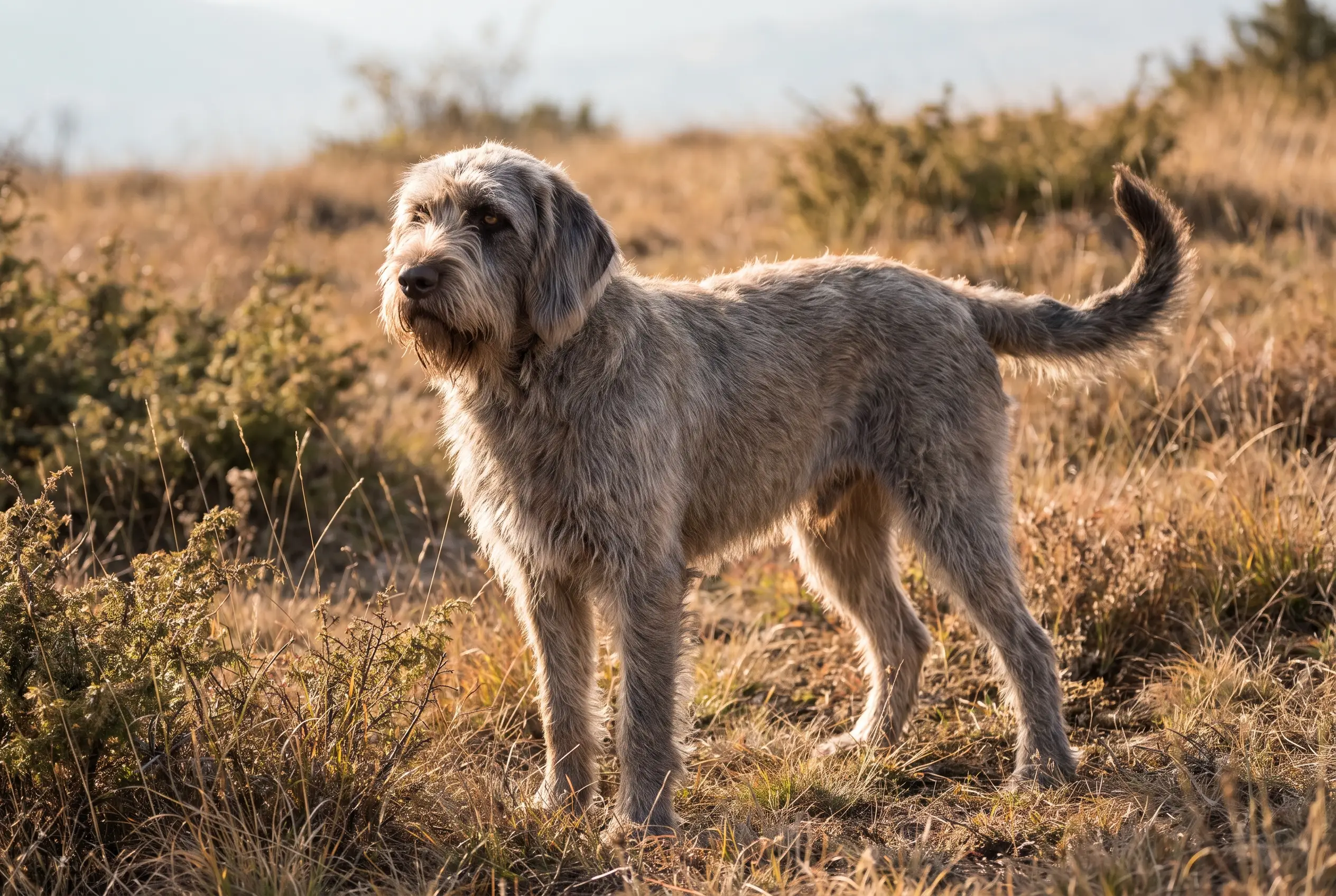
Bosanski Oštrodlaki Gonič-Barak
A shaggy-bearded Balkan scenthound bred to run for hours and announce every find.
Vital stats
| Size | Medium · 46–56 cm, ideal 52 cm; females a little smaller |
| Weight | 16–24 kg, ideal 20 kg |
| Life expectancy | 12–14 years — breed literature, not survey data |
| Energy | High — a working scenthound built for long days on a trail |
| Shedding | Moderate to high — dense undercoat, sheds with the seasons |
| Coat | Long, hard, shaggy, tousled, dense undercoat · wheaten yellow, reddish yellow, earthy grey or blackish with white markings, bi- or tricolour |
| Group | Hound · Scenthounds, Medium-sized Hounds (FCI №155, Group 6) |
| Origin | Bosnia and Herzegovina |
| FCI group | 6 — Scent hounds and related breeds · FCI 155 |
Breed traits
Friendliness
Care
Mind
The Bosanski Oštrodlaki Gonič-Barak by the numbers
The Bosanski Oštrodlaki Gonič-Barak facts owners search for most — price, lifespan, weight, shedding and colours, in one place.
Less common, so expect a waitlist and some travel to a reputable breeder — which pushes the price up. Plan for steady ongoing costs — mid-range food, routine vet care and insurance.
We don't quote a single figure: the real price swings with breeder, region, bloodline and health testing — and a rescue costs a fraction of a breeder's litter. Adopting is almost always the cheapest route.
Temperament
The standard's behaviour section is two lines long: "Lively temperament, courageous and persistant dog." Read next to the utilization clause — a "well working scenthound, resistant and persistant, with a sonorous high sounding voice, sometimes deep-voiced" — it describes a dog built to hold a scent trail for hours and keep announcing it the whole time. General appearance calls the expression "serious, severe but playful," which is as close as the standard gets to promising warmth at home: businesslike on the trail, looser once the work is done. It doesn't soften on soundness of character either — eliminating faults disqualify a dog that is "aggressive or overly shy" just as firmly as one with a crooked jaw.
Habits & quirks
A voice built to carry
The standard doesn't just ask for a good nose — it specifies the voice: "sonorous high sounding voice, sometimes deep-voiced." In the field that's how a Barak keeps its hunter posted on a trail running through cover it can't be seen from.
The beard is structural
Pronounced, bushy eyebrows and a muzzle "covered with a bushy moustache and beard" aren't styling — they're named requirements of the standard's head section, and together with a "serious, severe but playful" expression they give the breed its unmistakable look.
Ten per cent longer than tall
One of the standard's few hard numbers outside height and weight: body length must exceed height at the withers by 10%, which is why the breed reads long and low-slung rather than square.
Shaggy, never soft
The coat has to be "long, hard, shaggy, tousled" — texture, not just length. Hair that turns "too long, woolly, wavy or curly" is an eliminating fault, so a Barak that feels plush instead of wiry is off-type by the standard's own words.
Health
The breed standard says nothing about health, which is normal for an FCI standard, and the breed literature describes the Barak as a hardy landrace with no widely flagged genetic problems. The real caveat is numbers: this is a rare dog even in Bosnia and Herzegovina, so the sensible due diligence is to ask any breeder about pedigree depth and hip screening before committing. Day to day, it's a robust working hound — check the drop ears and the bearded muzzle after it's been out in cover, keep it properly exercised, and it tends to stay well.
Nutrition
| Exercise | The standard calls it "resistant and persistant" and gives it a working trial, which in practice means long days on a scent line over rough ground. Plan on real off-lead time or organised scent work daily — a walk around the block doesn't use up a dog built to run all day. |
| Grooming | Brush the dense undercoat and hard, shaggy topcoat weekly at minimum, more during seasonal shedding, and pay particular attention to the bearded muzzle and feathered legs where debris collects. Check and clean the beard after it's been working outdoors. |
| Training | It's an independent scenthound, built to trail on its own judgement rather than take constant direction, so expect a dog that thinks for itself once its nose is down. Start recall early; the standard's eliminating faults disqualify an "aggressive or overly shy" dog just as much as a poorly built one, so socialisation matters as much as obedience. |
| Health | The standard is silent on health, as most FCI standards are. Breed literature describes the Bosnian Coarse-haired Hound as a hardy landrace with no widely flagged genetic issues, though the population is very small even in Bosnia and Herzegovina — ask any breeder about pedigree depth and hip screening, standard due diligence for a numerically small working breed. |
The Barak is a working scenthound built to run all day, so feed it to its real workload — a dog getting long days on a trail needs more fuel than one that mostly walks, and the balance shifts with the seasons and the dog's job. Weigh the meals, keep it lean and hard-muscled rather than heavy, and go by feel under that dense coat, which hides condition. A fit working weight is what lets a Barak do the one thing it's for: hold a scent line for hours over rough ground.
Puppy guide
A Barak puppy is a working hound in miniature — high-energy, curious and driven by its nose from early on — so the first year is about laying down recall and socialisation before the hunting instinct fully arrives. Start recall young and keep it fun, because a scent-driven dog that has learned to switch off and come back is far safer off-lead than one you're arguing with mid-trail. Socialise it broadly so a naturally reserved hound grows up steady, get it used to weekly brushing and to having its ears and beard checked, and give the growing body and busy mind plenty to do.
Training
The Barak is an independent scenthound, bred to follow a trail on its own judgement rather than wait for instructions, so train it knowing it will think for itself the moment its nose hits the ground. Recall is the lesson that matters most and the hardest one to hold against a live scent — start it early, reward it richly, and proof it before you trust it in open country. Socialisation counts as much as obedience with this breed: the standard faults a dog that's aggressive or overly shy as firmly as a badly built one, so a well-socialised, level-headed hound is the goal.
Life expectancy
Baraks live 12–14 years — breed literature, not survey data. The Barak is a hardy working landrace, the kind of dog that tends to stay sound if you let it do what it's built for. You keep one at the top of its range with real daily exercise, a lean working weight, a coat and ears kept clean after time in the field, and a breeder chosen for pedigree depth in a small population. A Barak with a proper job and a fit body is usually a healthy one.
Similar breeds
Breeds with a similar build and background — worth a look if this one isn't quite the fit.
Breeds that look like this
Common questions
Is the Bosnian Coarse-haired Hound the same breed as the Illyrian Hound?
Yes. The FCI registered it in 1965 under the name Illyrian Hound; the standard's own history note explains that the 1973 revision kept the same Standard No. 155 and changed the name to Bosanski Oštrodlaki Gonič-Barak. One breed, two names on record, not two breeds.
How is it different from the other Balkan scenthounds?
Mostly by coat. Several other FCI breeds cover Balkan scenthounds close enough to confuse online — the Serbian Hound (Srpski Gonič, No. 150), the Serbian Tricolour Hound (Srpski Trobojni Gonič, No. 229), the Posavski Gonič (Posavatz Hound, No. 154), the two Istrian hounds (Istarski Kratkodlaki Gonič, No. 151, and Istarski Oštrodlaki Gonič, No. 152), and the Crnogorski Planinski Gonič (Montenegrin Mountain Hound, No. 279). Each has its own standard and country of origin. What sets the Bosanski Oštrodlaki Gonič-Barak apart at a glance is the coat: none of the others combine a long, shaggy coat with a full beard and pronounced eyebrows.
How much grooming does the shaggy coat need?
More than a short-coated hound, less than a breed groomed for the show ring. Brush weekly at minimum against the dense undercoat, more during seasonal shedding, and check the bearded muzzle and feathered legs after it's been working outdoors. The standard disqualifies hair that turns woolly, wavy or curly, so regular brushing that keeps the texture hard and flat also keeps a Barak in type.
Does the Bosanski Oštrodlaki Gonič-Barak shed a lot?
Moderately. The Bosanski Oštrodlaki Gonič-Barak sheds a fair amount, steadily through the year with heavier seasonal patches. A weekly brush keeps most of the loose hair off your floors and clothes.
Is the Bosanski Oštrodlaki Gonič-Barak hypoallergenic?
Not really. No dog is truly hypoallergenic, and the Bosanski Oštrodlaki Gonič-Barak's shedding coat releases plenty of the dander that sets off allergies. If someone at home is allergic, this isn't the easiest breed to live with — spend time around one first.
Is the Bosanski Oštrodlaki Gonič-Barak good with children?
They can be. The Bosanski Oštrodlaki Gonič-Barak is reasonably sociable and can be good with children in the right home, especially when socialised early. Supervise around young kids and teach dog and child to respect each other.
Is the Bosanski Oštrodlaki Gonič-Barak easy to train?
Reasonably. The Bosanski Oštrodlaki Gonič-Barak is trainable with consistency and rewards, though it isn't the quickest study. Keep sessions short and positive, and be patient with the basics like recall.