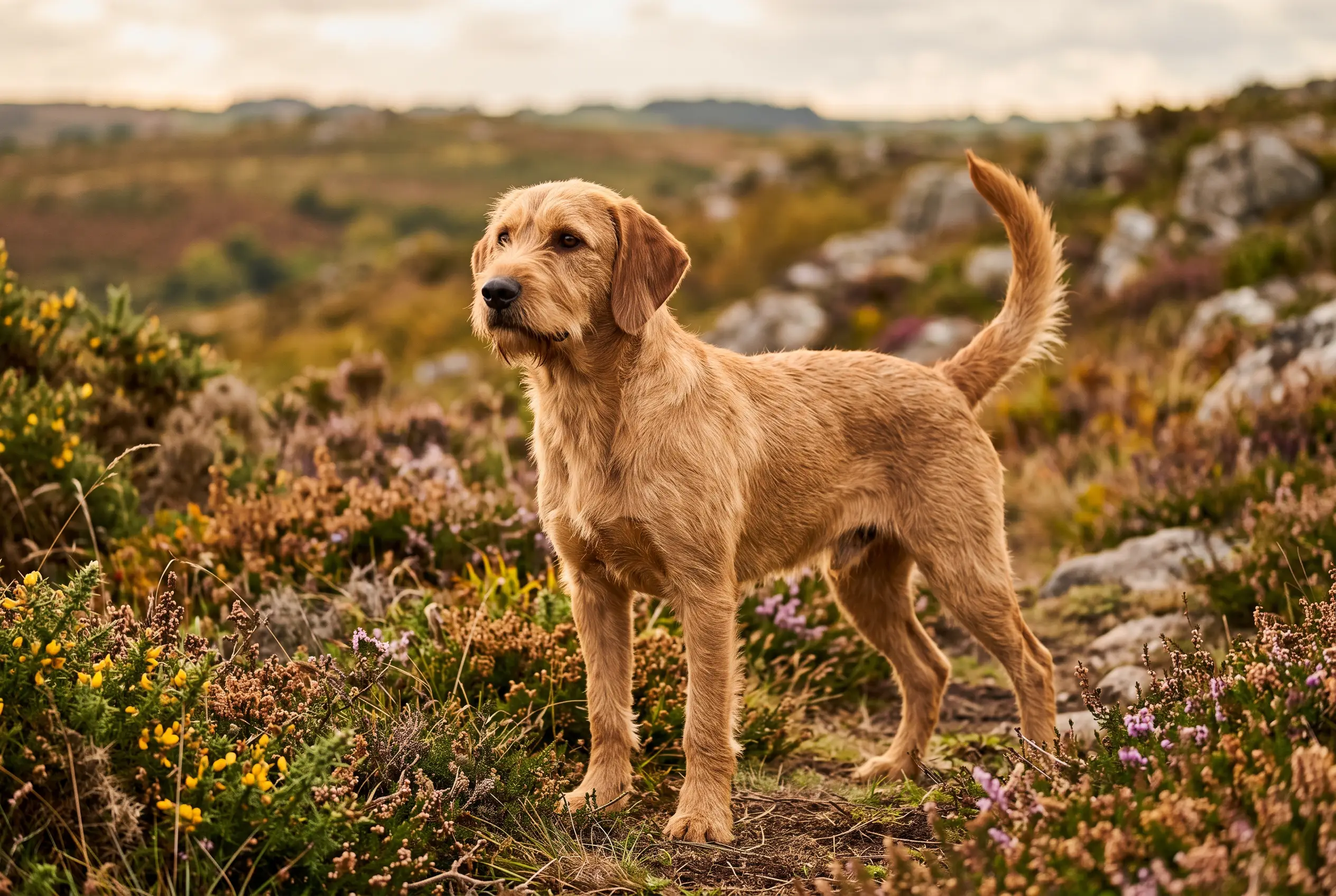
Griffon Fauve de Bretagne
Brittany's wolf-hound, rebuilt from what was left after the wolves were gone.
Vital stats
| Size | Medium · 48–56 cm, males and females alike |
| Weight | 18–22 kg — breed literature; the standard sets none |
| Life expectancy | 12–14 years — breed literature, not survey data |
| Energy | High — 2+ hrs/day, bred for a full day's work |
| Shedding | Moderate — short, harsh coat; weekly brush |
| Coat | Very rough and harsh, rather short, never woolly or curly · fawn, golden wheaten to red brick |
| Group | Scent Hounds · Medium-sized Hounds (FCI №66, Group 6) |
| Origin | Brittany, France |
| FCI group | 6 — Scent hounds and related breeds · FCI 66 |
Breed traits
Friendliness
Care
Mind
The Griffon Fauve de Bretagne by the numbers
The Griffon Fauve de Bretagne facts owners search for most — price, lifespan, weight, shedding and colours, in one place.
Less common, so expect a waitlist and some travel to a reputable breeder — which pushes the price up. Plan for steady ongoing costs — mid-range food, routine vet care and insurance.
We don't quote a single figure: the real price swings with breeder, region, bloodline and health testing — and a rescue costs a fraction of a breeder's litter. Adopting is almost always the cheapest route.
Temperament
The standard's own words: 'Fauves de Bretagne are impassioned hunters but are good natured with people, sociable, affectionate and equable.' On the trail, it adds, they turn 'courageous, wily, tenacious and steady,' adapting to any terrain and any quarry, working alone as easily as with a pack, and just as capable of pushing ahead as of 'harking in' — picking back up a line the pack has lost. 'When well conducted,' the standard closes, 'they are obedient and return readily,' which reads as a fair description of what training buys you, not something that comes free. Breed literature fills in the parts the standard skips: a griffon that matures slowly, likes to talk, and does badly bored and left alone.
Habits & quirks
A 'chopper' bark
The standard names the voice itself: a sustained 'chopper' of short, repeated notes, paired with good scenting ability as the two traits that make the breed effective working difficult ground. You'll often hear it on a line before you see it.
No dewclaws, by definition
The standard disqualifies any dog born with dewclaws, and the fault covers even a dog that had them surgically removed — this breed is meant to be clean-legged from birth, a rarer requirement than it sounds even among French hounds.
Fawn, full stop
One colour only, from golden wheaten to red brick. A scatter of black hairs on the back and ears is tolerated, and an occasional small white star on the chest is allowed but, in the standard's own phrase, 'not sought after' — a marking breeders would rather not see.
A tail that swings, not wags
In action the tail rides above the topline and swings side to side in a steady rhythm — the standard's own word is 'regular.' It's medium length, thick at the base and tapers to a bristly tip, carried in a slight sickle curve rather than a curl.
Health
There's no breed-wide health survey behind the Griffon Fauve de Bretagne, so the honest list is what breeders and breed literature flag to raise before you buy: hip and elbow dysplasia, eye problems, and a sensitivity to heat that's worth remembering on a hot day's work. The population is small outside France, which makes pedigree depth its own health question — ask how closely related the parents are and what the breeder screens for. Keep the dog lean and fit, check the ears after wet or brambly work, and treat the 12–14 years usually quoted as breed literature rather than measured fact.
Nutrition
| Exercise | A working scent hound bred to gallop hard ground all day; plan on two hours or more of real exercise, ideally with actual scent work — tracking, nose games or hunting itself — rather than a leash walk around the block. |
| Grooming | The standard is specific about the coat: very rough and harsh, rather short, never woolly or soft. A weekly brush keeps it in order; breed literature recommends occasional hand-stripping over clipping, since cutting the coat softens the texture the standard is written to protect. |
| Training | The standard credits it with obedience and a readiness to return home 'when well conducted' — worth reading as a job description, not a guarantee. This is an independent scent hound first; recall around a hot trail needs real, early investment, and the household habits breed literature reports — vocal, food-driven, slow to settle as a puppy — respond better to consistency than to a heavy hand. |
| Health | Breed literature flags hip and elbow dysplasia, eye problems and heat sensitivity as the concerns to raise with a breeder; there's no breed-wide health survey behind any of it. The population is small outside France, so ask about pedigree depth too. |
This is a lean, hard-working scenthound built for a full day on rough ground, and it's a food-driven one, so it will happily eat past what it needs. Feed to the actual workload, weigh the meals, and count the training treats — which you'll be using plenty of — inside the day's total. Aim for ribs you can feel under the harsh coat and keep the dog fit rather than heavy: a working build carries less strain and holds up better over the years.
Puppy guide
A Griffon Fauve de Bretagne puppy is slow to mature and, breed literature is honest about it, slow to settle — expect a vocal, busy youngster. Socialise him early and widely, start recall before the nose takes charge, and keep the growing joints to gentle exercise rather than forced distance. This is a pack-bred hunting hound that does badly bored and alone, so teach him to be left for short, growing stretches, and put the food drive to work early: a treat-led session is worth more here than any correction.
Training
Its own standard credits the breed with obedience and a readiness to come home 'when well conducted' — read that as a job you do, not a guarantee. Underneath the good nature is an independent scenthound with a serious nose, so recall around a hot trail needs real, early work, and the food drive is the lever: short, reward-based sessions beat a heavy hand every time. The dog is vocal and slow to settle young, and both respond better to consistency than to force.
Life expectancy
Griffon Fauves de Bretagne live 12–14 years — breed literature, not survey data. The Griffon Fauve de Bretagne is a tough, workmanlike hound with no breed-wide survey behind the 12–14 years usually quoted, so a long life comes down to the basics done well: real daily exercise, a lean weight, ears kept clean after rough work, and honest questions about the parents given how small the gene pool is outside France. A fit dog with a job to do tends to be a sound one.
Similar breeds
Breeds with a similar build and background — worth a look if this one isn't quite the fit.
Breeds that look like this
Common questions
How is the Griffon Fauve de Bretagne different from the Basset Fauve de Bretagne?
Same fawn coat, same rough hair, same Breton hunting stock — different legs. The griffon (FCI No. 66) stands 48–56 cm on straight legs built to gallop; the basset (FCI No. 36) was bred down onto short legs from the same stock, to hunt at a pace hunters on foot could keep up with. Both breeds trace their modern survival to the same 20th-century rescue effort out of Brittany.
Is it true the breed nearly went extinct along with the wolf?
Yes, and the FCI's own standard says so directly: the breed was 'much used until the XIX century for wolf hunting in Brittany' and 'suffered a decline when these animals disappeared' — wolves were hunted to extinction in France over that same century. What was left had become rare enough that Marcel Pambrun founded a dedicated club in 1949 specifically to save it; FCI documentation credits the Comte de Pluvié alongside him. The breed didn't fully re-establish its numbers among French scent hounds until the 1980s.
Are they good family dogs?
The standard calls them 'good natured with people, sociable, affectionate and equable,' and that holds up at home — but underneath it, this is still an impassioned hunter with a serious nose. Expect a vocal dog that wants a real outdoor job rather than a stroll, and put in early recall work around scent: the standard's promise that it 'returns readily' assumes a dog that's been well conducted, not one left to freelance.
Does the Griffon Fauve de Bretagne shed a lot?
Moderately. The Griffon Fauve de Bretagne sheds a fair amount, steadily through the year with heavier seasonal patches. A weekly brush keeps most of the loose hair off your floors and clothes.
Is the Griffon Fauve de Bretagne hypoallergenic?
Not really. No dog is truly hypoallergenic, and the Griffon Fauve de Bretagne's shedding coat releases plenty of the dander that sets off allergies. If someone at home is allergic, this isn't the easiest breed to live with — spend time around one first.
Is the Griffon Fauve de Bretagne easy to train?
Reasonably. The Griffon Fauve de Bretagne is trainable with consistency and rewards, though it isn't the quickest study. Keep sessions short and positive, and be patient with the basics like recall.