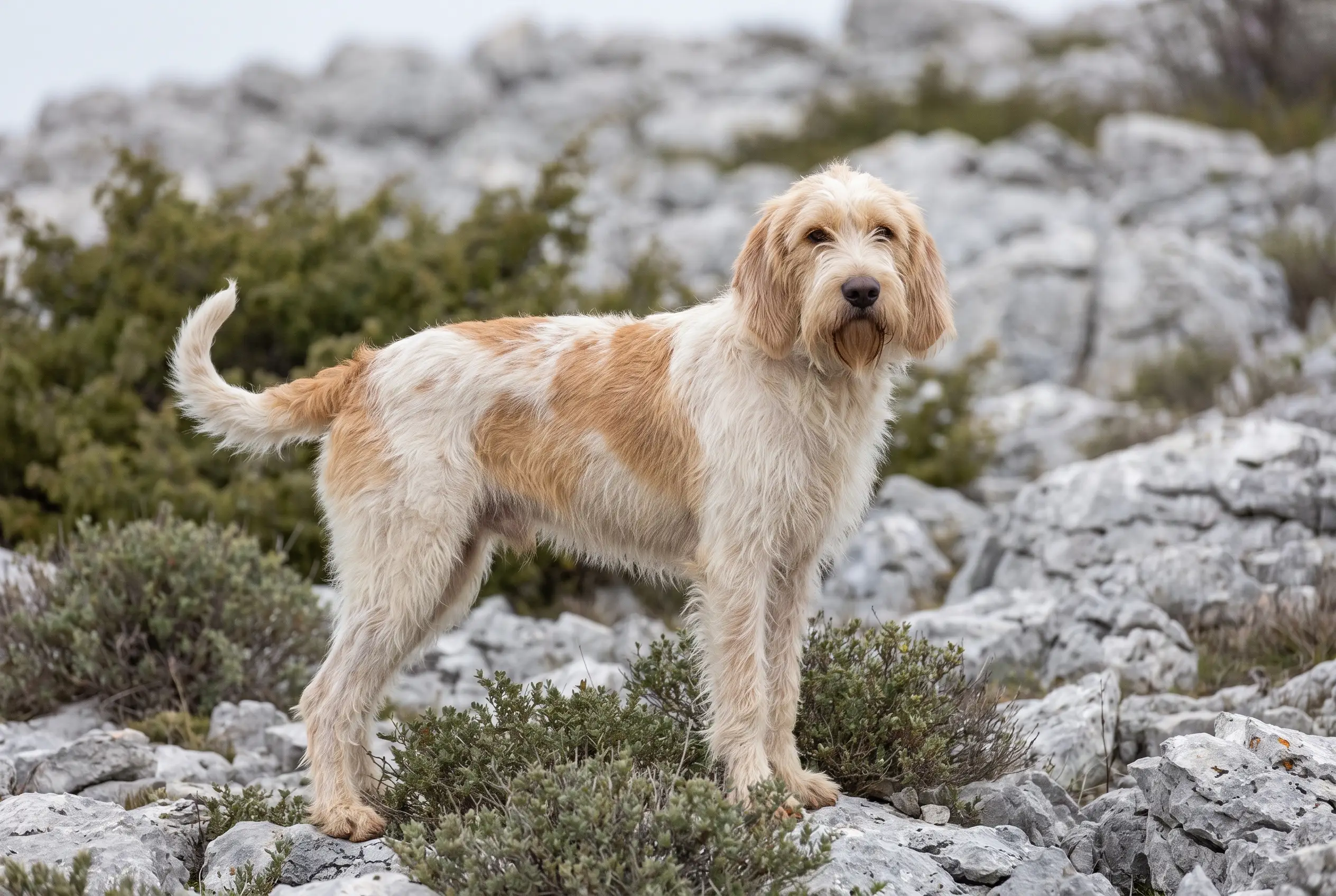
Istarski Oštrodlaki Gonič
A snow-white Croatian hound that grew a beard to survive its own mountains.
Vital stats
| Size | Medium · 50–54 cm (dogs), 48–52 cm (bitches) |
| Weight | 16–24 kg — breed literature; the standard sets none |
| Life expectancy | 12–14 years — breed literature, not survey data |
| Energy | High — a hunting hound built for hours on rough, stony terrain |
| Shedding | Low-to-moderate — wiry coat, denser undercoat in winter |
| Coat | Wiry, harsh, slightly wavy, 5–8 cm · moustache, beard and bushy eyebrows · snow-white with orange markings |
| Group | Scenthound · Medium-sized Hounds (FCI №152, Group 6) |
| Origin | Istria, Croatia |
| FCI group | 6 — Scent hounds and related breeds · FCI 152 |
Breed traits
Friendliness
Care
Mind
The Istarski Oštrodlaki Gonič by the numbers
The Istarski Oštrodlaki Gonič facts owners search for most — price, lifespan, weight, shedding and colours, in one place.
Less common, so expect a waitlist and some travel to a reputable breeder — which pushes the price up. Plan for steady ongoing costs — mid-range food, routine vet care and insurance.
We don't quote a single figure: the real price swings with breeder, region, bloodline and health testing — and a rescue costs a fraction of a breeder's litter. Adopting is almost always the cheapest route.
Temperament
The standard describes the breed in one short line: "Gentle, even temperament, with a stern expression. Devoted to his owner." It adds that the breed is easy to train for hunting and built to work "in any weather condition and also in rough, stony or hilly terrain," with a voice of medium tone that "also has deeper sounds" — the vocabulary of a hound that gives voice on a trail, not one that barks for its own sake. Breed literature adds the complication the standard leaves out: bred almost entirely for hunting rather than companionship, it can be willful once it's off a scent and slower to take instruction on anything that isn't tracking.
Habits & quirks
A coat built by the mountains
The standard is unusually direct about why the coat is wire-haired at all: "The hair is wire-haired due to the climate, where the breed was bred. These are mountain areas at the east Adriatic coast, where temperatures are low." The harsh topcoat and dense undercoat are cold-weather engineering, not a breeder's preference.
Orange, but only a third
White is the base and orange the accent, and the standard caps it: total markings "must not exceed one third of the whole body," spots have to stay clearly separated rather than blending, and red, chestnut brown or lemon yellow markings disqualify outright — this is not a breed with colour options.
Beard first, then the rest of the dog
The muzzle carries a dense moustache and beard, and the eyebrows are bushy with longish wiry hair — softer than the coat on the body. It is the one feature no smooth-coated Istrian hound will ever have, and the fastest way to tell the two breeds apart at a glance.
A tail that stays down
Carried as a continuation of the croup, sabre-shaped and below the topline; it may lift when the dog is excited but never above the back. A tail carried in a ring or curved sideways is a disqualifying fault, not a style choice.
Care
| Exercise | This is a working hound bred for hours on rough, stony, hilly ground in any weather. Hunting, long scent trails or extended off-lead hikes on varied terrain suit it far better than a lap around the block; a bored one gets vocal and destructive. |
| Grooming | Brush the wiry topcoat weekly to keep it standing off the body rather than lying flat, and check the beard and eyebrows after every outing — they collect burrs and mud on rough ground. The coat needs no clipping; hand-stripping loose dead hair keeps the harsh texture the standard calls for. |
| Training | The standard calls it easy to train for hunting, and that is the honest starting point: work with the nose and the drive to trail rather than against them. Off the scent it can be more stubborn, so keep early recall and basic obedience consistent and reward-based from puppyhood. |
| Health | Neither the standard nor the available breed literature reports problems specific to the breed, and there is no breed-wide health survey behind the 12–14 years usually quoted. The population outside Croatia is small, so ask breeders about hip and joint screening as sound practice for any working hound, not a documented scheme requirement. |
Life expectancy
This breed has a typical life expectancy of 12–14 years — breed literature, not survey data.
Similar breeds
Breeds with a similar build and background — worth a look if this one isn't quite the fit.
Breeds that look like this
Common questions
Is the Istrian Wire-haired Hound just the Istrian Short-haired Hound with more coat?
No — they are two separate FCI breeds with two separate standards, No. 152 for the wire-haired and No. 151 for the short-haired, recognised four days apart in April 1955. Both descend from the same historic "East Adriatic white hound with markings," both wear the same snow-white coat with orange markings capped at a third of the body, and both stand close in height (the wire-haired runs about 1–2 cm taller at the withers). What sets them apart is the coat itself: the wire-haired grew its harsh, bearded 5–8 cm topcoat because it was bred in the colder mountain areas of the east Adriatic coast, while the short-haired kept the original 1–2 cm hard, dense, close-lying coat. Coat variety and breed are not the same thing here — a wire-haired puppy cannot be registered as the short-haired breed, or the reverse.
Are they good family pets?
They can be, for a household ready to give a real hunting hound a job. The standard calls the temperament gentle, even and devoted to its owner, but this is a dog bred almost exclusively for scenting hare, fox and boar over difficult ground, and breed literature is honest that it can be willful and slow to focus on anything that isn't a trail. It needs daily exercise well beyond a walk, is reserved rather than outgoing with strangers, and does best with an owner who hunts, does scent work, or otherwise gives that nose a job.
Do they bark a lot?
They're vocal, in a working sense rather than a nuisance one. The standard describes the voice as medium in tone but able to produce deeper sounds — bred so a hunter can follow the hound by ear through cover it can't see into. Expect it to give voice freely on a scent trail and, like most hounds left without enough exercise or company, to find its own reasons to sound off at home.
Does the Istarski Oštrodlaki Gonič shed a lot?
Moderately. The Istarski Oštrodlaki Gonič sheds a fair amount, steadily through the year with heavier seasonal patches. A weekly brush keeps most of the loose hair off your floors and clothes.
Is the Istarski Oštrodlaki Gonič hypoallergenic?
Not really. No dog is truly hypoallergenic, and the Istarski Oštrodlaki Gonič's shedding coat releases plenty of the dander that sets off allergies. If someone at home is allergic, this isn't the easiest breed to live with — spend time around one first.
Is the Istarski Oštrodlaki Gonič easy to train?
Reasonably. The Istarski Oštrodlaki Gonič is trainable with consistency and rewards, though it isn't the quickest study. Keep sessions short and positive, and be patient with the basics like recall.