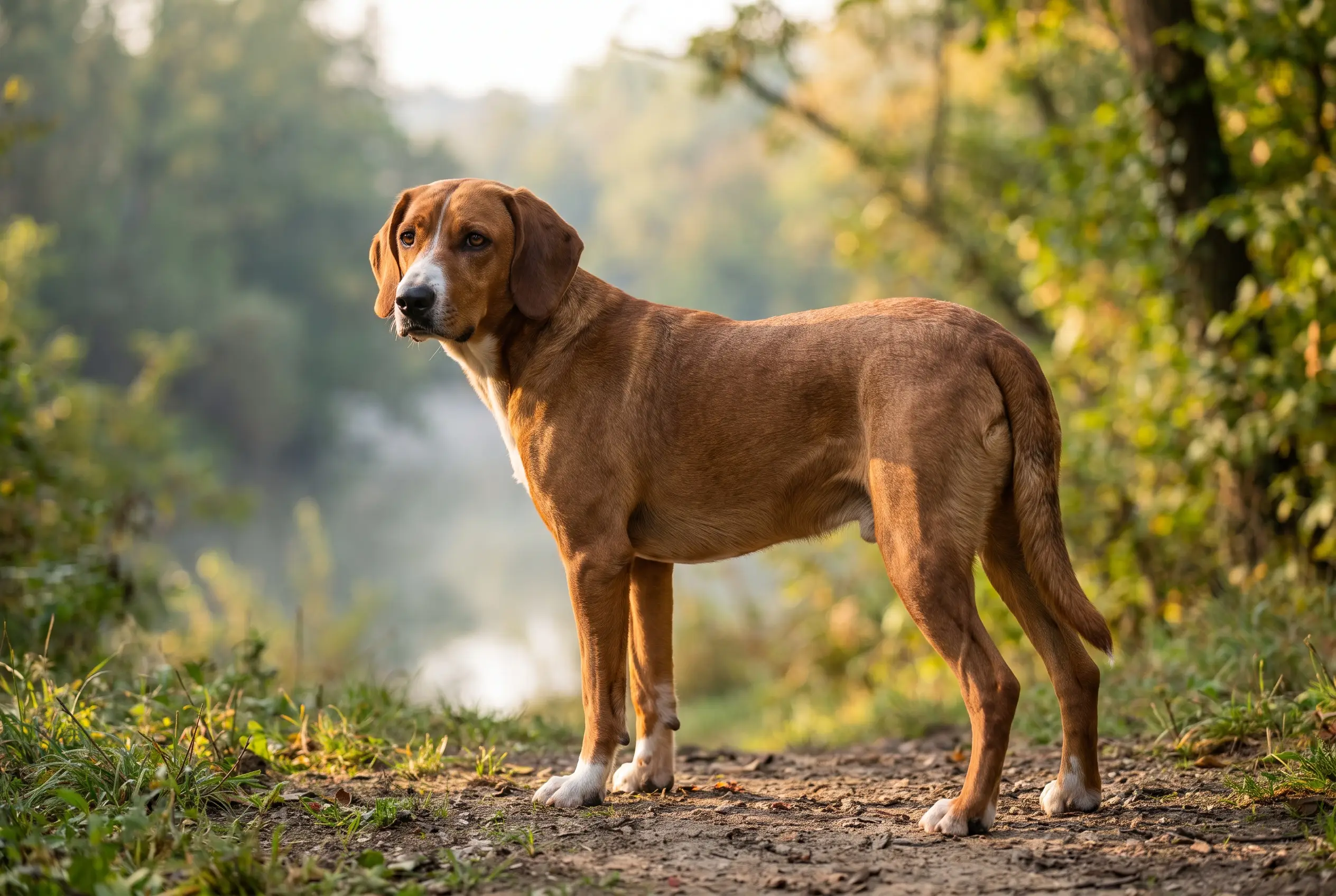
Posavski Gonič
The wheaten-red hound of Croatia's Sava valley, named for the ground it hunts.
Vital stats
| Size | Medium · 50–56 cm (males), 47–53 cm (females) |
| Weight | 16–24 kg — breed literature; the standard sets none |
| Life expectancy | 12–14 years — breed literature, not survey data |
| Energy | High — built for all-day stamina hunting hare, fox and boar |
| Shedding | Moderate — short, dense coat, sheds year-round |
| Coat | Short, harsh, dense · reddish wheaten with white markings, capped at one third of the body |
| Group | Scenthounds · Medium-sized Hounds (FCI №154, Group 6) |
| Origin | Sava Valley (Posavina), Croatia |
| FCI group | 6 — Scent hounds and related breeds · FCI 154 |
Breed traits
Friendliness
Care
Mind
The Posavski Gonič by the numbers
The Posavski Gonič facts owners search for most — price, lifespan, weight, shedding and colours, in one place.
Less common, so expect a waitlist and some travel to a reputable breeder — which pushes the price up. Plan for steady ongoing costs — mid-range food, routine vet care and insurance.
We don't quote a single figure: the real price swings with breeder, region, bloodline and health testing — and a rescue costs a fraction of a breeder's litter. Adopting is almost always the cheapest route.
Temperament
The standard's behaviour section is short and direct: 'The breed is easy to train. This is a universal hound with a clear and melodic voice for hunting in all areas. Docile, neither nervous nor aggressive, reasonably lively temperament. Very devoted to the owner.' That voice does real work in the field — a Posavski Gonič gives tongue the moment it picks up a trail, so the hunter following on foot always knows where it is. At home the same dog reads as calm rather than reactive: the standard rules out both nervous and aggressive dogs outright, disqualifying either trait on sight. It attaches closely to its owner and, like most scenthounds, follows its nose before it follows instructions; training that works with the trail drive instead of against it gets further, faster.
Habits & quirks
White, capped at one third
The standard allows white on the head as a blaze or stripe, as a collar on the neck, on the chest, the belly, the feet and pasterns, and the tip of the tail — but caps the total at one third of the body. A solid-coloured dog carrying none of it is disqualified outright.
No white on the ears
The blaze may run onto the head, but the standard specifically excludes the ears from it — the one patch of the head required to stay solid wheaten while white is expected almost everywhere else.
A voice built to carry
The standard asks for 'a clear and melodic voice for hunting in all areas': a hound meant to be heard the moment it picks up a scent, not just seen at the end of the trail.
A sabre tail, never a ring
Carried below the topline at rest and reaching, stretched out, no further than the hock, the tail tapers from a strong root and carries slightly longer hair underneath, 'preferably like a little brush.' A tail carried in a ring or curved to the side disqualifies.
Care
| Exercise | Bred to run all day over rough ground after hare, fox and boar, and the standard's own word for its stamina is 'excellent.' An hour or more of real exercise daily is the minimum, not the target — hunting, tracking work or long off-lead walks suit it better than a lap around the block, and a nose this capable wants something to do. |
| Grooming | The short, harsh coat lies close to the body and needs only a weekly brush to stay in order — this is a wash-and-wear hound. Check the drop ears after time spent working cover; they sit close to the head and can hold onto moisture and debris. |
| Training | The standard calls it easy to train, and that matches what handlers report. The complication is the nose: once a Posavski Gonič is on a trail, recall is competing with instinct that predates the standard by centuries. Start recall early, keep sessions short and reward-based, and expect a dog that listens better off a scent than on one. |
| Health | The standard's own closing note sets the bar: 'only functionally and clinically healthy dogs, with breed typical conformation should be used for breeding.' Beyond that, no breed-specific health problems appear in the standard or in wider hound literature, and the population outside Croatia and its neighbours is too small to have produced a formal health survey. Ask about hip screening and pedigree depth, as with any working hound. |
Life expectancy
This breed has a typical life expectancy of 12–14 years — breed literature, not survey data.
Similar breeds
Breeds with a similar build and background — worth a look if this one isn't quite the fit.
Breeds that look like this
Common questions
Is the Posavski Gonič the same dog as an Istrian Hound?
No — different breed, opposite colour scheme. The Istrian Short-haired and Wire-haired Hounds (FCI Nos. 151 and 152) are white dogs with orange patches; the Posavski Gonič runs the colours the other way, a wheaten-red dog with white markings capped at one third of its body. All three are Croatian scenthounds in FCI Group 6, Section 1.2, bred for similar hare and fox work, but the base colour tells them apart at a glance.
What does 'Posavski' mean?
'Of the Sava' — the river that runs from Slovenia through Croatia into Serbia. Posavina is the valley itself, and the FCI standard names it as the breed's home ground. 'Posavatz Hound' is an older English rendering of the same name; both point to the same FCI standard No. 154.
Is a Posavski Gonič a good family dog?
For a household ready for a hunting hound, yes. The standard's temperament line — docile, neither nervous nor aggressive, very devoted to the owner — describes a calm dog attached to its people rather than a guard dog or a lapdog. It needs daily stamina work and will use its voice once it catches a scent, so it suits a home with a real exercise plan far better than an apartment with none.
Does the Posavski Gonič shed a lot?
Moderately. The Posavski Gonič sheds a fair amount, steadily through the year with heavier seasonal patches. A weekly brush keeps most of the loose hair off your floors and clothes.
Is the Posavski Gonič hypoallergenic?
Not really. No dog is truly hypoallergenic, and the Posavski Gonič's shedding coat releases plenty of the dander that sets off allergies. If someone at home is allergic, this isn't the easiest breed to live with — spend time around one first.
Is the Posavski Gonič easy to train?
Reasonably. The Posavski Gonič is trainable with consistency and rewards, though it isn't the quickest study. Keep sessions short and positive, and be patient with the basics like recall.