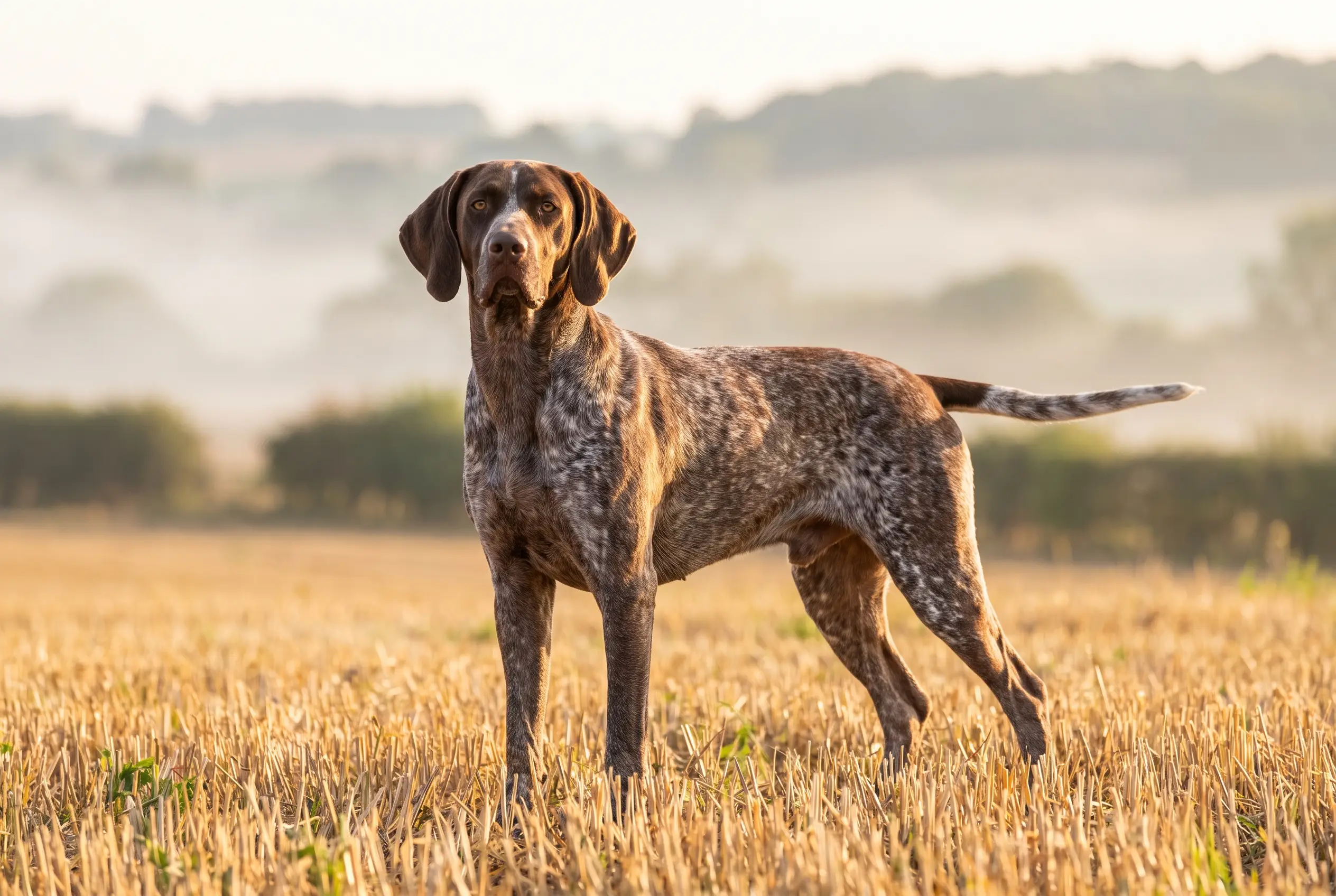
Braque Français (Gascogne Type)
The larger, rarer half of France's own pointing dog, still mostly found where it was made.
Vital stats
| Size | Large · 60–69 cm (dogs), 58–68 cm (bitches) |
| Weight | 25–32 kg — breed literature; the standard sets none |
| Life expectancy | 12–14 years — breed literature, not survey data |
| Energy | High — bred for full days in the field |
| Shedding | Moderate — short coat, seasonal peaks |
| Coat | Short, rather thick · chestnut brown — solid, with white, strongly speckled, or with tan |
| Group | Sporting · Continental Pointing Dogs (FCI №133, Group 7) |
| Origin | Gascony, South-West France |
| FCI group | 7 — Pointing Dogs · FCI 133 |
Breed traits
Friendliness
Care
Mind
The Braque Français (Gascogne Type) by the numbers
The Braque Français (Gascogne Type) facts owners search for most — price, lifespan, weight, shedding and colours, in one place.
Less common, so expect a waitlist and some travel to a reputable breeder — which pushes the price up. Ongoing costs run high — more food, bigger doses at the vet, and pricier insurance.
We don't quote a single figure: the real price swings with breeder, region, bloodline and health testing — and a rescue costs a fraction of a breeder's litter. Adopting is almost always the cheapest route.
Temperament
The standard has almost nothing to say about character: no behaviour clause at all, only a disqualification for any dog aggressive or overly shy. What fills the gap is French breed literature, and it is unusually consistent — gentle, calm, quiet in the house, attached to its family, and soft to handle. The same sources repeat an old claim that these dogs hunt so naturally they barely need formal training; take that as club pride rather than data, but the grain of truth is a pointer that co-operates instead of arguing. The soft side cuts both ways: harsh corrections shut a Gascogne down, and it learns fastest from quiet, patient handling. It still needs a job. Under the gentle manners sits a gun dog made for long days on rough ground, and a bored one will invent work you did not assign.
Habits & quirks
Two breeds, one name
The FCI splits the Braque Français in two: №133, the large Gascogne type, and №134, the small Pyrenean type, each with its own standard. The Gascogne standard's whole history section is that split — two types from the South-West of France and the Central Pyrenees, kept in pure state.
Brown, four ways
The colour section allows exactly four dresses: chestnut brown, chestnut brown and white, chestnut brown and white strongly speckled, and chestnut brown with tan markings above the eyes, at the lips and on the legs. The nose is brown, and the eyes are chestnut brown or dark yellow, with what the standard calls a frank expression.
An old braque's face
Pendent lips with a folded corner, ears set at eye level that frame the head and must reach the rear rim of the nose leather, and always a slight dewlap on the neck. The supple, quite loose skin is written into the standard — character of the breed, not a flaw of the dog in front of you.
A tail with options
The standard calls the tail generally docked, then adds that a long tail, well carried, is not a fault — and neither is a naturally short one. Born with no tail at all is a disqualification. Since docking is now banned across much of Europe, the long tail is what you will usually meet.
Health
The Braque Français carries no breed-wide health survey, and no widely recognised breed-specific disease is on record; French lines are bred for function first, which tends to keep a working dog sound. So the sensible plan is general. At this size hip screening is worth asking a breeder for, the breed is scarce outside France so pedigree depth and a health-testing breeder matter, and the folded, pendent ears want a weekly look and clean — and drying after wet outings — because a warm, closed ear canal is where infection starts. The build adds one caution: a big, deep-chested dog earns calm, unhurried meals around exercise to guard against bloat. (The loose lips mean a little drool after a drink — that is character, not a problem.)
Nutrition
| Exercise | This is a working pointer judged with a working trial, made for a full day's hunting in the South-West. Budget an hour or two daily and give the nose real work — field training, tracking, scent games. The calm house dog the literature promises is the reward for that, not the starting point. |
| Grooming | The short, rather thick coat asks for a weekly rub-down and little more. The folded, pendent ears are the real job: check and clean them regularly, as with any drop-eared gun dog, and dry them after wet outings. The loose lips mean a bit of drool after drinking. |
| Training | Gentle and co-operative by every account, and sensitive with it. Keep sessions short, rewards real and corrections mild — a raised voice costs more than it buys. Start recall early: the pointing instinct arrives on its own, and it points at things that then run. |
| Health | A working breed with no breed-wide health survey; French lines are bred for function first, which tends to keep them sound. Hip screening is sensible at this size, drop ears need watching for infection, and the 12–14 years in breed literature is a habit of the type rather than study data. |
A large gundog built for a full day's hunting eats to its workload, not to a habit, so weigh the meals, fold the training treats into the daily total, and keep ribs you can feel under the short, thickish coat. Extra weight sits heavily on a big frame and steals the stamina the breed is for, so lean is the goal at every age. And the deep chest makes the how matter as much as the amount: split the ration into two calm meals rather than one big gulped bowl, and leave a clear gap around hard running instead of feeding straight before or after it.
Puppy guide
French breed literature describes one of the gentlest, most people-attached gun dogs, and a Gascogne puppy usually makes early socialisation easy — take it calmly and widely to new people, dogs and places. It will grow large, so protect the young joints: keep repetitive hard galloping and big jumps light until they have set, and let it grow slowly on a lean, measured diet. Start recall from the first week, because the pointing instinct arrives on its own and it points at things that then run, and — since this is a sensitive dog — keep every early lesson short, kind and rewarding so nervousness never gets a foothold.
Training
Every French source describes a gentle, cooperative worker, and sensitive with it, so the method writes itself: short sessions, real rewards, mild corrections, and never a raised voice, which costs a Gascogne more than it ever buys. It wants to work with you rather than argue, so reward-based training moves quickly. Put the early effort into recall and steadiness around birds, because the pointing switches on by itself and does not switch off — the calm house dog the literature promises is what you get once the field dog has had its work.
Life expectancy
Braques Français of the Gascogne type live 12–14 years — breed literature, not survey data. A working breed with no documented breed-specific disease, the Gascogne holds the top of its range on the basics: lean weight on a big frame, ears kept clean and dry, real daily exercise and nose work, and parents from a breeder who health-tests and, with the breed scarce outside France, keeps a careful eye on pedigree depth.
Similar breeds
Breeds with a similar build and background — worth a look if this one isn't quite the fit.
Breeds that look like this
Common questions
What is the difference between the Gascogne and the Pyrenean type?
They are two separate FCI breeds with separate standards: №133 for the large Gascogne type, №134 for the small Pyrenean type. The standard's history keeps it simple — large size and small size, both from the South-West of France and the Central Pyrenees. The Gascogne is the heavier, old-style braque, with more skin, more lip and a slight dewlap; breed literature adds that the lighter, quicker Pyrenean type is far more numerous today, in France and abroad.
Are they good family dogs?
French breed literature is unanimous that this is one of the gentlest gun dogs: calm indoors, quiet, patient with children and easy with other dogs. The caveats are working-breed ones — it needs proper daily exercise and a busy nose, and it does poorly left alone and unemployed. One honesty note: this is a rare breed, so those judgements come from clubs and owners, not surveys.
Is the Braque Français the ancestor of other pointing breeds?
Breed literature has long claimed the old braque français as root stock for the continental pointers, and you will find the claim attached to half of Group 7. Treat it as tradition rather than documented pedigree. What the FCI standard itself records is narrower: two types, from the South-West of France and the Central Pyrenees, kept in pure state.
Does the Braque Français (Gascogne Type) shed a lot?
Moderately. The Braque Français (Gascogne Type) sheds a fair amount, steadily through the year with heavier seasonal patches. A weekly brush keeps most of the loose hair off your floors and clothes.
Is the Braque Français (Gascogne Type) hypoallergenic?
Not really. No dog is truly hypoallergenic, and the Braque Français (Gascogne Type)'s shedding coat releases plenty of the dander that sets off allergies. If someone at home is allergic, this isn't the easiest breed to live with — spend time around one first.
Is the Braque Français (Gascogne Type) easy to train?
Yes. The Braque Français (Gascogne Type) is one of the more trainable breeds — quick to learn and keen to work with you, which makes reward-based training straightforward. Start early, keep it positive, and it picks things up fast.