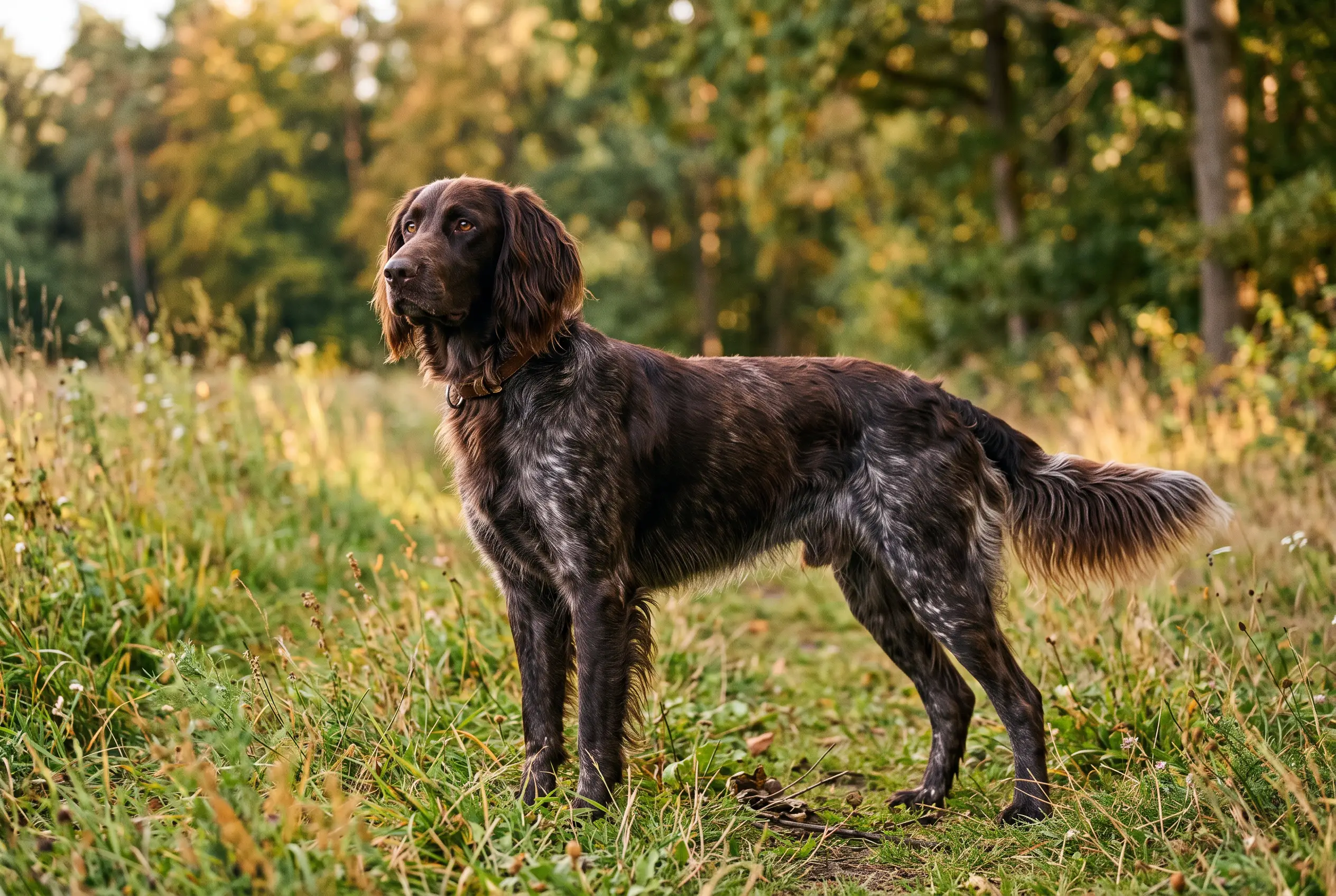
German Longhaired Pointer
Germany's original long-coated gundog — brown by rule, calm by standard, at home in field, water and forest.
Vital stats
| Size | Large · 60–70 cm (males), 58–66 cm (females) |
| Weight | About 30 kg — the standard gives an average, not a range |
| Life expectancy | 12–14 years — breed literature, not survey data |
| Energy | High — 2 hrs/day of genuine work |
| Shedding | Moderate, heavier in the seasonal moults |
| Coat | 3–5 cm on the body, feathered, with undercoat · always brown-based |
| Group | Sporting · Continental Pointing Dogs, Spaniel type (FCI №117, Group 7) |
| Origin | Germany |
| FCI group | 7 — Pointing Dogs · FCI 117 |
Breed traits
Friendliness
Care
Mind
The German Longhaired Pointer by the numbers
The German Longhaired Pointer facts owners search for most — price, lifespan, weight, shedding and colours, in one place.
Less common, so expect a waitlist and some travel to a reputable breeder — which pushes the price up. Ongoing costs run high — more food, bigger doses at the vet, and pricier insurance.
We don't quote a single figure: the real price swings with breeder, region, bloodline and health testing — and a rescue costs a fraction of a breeder's litter. Adopting is almost always the cheapest route.
Temperament
The standard describes the breed in four strokes: balanced, calm, good natured, easily trained. That calm is the working kind, not the sofa kind — the same document requires the abilities for all work in field, water and forest, before the shot and after it, and a dog built to that brief expects employment. Club and breed literature describe a companionable, people-oriented dog that settles well once exercised and takes training willingly; in the ring, aggression and marked shyness are disqualifying faults. The hunting instinct underneath is real. Birds, rabbits and fresh scent will all test the recall, so a long line earns its keep until the recall is proofed.
Habits & quirks
Brown, in every variation
The colour section lists six patterns and all of them are brown: solid brown, brown with white or speckled markings, dark roan, pale roan, mottled, and brown and white. White on the head is limited to a blaze, snip or star. Even the occasional fawn marking is accounted for — the standard calls it a very old throw-back to the Hounds in its ancestry.
A coat measured in centimetres
The standard puts numbers on the coat: 3–5 cm on the back and sides, close fitting, firm, smooth or slightly wavy, over a good undercoat. Longer hair is welcome under the neck, on the chest and belly, and as feathering on legs and tail — but a topknot is not desired, and neither is too much feathering. A working coat, with limits.
Before and after the shot
The utilization clause asks for a gundog that works field, water and forest, before the shot and after it: finding and pointing game first, then tracking and retrieving what falls. That versatility is the breed's whole brief, and the FCI judges it with a working trial.
Built low and flowing
General appearance, per the standard: strong, muscular, low set, flowing lines — slightly higher at the shoulder than the rump, never overbuilt or clumsy. The tail is carried about level, the last third curving gently upwards, and the ears sit not too low, turned slightly forward against the cheeks.
Health
The German Longhaired Pointer is generally a hardy working breed, with no breed-wide health survey to point to, so screening and good breeding matter more than a checklist. The German parent club X-rays breeding stock for hip dysplasia, so ask any breeder for hip results and working evaluations. As a large, deep-chested gundog it is worth knowing the signs of bloat and treating a suddenly swollen belly as an emergency. And the drop ears need a routine: a gundog that loves water and carries hanging, feathered ears is a classic candidate for ear trouble, so look inside them weekly.
Nutrition
| Exercise | This is a hunting breed judged with a working trial, and a walk is a warm-up, not a day's work. Plan on a couple of hours with real jobs inside them: dummy retrieves, tracking, swimming — the standard names water work alongside field and forest — or gundog training proper. Under-employed, it invents projects you will not like. |
| Grooming | A thorough brush once or twice a week keeps the 3–5 cm coat and its feathering free of knots, stepping up when the undercoat moults. Check the feathering and between the toes for burrs and grass seeds after outings, and look inside the hanging ears weekly — a drop-eared gundog that loves water is a classic set-up for ear trouble. |
| Training | 'Easily trained' is written into the standard, and the breed lives up to it when the work is fair and regular. Start young, keep sessions purposeful, and give the nose legitimate outlets; recall needs patient proofing around game, because finding it is what the breed has been selected for since 1879. |
| Health | A working breed generally described as hardy, with no breed-wide health survey to cite. The German parent club screens breeding stock for hip dysplasia, so ask any breeder for hip results and working evaluations; keep up the ear checks, and treat the 12–14 years in breed literature as a habit of the type rather than study data. |
This is a two-hours-of-real-work breed, and the bowl has to match the day: a Longhaired Pointer in the hunting season and one resting between outings do not need the same amount, so feed to the workload and the season rather than a fixed scoop. Keep it lean and muscled the way a working gundog should be, weigh the meals, and count retrieving and training treats in the day's total. Given the deep chest, split the food into smaller meals and keep things calm around eating rather than feeding one big bowl before hard exercise.
Puppy guide
A Longhaired Pointer puppy has the drive of a working gundog from the start, and the job of the first year is to shape it rather than exhaust it. Keep exercise low-impact while the joints are forming — free play and short outings beat forced miles — and pour the energy into the brain instead: short, fair training games, wide socialisation, and gentle first lessons for the nose. Start the recall now and expect to keep proofing it for years, because finding game is what the breed is built for. Get it used to having the ears and the feathering handled early, so grooming and ear checks are never a battle.
Training
Easily trained is written into the standard, and the breed earns it when the work is fair and regular. Start young, keep the sessions purposeful, and give the nose legitimate jobs — tracking, retrieves, water work — so the drive has somewhere to go. The one thing that takes patience is recall around game: finding birds is the whole point of the breed, so proof the recall slowly and use a long line until it holds when it matters.
Life expectancy
German Longhaired Pointers live 12–14 years — breed literature, not survey data. The life expectancy in breed literature for the German Longhaired Pointer is a habit of the type rather than survey data, and you hold a working gundog at the top of its range the working way: lean weight, hips screened in the parents, ears kept clean and dry, and the hours of real occupation the breed was built to expect.
Similar breeds
Breeds with a similar build and background — worth a look if this one isn't quite the fit.
Breeds that look like this
Common questions
Is this just a long-haired German Shorthaired Pointer?
No — Germany keeps separate pointer breeds with separate FCI standards, and the Longhaired is the elder: pure-bred since 1879, with its first standard written by Baron von Schorlemer in 1897. The FCI even files it apart — the Shorthaired sits with the continental pointers of 'Braque type', while the Longhaired is classed as 'Spaniel type', with a heavier, feathered coat and a standard that leads with calm.
What is the link with the Large Munsterlander?
Close family, by breed literature: the Large Munsterlander descends from the black-and-white longhaired dogs left outside when the Deutsch Langhaar club fixed brown as the breed's colour, and the Munsterlanders went their own way in the early twentieth century. The GLP standard itself does not tell that story; what it does say is that every allowed colour is brown-based — so a black-and-white 'longhaired pointer' is another breed.
Are they good family dogs?
The written temperament — balanced, calm, good natured, easily trained — is about as family-friendly as gundog standards get, and breed literature describes a dog that lives closely with its people. The honest condition is work: this is a hunting breed judged with a working trial, and it needs hours of genuine occupation, room to run, and a job for its nose. Met on those terms it settles well; ignored, it will not.
Does the German Longhaired Pointer shed a lot?
Moderately. The German Longhaired Pointer sheds a fair amount, steadily through the year with heavier seasonal patches. A weekly brush keeps most of the loose hair off your floors and clothes.
Is the German Longhaired Pointer hypoallergenic?
Not really. No dog is truly hypoallergenic, and the German Longhaired Pointer's shedding coat releases plenty of the dander that sets off allergies. If someone at home is allergic, this isn't the easiest breed to live with — spend time around one first.
Is the German Longhaired Pointer easy to train?
Yes. The German Longhaired Pointer is one of the more trainable breeds — quick to learn and keen to work with you, which makes reward-based training straightforward. Start early, keep it positive, and it picks things up fast.