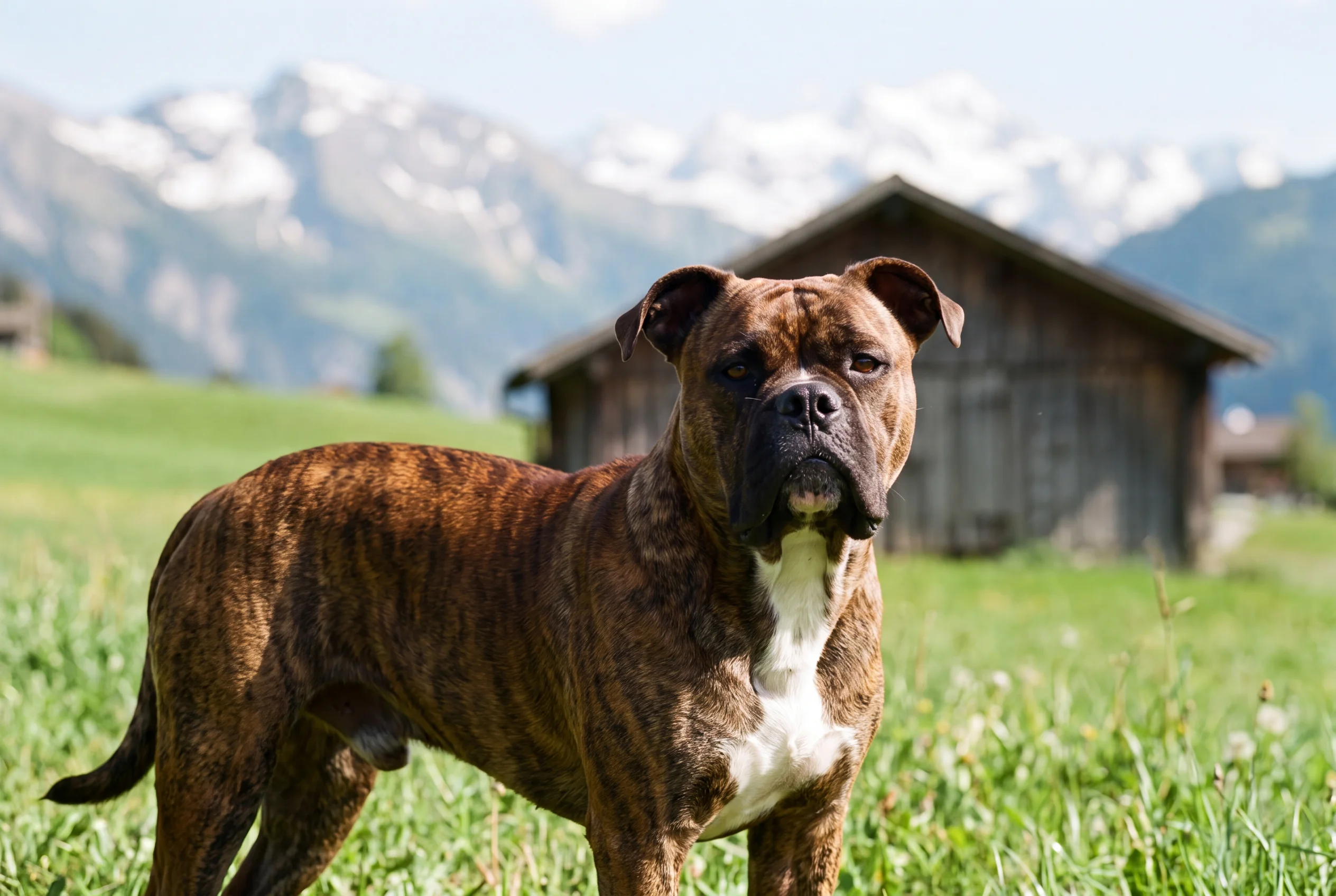
Continental Bulldog
The bulldog Switzerland redrew around a working airway.
Vital stats
| Size | Medium · 42–50 cm (males), 40–48 cm (females) |
| Weight | 20–30 kg |
| Life expectancy | 10–12 years — breed-source estimate, no published data |
| Energy | Moderate — an hour of varied ground, then off duty |
| Shedding | Moderate, year-round |
| Coat | Short, close, glossy · fawn, brindle or black, with or without white markings or a dark mask |
| Group | Non-Sporting · Bulldog (FCI №369, Group 2) |
| Origin | Switzerland |
| FCI group | 2 — Pinscher and Schnauzer, Molossoid and Swiss Mountain Dogs · FCI 369 |
Breed traits
Friendliness
Care
Mind
The Continental Bulldog by the numbers
The Continental Bulldog facts owners search for most — price, lifespan, weight, shedding and colours, in one place.
Less common, so expect a waitlist and some travel to a reputable breeder — which pushes the price up. Ongoing costs run high — more food, bigger doses at the vet, and pricier insurance.
We don't quote a single figure: the real price swings with breeder, region, bloodline and health testing — and a rescue costs a fraction of a breeder's litter. Adopting is almost always the cheapest route.
Temperament
The standard asks for four things: attentive, self-confident, friendly, neither aggressive nor shy. Day to day that comes out as a dog that greets visitors instead of screening them, settles well with children, and usually reads other dogs without picking anything up. The bulldog stubbornness survived the cross. A Conti hears a cue, weighs it against whatever it was already doing, and answers on its own schedule, which makes short reward-based sessions worth far more than drilling. What separates it from its ancestor shows up outdoors: it will do a long hill walk, keep pace on rough ground, and take to scentwork or a beginner agility class without running out of air.
Habits & quirks
Hears you, thinks about it
The recall lands, gets weighed against whatever it was already doing, and comes back late. Food and short sessions keep a Conti honest; repetition drills lose it inside a minute.
Parks on the nearest person
It picks whoever is home, follows them room to room and settles across their feet. Indoors it is a quiet dog that sleeps most of the day against something warm.
Snores anyway
A longer muzzle is not a long one. Most Contis breathe quietly awake and still snore asleep, and breeders treat noise on the move as a fault to screen out rather than a breed quirk.
Has an off switch
Ninety minutes of field and hill is well within it, and so is an afternoon doing nothing. Owners coming from the English Bulldog tend to describe the first half of that as the surprise.
Health
The Continental Bulldog was drawn up to fix the parts of the English Bulldog that fail — the standard demands a muzzle a third of the head's length, big open nostrils and elastic skin without body wrinkles, and disqualifies any dog that makes a noise breathing. That is healthier by design, and the build backs it up, but the breed is barely twenty-five years old and small, so almost nothing has been measured at population scale; it is a breeding goal, not a guarantee about the puppy in front of you. So lean on the tests. The Swiss club requires hip and elbow scores read by Vetsuisse Bern or Zurich before a dog is bred; the German club adds an airway grade of BOAS 0 or 1 from twelve months, a DNA profile and tests for DVL2 and cystinuria. Ask to see all of it, for both parents, and judge the individual dog rather than the reassuring name.
Nutrition
| Exercise | About an hour a day of varied ground, split across walks, suits most adults. Build up slowly through the first year, because heavy-boned puppies and long runs do not mix. Athletic for a bull-type dog is not the same as a running partner. |
| Heat | A shorter face than average still means less cooling surface than a shepherd has. Walk early in summer, carry water, stop at the first heavy panting, and never leave one in a car. |
| Grooming | Short coat, a brush once a week, moderate shedding all year. The standard calls for elastic skin without wrinkles on the body, but wipe and dry whatever folds the individual dog does have around the face after a wet walk. |
| Health | The breed is young and the data is thin, so lean on the breeding rules. The Swiss club requires hip and elbow scores (HD A–C, ED 0–1) read by Vetsuisse Bern or Zurich before a dog is approved for breeding; the German club adds an airway grade of BOAS 0 or 1 from twelve months, a DNA profile, and tests for DVL2 and cystinuria. Ask to see all of it, for both parents. |
Keep a Conti lean — this is a stocky, heavy-boned bull-type dog, and every extra kilo it carries works against the two things the breed was rebuilt to protect: easy breathing and sound joints. Measure the meals, keep ribs you can feel, and be strict about treats, because a stubborn dog is very good at convincing you it is starving. Match the food to a moderate worker that does its hour and then sleeps, not to an athlete. A trim Continental Bulldog breathes easier and moves better, which is the whole point of the breed.
Puppy guide
A Continental Bulldog puppy is heavy-boned, and heavy bone plus long runs is a bad mix while the joints are forming, so build exercise up slowly through the first year and let the growing happen. The temperament makes the rest straightforward: this is a friendly dog that wants to greet the world, so socialise widely and it takes to it easily. Work with the bulldog stubbornness rather than against it — keep training to short, food-led sessions from the start. And teach heat sense early, because a shorter face than a shepherd's still means less cooling to spare on a warm day.
Training
The bulldog stubbornness survived the cross intact. A Conti hears a cue, weighs it against whatever it was already doing, and answers on its own schedule — which makes short, rewarding sessions worth far more than repetition, since drilling loses it inside a minute. It is friendly and self-confident rather than driven, so keep the deal appealing and it will work with you. What sets it apart from its ancestor is that there is a real dog to train under the willingness: it can take on scentwork or a beginner agility class and keep pace on rough ground without running out of air.
Life expectancy
Continental Bulldogs live 10–12 years — breed-source estimate, no published data. Any figure you see for the breed is a breed-source estimate — it is too young and too small for anyone to have published real longevity data. What you can actually influence is clear enough: a lean weight, sensible care in the heat, and parents who passed the hip, elbow and airway tests the Swiss and German clubs ask for. The breed was rebuilt around a working airway, so protect it.
Similar breeds
Breeds with a similar build and background — worth a look if this one isn't quite the fit.
Breeds that look like this
Common questions
Is it actually healthier than an English Bulldog?
The anatomy the standard demands is better: a muzzle a third of the head's length, nostrils big and wide open, elastic skin without body wrinkles, and disqualification for any dog that makes breathing noise moving or standing. Those are the exact places the English Bulldog runs into trouble. What is missing is population-scale evidence. The breed is barely twenty-five years old and small, so almost nothing has been measured independently. When Finland reviewed six years of official kennel-club airway tests (Lilja-Maula and colleagues, Acta Veterinaria Scandinavica, 2024), four Continental Bulldogs had been tested against 245 English Bulldogs. Healthier by design is the breeding goal, and the build supports it, but it is not a guarantee about the puppy in front of you. Judge the individual dog and its parents' test results, not the breed name.
Can they mate and whelp naturally?
That was the point of the programme. A longer muzzle and a roomier pelvis are the visible parts of it, and Swiss and German breeders report bitches mating and whelping without help. The claim is harder to check than it sounds, because no registry publishes caesarean rates for the breed, and some Continental Bulldogs still end up in surgery. Ask a breeder how many of their litters were born naturally and how many by section, across several years rather than the last one, and treat a breeder who cannot answer as a breeder who has not counted.
Is it recognised, and where do puppies come from?
The FCI accepted it on a provisional basis on 30 March 2022 under standard No. 369, which means internationally registered but not yet definitively recognised; that status runs at least ten years. The AKC does not recognise the breed and it is not in the Foundation Stock Service either, so no American puppy comes with an AKC pedigree. Nearly all breeding sits in Switzerland and Germany under the Swiss and German clubs, with waiting lists to match. A puppy sold as a Continental Bulldog without a Swiss stud-book or VDH pedigree behind it is a crossbreed with a good name.
Does the Continental Bulldog shed a lot?
Moderately. The Continental Bulldog sheds a fair amount, steadily through the year with heavier seasonal patches. A weekly brush keeps most of the loose hair off your floors and clothes.
Is the Continental Bulldog hypoallergenic?
Not really. No dog is truly hypoallergenic, and the Continental Bulldog's shedding coat releases plenty of the dander that sets off allergies. If someone at home is allergic, this isn't the easiest breed to live with — spend time around one first.
Is the Continental Bulldog good with children?
Generally yes. The Continental Bulldog is a friendly, people-loving breed that usually does well with children when raised and socialised well. As with any dog, teach children to be gentle and supervise around toddlers.
Is the Continental Bulldog easy to train?
Reasonably. The Continental Bulldog is trainable with consistency and rewards, though it isn't the quickest study. Keep sessions short and positive, and be patient with the basics like recall.