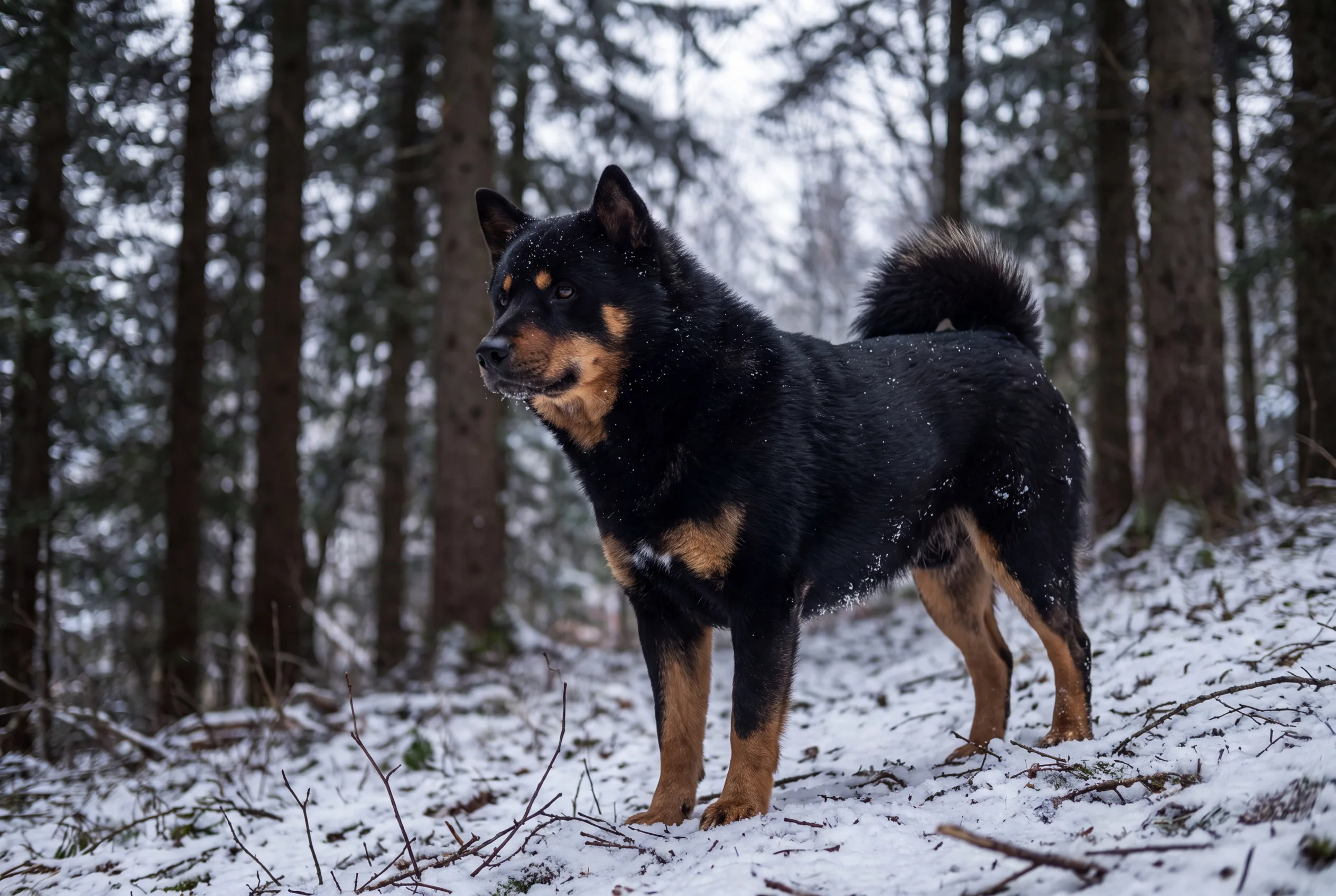
Hokkaido
The Ainu's bear dog, built for deep snow.
Vital stats
| Size | Medium · 46–52 cm |
| Weight | 20–30 kg |
| Life expectancy | 12–15 years |
| Energy | High — a hunter's stamina, bred for long days in cold |
| Shedding | High in season — two heavy moults a year |
| Coat | Harsh double coat · sesame, brindle, red, black, black and tan or white |
| Group | Non-Sporting · Asian Spitz (FCI №261, Group 5) |
| Origin | Hokkaido, Japan |
| FCI group | 5 — Spitz and primitive types · FCI 261 |
Breed traits
Friendliness
Care
Mind
The Hokkaido by the numbers
The Hokkaido facts owners search for most — price, lifespan, weight, shedding and colours, in one place.
Less common, so expect a waitlist and some travel to a reputable breeder — which pushes the price up. Ongoing costs run high — more food, bigger doses at the vet, and pricier insurance.
We don't quote a single figure: the real price swings with breeder, region, bloodline and health testing — and a rescue costs a fraction of a breeder's litter. Adopting is almost always the cheapest route.
Temperament
The standard asks for endurance, accurate judgement, and a dog that is faithful, alert and bold. Owners get something close to that. A Hokkaido attaches hard to its people, keeps a running tally of where everyone in the house is, and has opinions about anything unusual outside the door. It is more willing to work with you than a Shiba and less reserved than an Akita, but the hunting head never switched off: deer, cats and small pets read as game, and a dog bred to face down a brown bear rather than retreat from one does not back off much when a bigger dog gets rude. It is also vocal, with a rising howl that neighbours learn to recognise. Under-exercised or left alone for long days it can slide into anxiety, compulsive water drinking, or chewing things that are not food.
Habits & quirks
Snow is where it relaxes
The standard credits its build with handling severe cold and heavy snowfall, and that is not decoration. Most Hokkaido will lie down in a drift and stay out there while you go back inside.
Says what it thinks
This is a talker: a bark for the delivery van, a rising howl when it wants something, a running commentary on the garden. Thin walls and a Hokkaido are a bad pairing.
Holds its ground
It was bred to bay at an animal several times its size and keep it busy. That nerve is impressive in the mountains and awkward at the dog park.
Stays in the same room
It follows its family from room to room and settles where it can see them. The flip side is that long days alone hit this breed harder than most spitz.
Health
Ask for eye testing before anything else. Collie eye anomaly runs high in the Hokkaido — roughly a third of dogs affected and two thirds carriers by the American College of Veterinary Ophthalmologists' 2011 figures — though most affected dogs see perfectly well, so the point is breeding away from it, not panic. Good breeders also screen hips and hearts and check the family history for idiopathic seizures. A double-coated northern dog, it handles cold easily but feels the heat, so watch it in summer.
Nutrition
| Exercise | An hour or two of real work daily — hiking, running, tracking, long-line work in open country. Where deer or livestock live, keep it on a lead; recall competes with instinct and often loses. |
| Grooming | Brush the double coat weekly, then daily through the spring and autumn moults, when the undercoat comes out in handfuls. Baths are rarely needed, and the harsh outer coat sheds mud on its own. |
| Training | Reward-based, short and varied, starting the week the puppy arrives. Heavy early socialisation with people and dogs matters more here than obedience polish; a Hokkaido that missed it stays suspicious for life. |
| Health | Ask for eye testing above all. Collie eye anomaly runs high in the breed — roughly a third affected and two thirds carriers by the American College of Veterinary Ophthalmologists' 2011 figures, though most affected dogs see fine. Good breeders also screen hips, hearts and check family history for idiopathic seizures. |
There's no special diet the breed demands — feed a good, complete food matched to a hardy, active hunter's workload, and keep it lean enough to feel the ribs under that thick double coat. Weigh the meals and count treats into the day's total, because weight is easy to miss under all that fur until it's a problem. If your Hokkaido starts drinking or eating oddly when bored or left alone, that's a sign it needs more to do, not more in the bowl.
Puppy guide
With a Hokkaido the first weeks are mostly about socialisation, and it is not optional — a puppy that misses heavy early exposure to people and other dogs stays suspicious for life. Start reward-based training the week it comes home, keep sessions short and varied, and get on top of the prey drive early, because deer, cats and small pets all read as game to this dog. Plan the exercise and the alone-time before the puppy arrives: this breed feels long empty days harder than most spitz, and boredom curdles into anxiety.
Training
Keep it reward-based, short and varied, and start the week the puppy arrives. A Hokkaido is more willing to work with you than a Shiba, but the hunting head never fully switches off, so heavy early socialisation matters more than a polished heel. Recall is the honest weak spot — near deer or livestock it competes with instinct and often loses — so build it early and don't gamble with it off-lead where game lives. Reach for a trainer who is comfortable with primitive breeds if you are new to them.
Life expectancy
Hokkaido live 12–15 years. This is a hardy, long-lived northern breed, and you hold it at the top of that range with the usual levers plus one that's specific to it: lean weight, screened hips and hearts, and eye-tested parents, since collie eye anomaly is common in the breed. Add the daily work and the company a Hokkaido needs to stay settled, and you have a robust dog for the long haul.
Similar breeds
Breeds with a similar build and background — worth a look if this one isn't quite the fit.
Breeds that look like this
Common questions
Is a Hokkaido a sensible first dog?
For most first-time owners, no. It is not a difficult dog in the sense of being aggressive or untrainable, but it comes with a hunter's prey drive, real separation anxiety when under-occupied, a loud voice, and a fixed opinion about strange dogs. It also lands in the hands of owners who have almost no local breed knowledge to lean on. If your first dog is a Hokkaido, budget for a trainer who is comfortable with primitive breeds, plan the exercise before the puppy arrives, and be honest about how many hours a day the dog will be alone.
How is a Hokkaido different from a Shiba or an Akita?
Job and temperature. The Shiba hunted small game and is the smallest and most self-contained of the three. The Akita is far bigger and was a guard and large-game dog. The Hokkaido sits between them in size and was bred for endurance in snow against bears and deer, which shows up as more stamina than a Shiba, more attachment to its people, more noise, and a coat that treats a Nordic winter as normal weather.
Can you get one outside Japan?
With patience. Japan's two preservation societies register only a few hundred puppies a year, and abroad the breed is counted in handfuls per country, so most litters go to a waiting list before they are born. Buying almost always means importing or working with one of the few European or North American breeders. Whoever you talk to, ask for the DNA test result for collie eye anomaly on both parents before anything else.
Does the Hokkaido shed a lot?
Yes — the Hokkaido is a heavy shedder, dropping hair year-round or in big seasonal moults. Brush it several times a week and expect regular vacuuming; it isn't the coat for you if loose fur is a dealbreaker.
Is the Hokkaido hypoallergenic?
Not really. No dog is truly hypoallergenic, and the Hokkaido's shedding coat releases plenty of the dander that sets off allergies. If someone at home is allergic, this isn't the easiest breed to live with — spend time around one first.
Is the Hokkaido good with children?
They can be. The Hokkaido is reasonably sociable and can be good with children in the right home, especially when socialised early. Supervise around young kids and teach dog and child to respect each other.
Is the Hokkaido easy to train?
Reasonably. The Hokkaido is trainable with consistency and rewards, though it isn't the quickest study. Keep sessions short and positive, and be patient with the basics like recall.