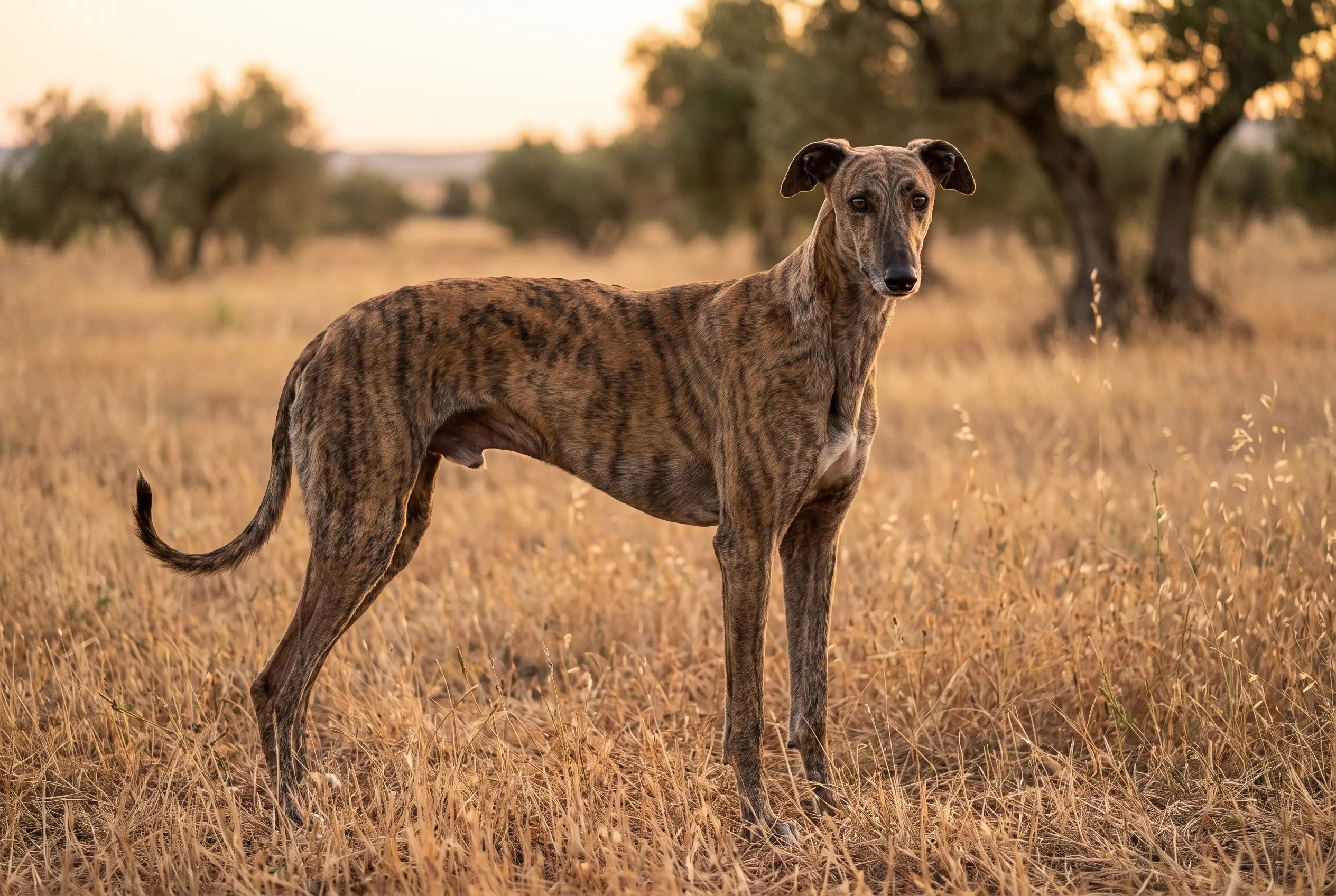
Galgo Español
Spain's hare courser: a sprinter outdoors, a sleeper everywhere else.
Vital stats
| Size | Large · 60–70 cm |
| Weight | 20–30 kg |
| Life expectancy | 12–15 years |
| Energy | Moderate — short sprints, then a long nap |
| Shedding | Low — short coat, light seasonal drop |
| Coat | Smooth or rough (wire) · many colours, brindle and barquillo common |
| Group | Hound · Sighthound (FCI №285, Group 10) |
| Origin | Spain |
| FCI group | 10 — Sighthounds · FCI 285 |
Breed traits
Friendliness
Care
Mind
The Galgo Español by the numbers
The Galgo Español facts owners search for most — price, lifespan, weight, shedding and colours, in one place.
Widely bred, so you can usually find a litter from a registered breeder without a long wait. Ongoing costs run high — more food, bigger doses at the vet, and pricier insurance.
We don't quote a single figure: the real price swings with breeder, region, bloodline and health testing — and a rescue costs a fraction of a breeder's litter. Adopting is almost always the cheapest route.
Temperament
Quiet is the word owners reach for first. A galgo at home is calm, gentle and a little reserved — it greets by leaning rather than jumping, and spends most of the day folded up somewhere soft. With its family it is affectionate in an understated way; with strangers it hangs back, and a poorly socialised one can tip into timidity. None of that survives the sight of a running hare. The chase instinct is old, strong and beyond the reach of recall training, which is why galgo people talk about leads and fenced fields rather than obedience scores.
Habits & quirks
Sprinter's schedule
A few flat-out minutes, then hours of sleep. A galgo's day is mostly nap, by design — the body is built for short bursts, not constant motion.
The switch
Cats, rabbits, a plastic bag on the wind — anything small and fast can start a chase. On walks, the lead stays on.
Heat-seeking
Thin skin and almost no body fat make it a connoisseur of sunbeams, blankets and radiators. In winter it wears a coat without complaint.
The lean
Its greeting: walk over, fold against your legs, wait. Jumping up costs energy a galgo would rather save.
Health
The Galgo is a hardy sighthound, and most of its health story is really about the things that make a sighthound a sighthound. Tell any vet it is a sighthound before anaesthesia — the breed's very low body fat changes how it handles the drugs. The skin is thin and tears easily on wire and brambles, so the bony pressure points want soft bedding. Keep the teeth clean, have the heart listened to as the years add up, and learn the one emergency that matters in a deep-chested dog: a suddenly swollen, hard belly is a reason to drive to the vet now, not in the morning. Beyond that, a lean, well-exercised galgo is a remarkably sound dog.
Nutrition
| Exercise | A couple of lead walks a day plus a few weekly sprints in a securely fenced space cover it. Off-lead in open country is a bet against instinct — most owners don't take it. |
| Grooming | A weekly rub-over does the coat, smooth or rough. Watch the skin instead: it is thin, tears easily on wire and brambles, and bony pressure points need soft bedding. |
| Training | Sensitive and mild-mannered — it shuts down under harsh handling and does well with calm, reward-based work. Teach recall anyway, then never rely on it near prey. |
| Health | A hardy breed overall. Tell your vet it is a sighthound before any anaesthesia, keep up dental care, have hearts checked as it ages, and treat a suddenly swollen belly as an emergency — bloat can occur. |
Feed a galgo to look like a galgo: lean, with the last ribs and the hip bones just showing is correct for a sighthound, not a sign of underfeeding. This is a dog built with very little body fat, so resist the urge to fill it out — extra weight does a runner's joints no favours. Weigh the meals rather than eyeing them, count the training treats in the day's total, and feed that deep chest with the bloat risk in mind: smaller portions, and calm rather than a wild game straight after eating.
Puppy guide
A galgo puppy is a gentle, leggy thing that grows fast, so keep the exercise low-impact while the joints are still forming — a few sprints on soft ground beat long forced walks on pavement. Socialise it early and widely; the breed can tip into timidity when it misses that window, and a confident galgo makes a calmer adult. Start lead manners and a recall now, knowing the recall is a lifelong project rather than a finished trick, because the chase instinct wakes up as the puppy grows. And since the skin is thin and the coat is barely there, a warm, soft place to sleep is not a luxury for this breed.
Training
Sensitive is the key word. A galgo wilts under a hard voice and blooms with calm, reward-based work, so keep the tone light and the small wins frequent. Teach a recall properly — and then never bet its life on that recall near anything small and running, because the chase is older than any cue you can teach. Most of training a galgo is really management: a lead in open country, a securely fenced field for the sprints, and realistic expectations about what a sighthound does when a hare breaks.
Life expectancy
Galgos live 12–15 years. The galgo is a long-lived sighthound, and the way you keep it at the top of that range is the way you keep it comfortable: lean weight, soft bedding for those bony joints, teeth and heart watched as it ages, and a sensible respect for the bloat risk that comes with a deep chest.
Similar breeds
Breeds with a similar build and background — worth a look if this one isn't quite the fit.
Breeds that look like this
Common questions
Is a Galgo the same as a Greyhound?
Close cousins, not the same dog. The galgo is the older line: lighter, longer in the body, higher in the rump, bred to course hares across rough Spanish plains for kilometres rather than sprint a short track. Side by side, a greyhound is faster; a galgo lasts longer.
What should I know before adopting an ex-hunting galgo?
Most rescue galgos come out of Spain's hunting season, when large numbers are surrendered or abandoned, and reach new homes through an established international rescue network. They tend to adapt well: gentle, house-quiet, grateful for a sofa. Expect some gaps — stairs, glass doors, traffic and living rooms can all be new — and give them weeks, not days, to settle. The one lifelong rule is sighthound recall: assume it will chase, and manage accordingly.
Can a Galgo live in a flat?
Yes, often better than higher-energy breeds half its size. Indoors it is quiet, still and undemanding, as long as it gets its daily walks and a regular chance to run. Small pets are the real question: many galgos learn to live with the family cat, but the introduction takes care and some individuals never manage it.
Does the Galgo Español shed a lot?
Not much. The Galgo Español is a low-shedding breed, so loose hair around the home stays minimal. It still needs regular grooming, but you won't be fighting drifts of fur.
Is the Galgo Español hypoallergenic?
No dog is truly hypoallergenic, but the Galgo Español comes closer than most: its low-shedding coat releases less of the dander that triggers allergies. Many allergy sufferers manage well with this breed, but spend time around one before committing.
Is the Galgo Español good with children?
They can be. The Galgo Español is reasonably sociable and can be good with children in the right home, especially when socialised early. Supervise around young kids and teach dog and child to respect each other.
Is the Galgo Español easy to train?
Reasonably. The Galgo Español is trainable with consistency and rewards, though it isn't the quickest study. Keep sessions short and positive, and be patient with the basics like recall.