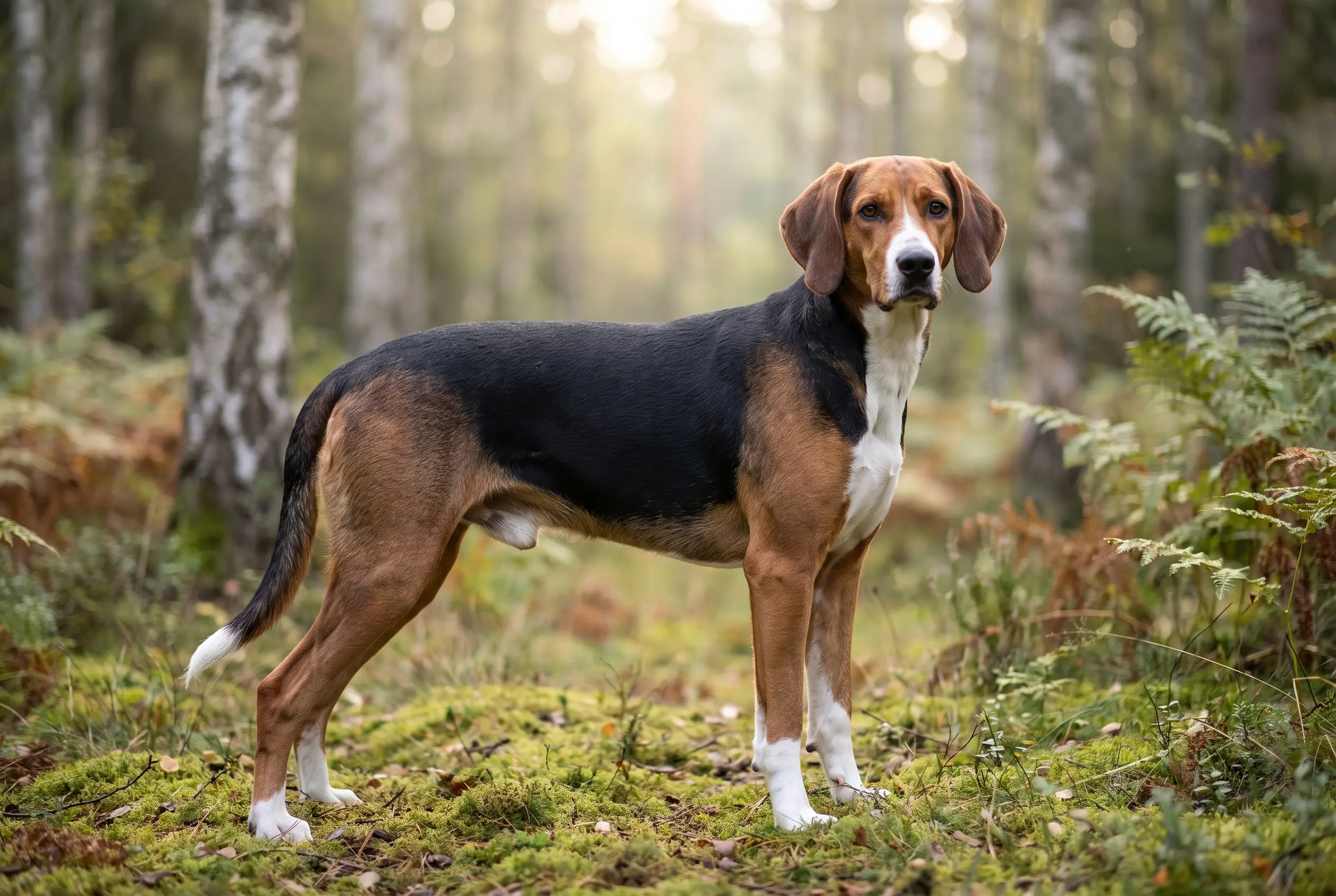
Hamiltonstövare
A tricolour Swedish scenthound that trails hare and fox on its own, never in a pack.
Vital stats
| Size | Medium-large · 53–61 cm (males), 49–57 cm (females) |
| Weight | 23–27 kg — breed literature, not in the standard |
| Life expectancy | 12–13 years — breed literature, not survey data |
| Energy | High — 1–2 hours a day, real scent work |
| Shedding | Moderate — short, harsh coat, weekly brush |
| Coat | Short, harsh, close-lying · tricolour: black mantle, tan, white |
| Group | Hound · Medium-sized Hounds (FCI №132, Group 6) |
| Origin | Sweden |
| FCI group | 6 — Scent hounds and related breeds · FCI 132 |
Breed traits
Friendliness
Care
Mind
The Hamiltonstövare by the numbers
The Hamiltonstövare facts owners search for most — price, lifespan, weight, shedding and colours, in one place.
Less common, so expect a waitlist and some travel to a reputable breeder — which pushes the price up. Ongoing costs run high — more food, bigger doses at the vet, and pricier insurance.
We don't quote a single figure: the real price swings with breeder, region, bloodline and health testing — and a rescue costs a fraction of a breeder's litter. Adopting is almost always the cheapest route.
Temperament
The standard's entire behaviour section reads friendly and even-tempered — four words for a dog that was bred to work confidently on its own, out of sight of its handler, all day. In practice that shows up as a hound that is easy with its family and steady rather than jumpy around visitors, qualities that suit a dog historically expected to read a trail and make its own decisions about it. The utilization clause adds the detail that matters most for anyone who has never met one: it gives tongue while it works, meaning it bays as it follows a scent, and it is not a pack hound and never used for hunting deer. Breed literature fills the rest in where the standard stays quiet — intelligent but capable of stubbornness once its nose is down, and vocal by nature rather than by bad habit.
Habits & quirks
Bred to hunt alone
The standard states it outright: not a pack hound, and never used for hunting deer. Unlike a foxhound running with a dozen others, a Hamiltonstövare traditionally works a trail by itself, marking its progress with its voice so the hunter can follow at a distance.
A precise tricolour
Black forms a mantle over the neck, back and top of the tail; tan covers the head, legs and sides; white is allowed only as a blaze, on the throat, chest, tail tip and feet. Two-colour combinations — black-white, black-tan, yellow-white — are disqualifying, not just faulted.
Named for a count, after the fact
Two hounds called Pang and Stella, owned by Count Adolf Patrik Hamilton, appeared at Sweden's first dog show in 1886 and are considered the breed's foundation. They were shown simply as Swedish hounds; the Hamiltonstövare name only arrived in 1921, as a tribute to Hamilton after he had already helped found the Swedish Kennel Club.
Ears measured to the muzzle
The standard sets the ear length by a specific rule: slightly shorter than the distance from where they set on to halfway along the muzzle. They hang flat and soft against the cheek at rest, rising only slightly at the base when the dog is alert.
Health
The standard carries no health section beyond the note that only sound dogs should be bred, and in practice the Hamiltonstövare is a hardy hound. What turns up is what you'd expect from an actively worked, drop-eared dog: hip dysplasia here and there, and ear infections from ears that hang flat against the cheek and trap moisture after a day in cover. Buy from a breeder who hip-scores their dogs, check and dry the ears after every outing, and you have dealt with most of it.
Nutrition
| Exercise | An hour or two of real work most days — tracking, hunting, or long off-lead walks with a dependable recall. A hound conformed for a full day's trailing on its own is not satisfied by a walk around the block. |
| Grooming | The short, harsh coat lies close to the body and needs only a weekly brush; hair under the tail and on the back of the thighs runs slightly longer and can pick up burrs after time in cover. |
| Training | Friendly and biddable at home, more independent once it is following a scent — breed literature describes it as capable of real stubbornness in that state. Start recall early and keep sessions positive; the standard disqualifies both aggression and severe shyness, so a calm, confident dog is the baseline the breed is bred toward, not something to build from scratch. |
| Health | The standard carries no health section beyond the general note that only functionally and clinically healthy dogs should be bred. Breed literature reports the Hamiltonstövare as generally hardy, with hip dysplasia and ear infections turning up occasionally — unsurprising for an actively worked, drop-eared hound. Ask breeders about hip screening. |
Feed to the work the dog actually does — a Hamiltonstövare that tracks all weekend and one that gets a daily walk don't need the same bowl. Weigh the meals, count training treats into the day's total, and aim for ribs you can feel under that short, close coat. A working scenthound carries no spare weight, and keeping it that way protects the joints it hunts on.
Puppy guide
A Hamiltonstövare puppy comes with the nose already switched on, so the first year is about pointing it in useful directions. Socialise widely — the breed is bred toward a calm, confident dog, and early handling is how you get there — and start recall the day the puppy arrives, before the trail becomes more interesting than you are. Keep the hard exercise light while the joints are still forming, and let it use its nose in games rather than long, repetitive runs.
Training
Friendly and easy at home, a Hamiltonstövare becomes a different dog once its nose finds a line — breed literature is honest that it can be genuinely stubborn in that state. That is not disobedience, it is a hound doing the job it was built for, so work with it rather than against it: start recall early, keep sessions short and rewarding, and proof it around real distractions. The calm, confident temperament the standard asks for is the starting point, not something you have to build from nothing.
Life expectancy
Hamiltonstövare live 12–13 years — breed literature, not survey data. This is a hardy, long-lived hound, and you hold it at the top of that range the same way you keep it happy: lean weight, parents screened for hips, ears kept clean and dry, and enough real work to keep body and nose busy. A Hamiltonstövare with a job ages well.
Similar breeds
Breeds with a similar build and background — worth a look if this one isn't quite the fit.
Breeds that look like this
Common questions
What does 'stövare' mean?
It is the Swedish word for a scenthound that works a trail alone rather than running with a pack — the reverse of a British foxhound's style of hunting. The Hamiltonstövare's own standard says so directly: it is not a pack hound. Two other Swedish breeds carry the same word in their name, the Schillerstövare and the Smålandsstövare, and several more Nordic and Baltic scenthounds hunt the same solitary way without using the word.
How is it different from Sweden's other stövare breeds?
Mostly by colour. The Schillerstövare (FCI №131) shares the Hamiltonstövare's exact height range — 57 cm ideal for males, 53 cm for females, down to the centimetre — but its standard calls for black and tan only, with no white. The Smålandsstövare (FCI №129) is smaller again, 46–54 cm for males, and also strictly black and tan. The Hamiltonstövare alone adds white as a third colour, in a blaze and on the throat, chest, tail tip and feet, which is why it is described as tricolour and the other two are not.
Is the Hamiltonstövare a good family dog?
Yes, for a household that can meet its exercise needs. The standard calls it simply friendly and even-tempered, and breed literature adds that it settles calmly indoors once it has had real exercise — an hour or two of it, most days. It was bred to hunt on its own voice and nose, so a bored one will bay, and a fenced garden is not a substitute for a walk with something to follow.
Does the Hamiltonstövare shed a lot?
Moderately. The Hamiltonstövare sheds a fair amount, steadily through the year with heavier seasonal patches. A weekly brush keeps most of the loose hair off your floors and clothes.
Is the Hamiltonstövare hypoallergenic?
Not really. No dog is truly hypoallergenic, and the Hamiltonstövare's shedding coat releases plenty of the dander that sets off allergies. If someone at home is allergic, this isn't the easiest breed to live with — spend time around one first.
Is the Hamiltonstövare easy to train?
Reasonably. The Hamiltonstövare is trainable with consistency and rewards, though it isn't the quickest study. Keep sessions short and positive, and be patient with the basics like recall.